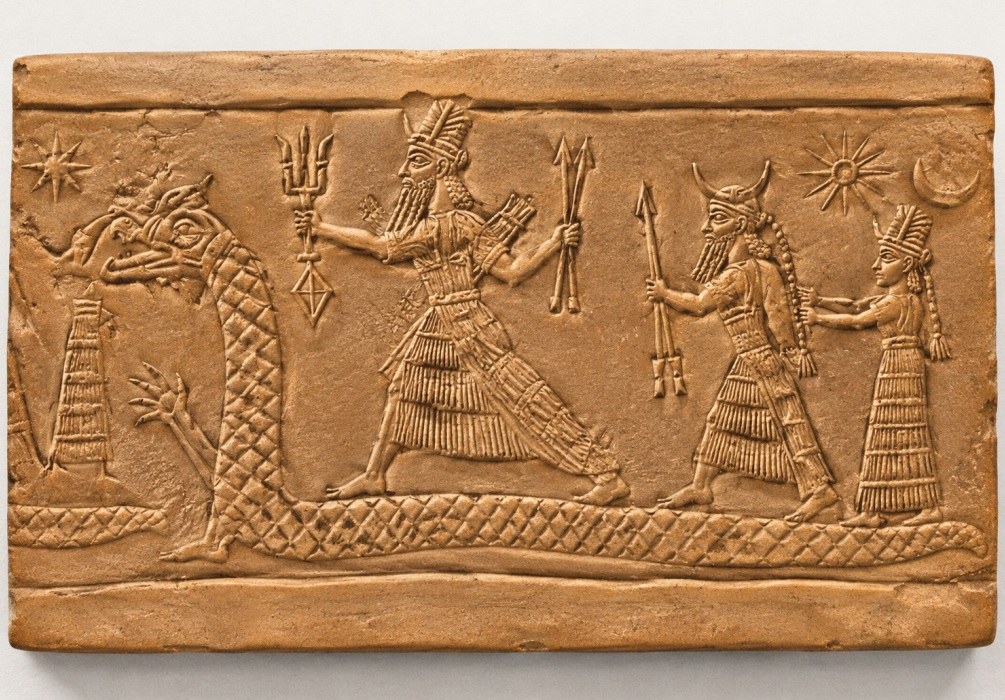
Neo-Assyrian cylinder seal (900–750 B.C.E.) possibly depicting Tiamat, as a horned reptile, battling the gods at creation. The British Museum (Image enhanced)
The two creation stories in Genesis (1 and 2–3), and the hidden creation account in Psalms and the Prophets, can be read without their ancient Near Eastern context. But to understand what the biblical authors are responding to, revising, and arguing against, we need to read them alongside four Mesopotamian stories—Atrahasis (ca. 1700 B.C.E.), Enuma Elish (late 2nd millennium B.C.E.), Adapa (early 2nd millennium B.C.E.), and the Epic of Gilgamesh (2nd millennium B.C.E.)—along with the Canaanite Baal Cycle (14th–13th century B.C.E.).
Neo-Assyrian cylinder seal (900–750 B.C.E.) possibly depicting Tiamat, as a horned reptile, battling the gods at creation. The British Museum (Image enhanced)
Published September 22, 2026
Azzan Yadin-Israel, Temptation Transformed: The Story of How the Forbidden Fruit Became an Apple (University of Chicago Press, 2023). Editor’s note: See also Azzan Yadin-Israel, “How the Forbidden Fruit Became an Apple,” TheTorah (2022).
“Original sin” is a Christian theological concept first developed by Irenaeus of Lyons in the 2nd century C.E. and elaborated by Augustine in the 4th—a thousand years after this story was written.
See the well-known edition and translation from Stephanie Dalley, Myths from Mesopotamia: Creation, The Flood, Gilgamesh, and Others (Oxford University Press, 2000), 1–38. See also Benjamin Foster, Before the Muses: An Anthology of Akkadian Literature, 3rd ed. (CDL Press, 2005), 227–280. Translations below are drawn from the electronic Babylonian Library, because it provides the most up to date and accessible translations.
Dalley, Myths from Mesopotamia, 2.
“Story of the Flood (Atraḫasīs): Standard Babylonian II, Anu [Made Ready] To Speak,” electronic Babylonian Library (n.d.). The word ili, “god,” here (line 70, as well as 74 and 80) should be understood as a collective singular.
For further discussion, see Will Kynes, “A Suitable Match: Eve, Enkidu, and the Boundaries of Humanity in the Eden Narrative and the Epic of Gilgamesh,” Harvard Theological Review 116.4 (2023): 491–513.
It is only in the flood account within the Epic of Gilgamesh that the survivor, there called Utnapishtim, is granted immortality and settled at the ends of the earth — and even then the epic is careful to mark it as a singular exception that Gilgamesh himself cannot replicate. Gilgamesh does learn of the plant of life from Utnapishtim, but as discussed below, this path to immortality is also lost to him.
Dalley, Myths from Mesopotamia, 228–277. See also W.G. Lambert, Babylonian Creation Myths (Eisenbrauns, 2013). It is often called “The Babylonian Creation Story,” but this is imprecise: Babylonia had many creation stories, and the main focus of Enuma Elish is the elevation of Marduk, not creation. Editor’s note: See Wayne Horowitz, “Enuma Elish: Babylonia’s Creation Myth and the Enthronement of Marduk,” TheTorah (2023).
Translations of Enuma Elish follow A. C. Heinrich, “Poem of Creation (Enūma eliš),” with contributions by Z. J. Földi and E. Jiménez, trans. Anmar A. Fadhil and Benjamin R. Foster, electronic Babylonian Library (2021).
Note the geography: ancient Sumer, the cradle of civilization in the region, was founded at the Persian Gulf—where freshwater and saltwater mingle.
“Adapa,” electronic Babylonian Library (n.d.).
Translation follows T. D. N. Mitto, “Adapa: Middle Babylonian, ‘I Di[d...],” with contributions by Z. J. Földi, A. C. Heinrich and E. Jiménez, trans. Benjamin R. Foster, electronic Babylonian Library (2022).
“Poem of Gilgameš,” electronic Babylonian Library (n.d.).
Translation follows A. R. George, “Poem of Gilgameš: Standard Babylonian I, [He Who Saw the Deep, The] Foundation of the Country,” with contributions by E. Jiménez and G. Rozzi, trans. Anmar A. Fadhil, Andrew R. George and Wasim Khatabe, electronic Babylonian Library (2022).
Gilgamesh I.205. George, “Poem of Gilgameš: Standard Babylonian I [He Who Saw the Deep, The]Foundation of the Country.”
Translation follows A. R. George, “Poem of Gilgameš: Standard Babylonian XI, Gilgameš Spoke to Him, to Ūta-Napišti the Far-Away,” with contributions by E. Jiménez and G. Rozzi, trans. Andrew R. George, electronic Babylonian Library (2022).
Dalley, Myths from Mesopotamia, 45.
The Ugaritic texts are translated and discussed in Michael D. Coogan and Mark S. Smith, Stories from Ancient Canaan, 2nd ed. (John Knox Press, 2012).
The Merneptah Stele, ca. 1210 B.C.E., contains the earliest certain reference to an entity called “Israel” existing in the Judean highlands; see e.g. Aren Maeir, “Israel and Judah,” in The Encyclopedia of Ancient History (Blackwell, 2013), 3523–3527.
Hebrew is, in fact, a dialect of Canaanite; the Israelites and Canaanites shared grammar, a writing tradition (though later Canaanite and Hebrew texts replace Ugaritic cuneiform with an alphabet), large amounts of vocabulary, and—as the archaeological and historical evidence increasingly demonstrates—ethnic and cultural origins.
Translations from the Baal Cycle follow Coogan and Smith, Stories from Ancient Canaan, 96–153.
In Hebrew, מָוֶת (mavet) is a common noun meaning “death,” though it may also be used as a proper noun in some biblical passages (e.g., 2 Sam 22:5, and the parallel in Ps 18:5).
For a full discussion, see Baruch Halpern, “‘Brisker Pipes than Poetry’: The Development of Israelite Monotheism,” in From Gods to God: The Dynamics of Iron Age Cosmologies, ed. M. J. Adams, Forschungen zum Alten Testament 63 (Mohr Siebeck, 2009), 13–56.
Editor’s note: See Marc Zvi Brettler, “Differing Conceptions of the Divine Creator,” TheTorah (2013); and Konrad Schmid, “Genesis’ Two Creation Accounts Compiled and Interpreted as One,” TheTorah (2023.)
On these traditions, see Debra Scoggins Ballentine, The Conflict Myth and the Biblical Tradition (Oxford University Press, 2015).
I have kept the traditional translation of תַּנִּין, “dragon,” here, but note the argument against this term in Esther Hamori’s God’s Monsters: Vengeful Spirits, Deadly Angels, Hybrid Creatures, and Divine Hitmen of the Bible (Broadleaf, 2023).
The Song of the Sea in Exodus 15 participates in the same imagery: God’s defeat of the Egyptians at the Sea draws on the language of divine combat, the divine storm winds mastering the waters in service of the covenant people.
Although this idea of creation out of nothing was accepted in Judaism before Christianity (e.g. 2 Macc 7:28), Rashi noted in the 11th century C.E. that from a linguistic and exegetical perspective, this is not the preferred reading. For an extended discussion, see Joseph Blenkinsopp, Creation, Un-Creation, Re-Creation: A Discursive Commentary on Genesis 1–11 (T&T Clark International, 2011).
Modern translators and exegetes have offered a number of suggestions to translate this hendiadys; the one that best captures the meaning of the phrase in this context is Ron Hendel’s “desolate chaos,” in Genesis 1–11: A New Translation with Introduction and Commentary, The Anchor Yale Bible Commentaries (Yale University Press, 2024), 110, but see also, e.g., “welter and waste” in Robert Alter’s The Five Books of Moses (W. W. Norton & Company, 2004), 17.
See Robert D. Holmstedt, “The Restrictive Syntax of Genesis i 1,” Vetus Testamentum 58 (2008): 56–67, for a detailed refutation of the traditional interpretation of creatio ex nihilo based on the grammar and syntax in Genesis 1:1.
On the tehom/Tiamat connection, see Alexander Heidel, The Babylonian Genesis, 2nd ed. (University of Chicago Press, 1951), 98–101.
Hendel suggests “vault” as a replacement for the traditional (KJV) “firmament,” to describe the function of the raqia as a thin firm sheet holding back the waters above. I actually think “force-field” better captures the invisible, yet powerful, membrane that is imagined here.
Leviathan is cognate to Canaanite Litan: another of Baal’s water-based enemies—possibly Yam’s offspring (see Coogan and Smith, Stories from Ancient Canaan, 99–100). The name רַהַב (Rahab) has not been found outside the Bible (Robert D. Miller, II, “Leviathan,” in The Oxford Handbook of Biblical Monsters, ed. Brandon R. Grafius, and John W. Morehead [Oxford University Press, 2025], 174–185).
For full discussions, see David Clines, “Humanity as the Image of God,” in On the Way to the Postmodern: Old Testament Essays, 1967–1998, vol. 2, Journal for the Study of the Old Testament Supplement Series 293 (Sheffield Academic, 1998), 447–497; J. Richard Middleton, The Liberating Image: The Imago Dei in Genesis 1 (Brazos Press, 2005). For the democratization of the royal image in Genesis 1, see also W. Randall Garr, In His Own Image and Likeness: Humanity, Divinity, and Monotheism (Brill, 2003).
Gilgamesh is introduced in the Standard Babylonian Version of the Epic as “He who saw the Deep, the foundation of the country, who knew all ways, was wise in everything” (I.1–4, George, “Poem of Gilgameš: Standard Babylonian I”)—a quality that he has gained only by the end of the epic. For a full discussion of Gilgamesh’s quest for immortality becoming instead a journey toward the inadvertent attainment of wisdom, see Sophus Helle, Gilgamesh: A New Translation of the Ancient Epic (Yale University Press, 2021).
See also Proverbs 12:16, 23; 14:8, 15, 18; 22:3; 27:12.
See Shawna Dolansky, “How the Serpent Became Satan,” Biblical Archaeology Society (2016).
See further Shawna Dolansky, “A Goddess in the Garden? The Fall of Eve,” in Milk and Honey: Essays on Ancient Israel and the Bible in Appreciation of the Judaic Studies Program at the University of California, San Diego, ed. Sarah Malena and David Miano (Eisenbrauns, 2007); Hendel also has a fulsome discussion of serpents and serpent imagery in Genesis 1–11, 177–180.
Elizabeth Cady Stanton’s The Woman's Bible (1895) reads Eve’s reach for knowledge as admirable rather than culpable, and explicitly praises her preference for wisdom over ease; this is the foundational reading of Eve as the more complex and active figure, and won’t be revisited by exegetes until Phyllis Trible's God and the Rhetoric of Sexuality (1978), which sets the stage for a second-wave feminist analysis of this and other stories about women in the Hebrew Bible. Carol Meyers’ Rediscovering Eve: Ancient Israelite Women in Context (Oxford: 2013) is the social-historical counterpart; and Ilana Pardes’ Countertraditions in the Bible: A Feminist Approach (Harvard University Press, 1992) adopts an explicitly feminist approach to finding the counter-patriarchal subtext in biblical stories about women. Others, however, read Eve’s initiative as the point of the indictment rather than a mark of her agency: for these interpreters, the text is structurally androcentric and cannot be redeemed, see e.g. David J. A. Clines, “What Does Eve Do to Help?” in What Does Eve Do to Help? and Other Readerly Questions to the Old Testament, JSOTSup 94 (Sheffield, 1990), 25–48; Pamela Milne, “The Patriarchal Stamp of Scripture: The Implications of Structuralist Analyses for Feminist Hermeneutics,” Journal of Feminist Studies in Religion 5 (1989): 17–34; and Susan Lanser, “(Feminist) Criticism in the Garden: Inferring Genesis 2–3,” Semeia 41 (1988): 67–84.
On the latter concept, see Ishay Rosen-Zvi, Demonic Desires: “Yetzer Hara” and the Problem of Evil in Late Antiquity (University of Pennsylvania Press, 2011).
As discussed above, Enkidu can no longer live with the animals. He has crossed an irreversible threshold into human cultural life: clothing, bread, beer, self-awareness. Editor’s note: See also Karel van der Toorn, “Becoming Homo Erectus: Adam and Eve in the Garden of Eden,” TheTorah (2025).
In everyday usage, the word “myth” typically means a falsehood—a misconception, something that did not happen. What scholars call a myth, however, is something else: it is a story that a culture tells itself to explain its world, embody its values, and articulate its understanding of who it is and where it fits in the cosmos. Myths, in academic parlance, are not trivial—they are often the most serious and important stories a culture produces. By that definition, Genesis is myth. So is the Passover narrative. This is not irreverence, and it is not a statement about historical truth or lack thereof. It is a recognition of what these stories are designed to do for a community: to locate them in a meaningful universe, to answer the questions that matter most, and to do so in language and imagery that resonate. The ancient Near Eastern texts we have examined here are myths in exactly the same sense, and understanding them as such is the only way to appreciate how profoundly and deliberately the biblical authors engage and reshape them.
Editor’s note: See also Robert S. Kawashima, “Adam and Eve in the Garden of Eden: An Etiology for the Human Condition,” TheTorah (2022).
Another etiology that is included is an explanation for patriarchy: וְהוּא יִמְשׇׁל בָּךְ, “he shall rule over you” (Gen 3:16). Just as the author sees a need to explain why humans are mortal and wear clothes and why snakes do not have legs, he requires an answer to the question of why men are in charge. This belies a discomfort with the status quo, which—like hard labor, painful childbirth, and belly-crawlers eating dust—seemed to the author to be an unnatural state of existence that is not the way that things should have been; not the way God created the world originally.
See further my article, “The Immortal Myth of Adam and Eve,” TheTorah (2015).