


 Edit article
Series
A Captive Woman’s Transition to Wife


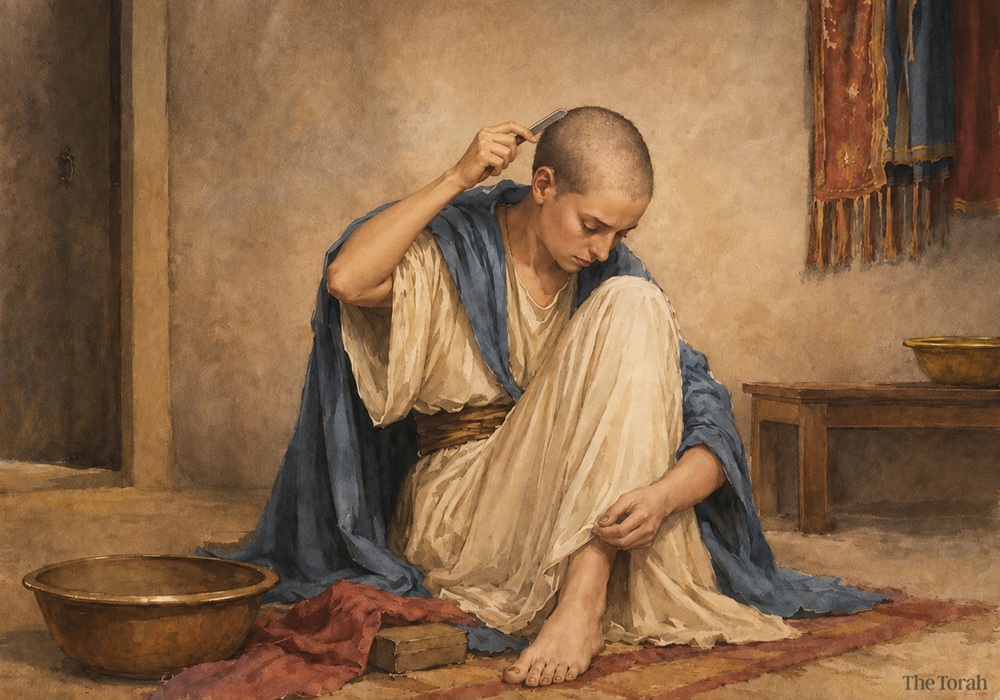
A non-Israelite captive shaving her head in her captor's home. AI
If an Israelite sees a captive woman that he desires and he wants to marry her, she must first undergo a process:[1]
דברים כא:יבוַהֲבֵאתָהּ אֶל תּוֹךְ בֵּיתֶךָ וְגִלְּחָה אֶת רֹאשָׁהּ וְעָשְׂתָה אֶת צִפׇּרְנֶיהָ.
Deut 21:12 You shall bring her into your house, and she shall shave her head,[2] pare (or possibly, let grow) her nails,
House as Liminal Space
The instruction that the woman be brought into and remain "in your house" establishes a spatial parameter that is central to the ritual sequence. In this context, the house becomes an architectural liminal (in-between) space — a threshold in which her former identity is set aside while her future status remains suspended.[3]
Enclosed within the domestic sphere, she is no longer a captive on the battlefield, and not yet a wife. Confining the ritual sequence to the interior of the home creates a physical and symbolic boundary that separates the domain of wartime conquest from the domestic sphere of the household.
Shaving Her Head
Cutting off hair appears in several biblical texts as a visible expression of grief. For example, Job’s response when he is informed that all his children have died when the house they were gathered in collapsed:
איוב א:כ וַיָּקׇם אִיּוֹב וַיִּקְרַע אֶת־מְעִלוֹ וַיָּגׇז אֶת רֹאשׁוֹ וַיִּפֹּל אַרְצָה וַיִּשְׁתָּחוּ.
Job 1:20 Then Job arose, tore his robe, sheared his head, and threw himself on the ground and worshiped.[4]
Modification of Her Nails
The reference to the woman's nails is more elusive. The Bible offers no close ritual parallel, making this feature particularly striking. Whether the verb is understood to mean trimming or allowing the nails to grow, the action concerns bodily modification alongside the shaving of the head.[5] Together these acts alter the captive's physical appearance, marking her body as the site of transition.
Transitioning and Mourning
After the bodily changes, she removes her garments and remains in the house, mourning:
דברים כא:יגוְהֵסִירָה אֶת שִׂמְלַת שִׁבְיָהּ מֵעָלֶיהָ וְיָשְׁבָה בְּבֵיתֶךָ וּבָכְתָה אֶת אָבִיהָ וְאֶת אִמָּהּ יֶרַח יָמִים וְאַחַר כֵּן תָּבוֹא אֵלֶיהָ וּבְעַלְתָּהּ וְהָיְתָה לְךָ לְאִשָּׁה.
Deut 21:13 and she shall discard her captive’s garb. She shall spend a month’s time[6] in your house lamenting her father and mother; after that you may come to her and possess her, and she shall be your wife.
Changing Clothes
The removal of the "clothing of her captivity" employs ritualized language in its unusually specific designation of the garments themselves. The phrase is unique in the Hebrew Bible, marking these clothes not simply as items to be exchanged but as material extensions of the woman’s former status as a captive. It evokes scenes across the Bible where a change of garments marks a fundamental shift in status or identity.
After he is released from the dungeon, Joseph first shaves and then changes garments in preparation for his appearance before Pharaoh:
בראשית מא:יד וַיִּשְׁלַח פַּרְעֹה וַיִּקְרָא אֶת יוֹסֵף וַיְרִיצֻהוּ מִן הַבּוֹר וַיְגַלַּח וַיְחַלֵּף שִׂמְלֹתָיו וַיָּבֹא אֶל פַּרְעֹה.
Gen 41:14 Thereupon Pharaoh sent for Joseph, and he was rushed from the dungeon. He shaved and changed his clothes, and he appeared before Pharaoh.[7]
Notably, changing garments takes on ritual significance when Jacob tells his household to change their clothing before they build an alter to YHWH in Bethel because of their worship of foreign gods:[8]
בראשית לה:ב וַיֹּאמֶר יַעֲקֹב אֶל בֵּיתוֹ וְאֶל כׇּל אֲשֶׁר עִמּוֹ הָסִרוּ אֶת אֱלֹהֵי הַנֵּכָר אֲשֶׁר בְּתֹכְכֶם וְהִטַּהֲרוּ וְהַחֲלִיפוּ שִׂמְלֹתֵיכֶם.
Gen 35:2 So Jacob said to his household and to all who were with him, “Rid yourselves of the alien gods in your midst, purify yourselves, and change your clothes.
In a similar way, priests receive sacred vestments for ordination (Exod 28, 39; more on this later), David washes, anoints himself, and changes clothes after mourning his child (2 Sam 12:20), and Joshua the high priest exchanges soiled garments for clean ones in Zechariah's vision (Zech 3:3–5). Across these texts, clothing functions not merely as attire, but as an outward sign of a transformed social or ritual condition.[9]
A Month of Mourning
The prescribed full month of mourning reflects an ancient Israelite institution,[10] exemplified by the thirty-day periods observed for Aaron (Num 20:29) and Moses:
דברים לד:ח וַיִּבְכּוּ בְנֵי יִשְׂרָאֵל אֶת־מֹשֶׁה בְּעַרְבֹת מוֹאָב שְׁלֹשִׁים יוֹם וַיִּתְּמוּ יְמֵי בְכִי אֵבֶל מֹשֶׁה.
Deut 34:8 And the Israelites bewailed Moses in the steppes of Moab for thirty days. The period of wailing and mourning for Moses came to an end.
The captive's lament for "her father and her mother" likewise places her within the biblical world of bereavement, acknowledging the severance of familial bonds brought about by war. Read in this light, the legislation grants the woman space to grieve before assuming a new social role.
The Reason for the Process?
Various explanations have been proposed for this process that is required before the man can marry the woman.
Making Her Unappealing to Her Captor
Sifre Deuteronomy (ca. 3rd century C.E.) explains that these actions are designed to render the captive unappealing to deter her captor from marrying her:
ספרי דברים ריג (דברים כא יג) וְהֵסִירָה אֶת שִׂמְלַת שִׁבְיָהּ מֵעָלֶיהָ, מְלַמֵּד שֶׁמַּעֲבִיר מִמֶּנָּה בְּגָדִים נָאִים וּמַלְבִּישָׁהּ בִּגְדֵי אַלְמְנוּת, שֶׁהַגּוֹיִם, אֲרוּרִים הֵם, בְּנוֹתֵיהֶם מִתְקַשְּׁטוֹת בַּמִּלְחָמָה בִּשְׁבִיל לְהַזְנוֹת אֲחֵרִים אַחֲרֵיהֶן.
Sifre Deut 213 “And she shall remove from herself the garment of her captivity” (Deut.21:13). This teaches that they remove from her any fine clothing, and dress her in widow’s garb. For the gentiles—curse them!—prettify their daughters during battles so that others will whore after them.
וְיָשְׁבָה בְּבֵיתֶךָ – בְּבַיִת שֶׁמִּשְׁתַּמֵּשׁ בּוֹ; נִתְקָל בָּהּ וְנִכְנָס, נִתְקָל בָּהּ וְיוֹצֵא; דּוֹמָה לְקֵרוּיָה וְרוֹאֶה בְּנִוּוּלָהּ.
“And she will stay in your house” (Deut.21:13)—in the house he normally uses, so that he will trip over her upon entering, and he will trip over her upon leaving, like an old piece of pumpkin. And he will notice her disgrace.[11]
This interpretation probably reflects the dim view these commentators had of intermarriage more than the law’s original intent.
Allowing the Woman to Mourn
Others, such as Philo, have connected the entire sequence of ritual actions in this law with the mourning period (v. 13):
Philo, On Virtues, 111 And you will provide such relief if you cut off the hair on her head, trim her nails, remove the clothes she wore when she was taken captive, and for thirty days leave her alone and allow her to mourn and weep freely for her father and mother and the other members of her family, from whom she has been separated either by death or because they are enduring afflictions in slavery that are worse than death. After these things have been done, join with her as your lawful wife.[12]
Yet mourning alone cannot account for all parts of the ritual (the cutting of her nails and discarding of her garments are not adequately explained), nor is the woman’s experience the sole focus of this sequence.[13]
Indeed, the mourning elements acknowledge profound personal loss, preserving a ritual space in which the captive woman’s grief remains visible even as the legislation is aimed at her incorporation into another household. However, the bodily modifications, change of clothing, domestic seclusion, and fixed period of waiting together facilitate a transition from one social identity to another.[14]
Materializing Identity: Aaron and the Captive Woman
Juxtaposing the captive woman’s ritual sequence with Aaron’s consecration illustrates how clothing directly mediates a change in social role.
שמות כח:גוְאַתָּה תְּדַבֵּר אֶל כׇּל חַכְמֵי לֵב אֲשֶׁר מִלֵּאתִיו רוּחַ חׇכְמָה וְעָשׂוּ אֶת בִּגְדֵי אַהֲרֹן לְקַדְּשׁוֹ לְכַהֲנוֹ לִי.
Exod 28:3 Next you shall instruct all who are skillful, whom I have endowed with the gift of skill, to make Aaron’s vestments, to consecrate him for My priesthood.[15]
The captive woman’s ritual follows a comparable logic. Just as Aaron’s garments authorize entry into the sacred realm of the tabernacle, the captive woman’s altered appearance prepares her to cross the threshold into another carefully ordered sphere: the Israelite household.[16] Furthermore, both rites demonstrate that bodily materials can mediate new social realities. For the captive woman, removing the “garments of captivity” and stripping her physical appearance is integral to the rite rather than incidental preparation for marriage.
The physical changes undertaken by the woman not only affect a change in social status, but also serve another purpose. Her assimilation ritual simultaneously functions as a protective domestic rite, guarding the Israelite family against the perceived dangers of war, foreignness, and domestic disruption.[17]
Boundary Crossing and Household Protection
Across ancient West Asia, moments of transition were regarded as particularly dangerous because established social and cosmic boundaries were temporarily suspended. Rituals that transformed identity therefore frequently combined status change with protection against unseen forces.[18]
Although the Mesopotamian rites (discussed below) arise from different cultural settings and respond to different ritual concerns, they share a common ritual grammar. Hair, clothing, nails, and other bodily materials function as media through which dangerous transitions are negotiated, identities are transformed, and households are protected at moments of liminality. Together, these texts illuminate the broader ritual world which Deuteronomy inhabited.
A Ritual Repelling a Demon
The Mesopotamian Lamashtu ritual protects pregnant women, infants, and households from the Lamashtu demoness, who they believe is responsible for miscarriages and infant death, and thus poses a lethal threat to them.[19] She is understood not merely as a malevolent spirit but as an independent supernatural power with agency of her own. She is repelled through carefully prescribed ritual actions involving figurines, clothing, hair, amulets, and other objects closely associated with the body. One of the rituals begins with fashioning a figurine of the demon:
Lamashtu series 1, 47 You make a Daughter-of-Anu from clay. 48 [You cover her head with hair]. A soiled towel 49 you give her as clothing. You prick her with the th[orn of a date palm.] 50 You give her a comb, d[is]taff, (and) a half-sūtu? fla[sk] of oil.[20]
The figurine is then incapacitated:
54In late afternoon, (shortly) before [sunset], you move her (= the figurine of Lamaštu) out into the uncultivated area. 55 You have her face eastward. You fasten a rope around her waist. 56 You bind her to a baltu (and/or) an ašāgu thorn bush. You surround her three times with a magic circle.[21]
The instructions continue with the next steps necessary to drive away the demoness. It is also worth noting her description in a later incantation includes long fingernails and unshaven armpits.[22]
A Rite for Protection against Witches
Whereas the Lamaštu rituals defend households against a demonic assailant, the anti-witchcraft series Maqlû confronts witches who manipulate bodily materials in order to inflict harm.
In these rituals, hair and garments function as ritual media capable of absorbing or transferring malign influences before they are burned, buried, or otherwise disposed of:[23]
Maqlu tablet I, 130 A woman who instigates sorcery has ensorcelled me; ensorcell her with the sorcery with which she ensorcelled me. 131 (Those) who have made figurines corresponding to my figurines, reproduced my facial features, 132 Taken my spittle, plucked out my hair, 133 Cut off my hem, collected a clump of dirt (over which) my feet (had passed), 134 May Girra, the warrior, release their incantation…
These rites assume that the household is vulnerable to invisible cosmic forces that may enter through persons or objects crossing its threshold.[24]
While Deuteronomy never portrays the captive woman as demonic, cursed, or morally suspect, neither does it treat her incorporation as ritually insignificant. She arrives from enemy territory bearing different familial loyalties, cultural practices, and social identity. These tensions are addressed through legal regulation and ritual performance.
A Rite of Incorporation
The process that the captive woman undergoes (Deuteronomy 21:12–13) is best understood as a carefully ordered rite of incorporation. Mourning, bodily modification, change of clothing, domestic seclusion, and the prescribed waiting period each contribute to a process that transforms a foreign captive into a member of an Israelite household without allowing the violence of the conquest to disappear entirely from view.
The sequence serves a double purpose: it accommodates the captive woman’s bereavement and formalizes her involuntary status change, while also drawing on regional protective practices to shield the family from the vulnerabilities of taking in an outsider. By balancing human grief with domestic stability, Deuteronomy relies on bodily material to govern, validate, and integrate her entry into the Israelite home.
In modern times, we may focus on the captive woman's vulnerability, asking whether these actions protect her, erase her identity, or merely regulate male violence after war.[25] These ethical tensions are hard to resolve.[26] Rather than displacing these concerns, we can appreciate how the ritual sequence itself makes space for her mourning, slows her incorporation, recognizes severed kinship ties, and ritualizes rather than erases her transition.[27]
TheTorah.com is a 501(c)(3) nonprofit organization.
We rely on the support of readers like you. Please support us.
Published
August 20, 2026
|
Last Updated
September 12, 2026
Previous in the Series
Next in the Series
Before you continue...
Thank you to all our readers who offered their year-end support.
Please help TheTorah.com get off to a strong start in 2025.
Footnotes


Prof. Melissa Ramos is Associate Professor of Hebrew Bible at Portland Seminary of George Fox University. Her Ph.D. is from UCLA and M.Phil. from Cambridge University. She is the author of Ritual in Deuteronomy: The Performance of Doom and co-editor of New Perspectives in Ritual in the Biblical World. She is also the co-founder of Religion for Her, a site for women’s interpretive readings of the Bible (www.religionforher.com).
Essays on Related Topics: