

 Edit article
Series
Blood on the Doorposts: A Rite of Passage Marking Israel’s Freedom


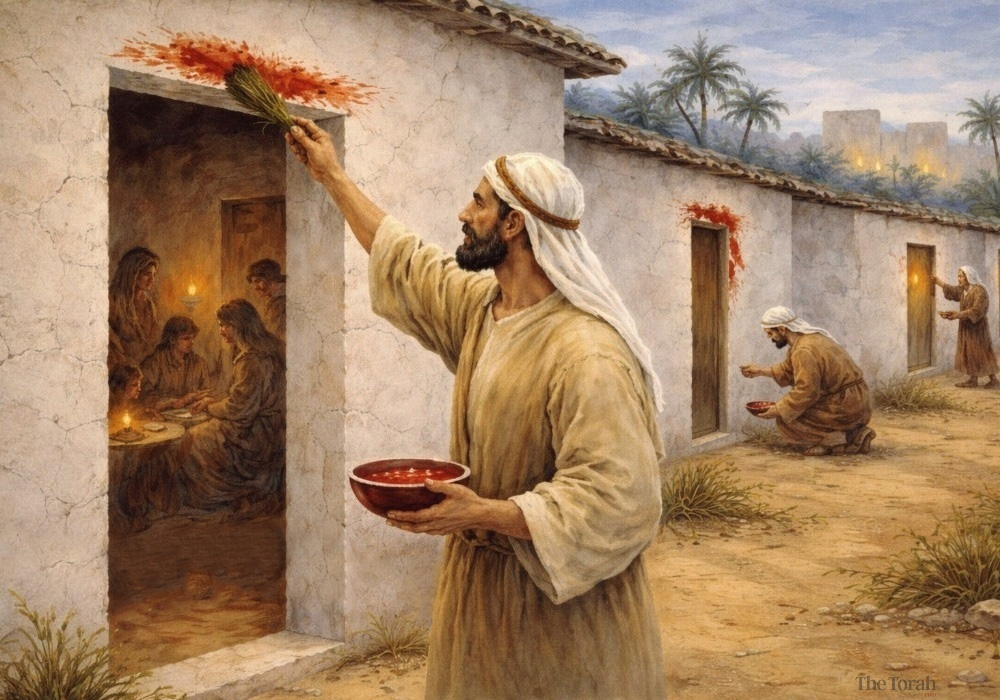
“They shall take some of the blood and put it on the two doorposts and the lintel of the houses… ” - Exodus 12:7.
Bīt rimki, “House of Cleansing,” was a Mesopotamian royal apotropaic ritual, meant to protect the king if bad omens predicted his harm.[1] Our knowledge of the ritual derives from a Neo-Assyrian tablet that was found in numerous fragments in Ashurbanipal’s library in Nineveh. An abbreviated version of the ritual is detailed on another tablet from the same time (the later part of the Neo-Assyrian period) which finding location is unknown, but is assumed to be the city of Babylon.
The ritual was performed by an “exorcist” (āšipu), and one of its procedures entailed smearing the blood of an animal over the threshold, lintel, and doorjambs of the palace gate to protect the royal residence against the intrusion of external malevolent influences:
BBR 26 The exorcist goes out by the outer gate. He sacrifices [a sacrificial] ra[m] (immeru) at the palace gate. With the blood of that buck (urīṣu) [he smears] the [outer] thre[shold], outer lintel and the right and left doorjambs of the palace gate.[2]
Such a practice is highly reminiscent of what the book of Exodus describes for Israel’s final night in Egypt.[3]
Protecting the Israelite Firstborns with Blood on the Doorposts
In his penultimate meeting with Pharaoh before the exodus, Moses warns that the final plague will be the striking down of all the firstborns of Egypt (Exod 11:4–6). To avoid the Israelite firstborns sharing the same fate, God tells Moses that the people must slaughter an animal from the flock, and smear its blood on the “lintel” (משקוף) and “doorposts” (מזוזת), which together make up the house doorframe:
שמות יב:ז וְלָקְחוּ מִן הַדָּם וְנָתְנוּ עַל שְׁתֵּי הַמְּזוּזֹת וְעַל הַמַּשְׁקוֹף עַל הַבָּתִּים אֲשֶׁר יֹאכְלוּ אֹתוֹ בָּהֶם... יב:יב וְעָבַרְתִּי בְאֶרֶץ מִצְרַיִם בַּלַּיְלָה הַזֶּה וְהִכֵּיתִי כׇל בְּכוֹר בְּאֶרֶץ מִצְרַיִם... יב:יג וְהָיָה הַדָּם לָכֶם לְאֹת עַל הַבָּתִּים אֲשֶׁר אַתֶּם שָׁם וְרָאִיתִי אֶת הַדָּם וּפָסַחְתִּי עֲלֵכֶם וְלֹא יִהְיֶה בָכֶם נֶגֶף לְמַשְׁחִית בְּהַכֹּתִי בְּאֶרֶץ מִצְרָיִם.
Exod 12:7 They shall take some of the blood and put it on the two doorposts and the lintel of the houses in which they are to eat it… 12:12 For that night I will go through the land of Egypt and strike down every [male] firstborn in the land of Egypt… 12:13 And the blood on the houses where you are staying shall be a sign for you: when I see the blood I will pass over you, so that no plague will destroy you when I strike the land of Egypt.[4]
The narrative depicts the act of smearing blood as practical, so that YHWH or the Destroyer[5] will know not to enter a given house, but its similarity to bit rīmki and other ancient Near Eastern magical rituals implies that the act is more than a visual sign for the deity.
Smearing the Doorframe for Protection in ANE
Many ancient Near Eastern magical rituals make use of substances on the doorframe as apotropaic protection.[6]
Fine Oil for Plague—A Hittite ritual authored by the “physician” Zarpiya,[7] to protect a house from a virulent plague brought by malevolent entities entails several procedures focused on the outer gate of the household and the door of the house itself, and concludes with:
He closes the door and smears it with fine oil. He recites: “May it shut evil out! May it keep good in!”[8]
The smearing of the house door with fine oil is explicitly said to keep the forces of evil outside, and goodness inside. Since the text supplies no explanation, we can only speculate that fine oil, as a substance used in libations and related to purity, symbolized goodness and hence was considered as countering the forces of evil.
Cedar and Plants for Ghosts—In a Neo-Assyrian ritual to treat a person who was afflicted by ghosts,[9] found in a Sammeltafel (= collection tablet) from Ashurbanipal’s library in Nineveh which detailed numerous similar short rituals, the practitioner was instructed to prepare a paste of sulfur, sea algae, wood, medicinal plants, bitumen and cedar oil, and afterwards:
You should repeatedly smear [the ga]te of the house of his dwelling, the door, the bolt, the sides of his bed, his [tab]le (and) his reed mat, and he will not see (ghosts anymore).[10]
The ghosts tormenting the beneficiary were driven away by smearing the mixture over the person’s personal belongings: his bed, table and mat. But his house was also protected, by smearing the same mixture over the door and the bolt. Here again, the suitability of the different substances for blocking or warding off evil forces can only be speculated: the strong odor of sulfur could be perceived as deterring; the therapeutic qualities of medicinal plants can be understood as countering harmful effects; the waterproof qualities of bitumen could make it seen adequate for sealing the house for protection. But these are mere conjectures as the text never specifies why certain ingredients are chosen.
Red Paste for Witchcraft—A house door creaking, understood as a sign of an evil spell that had been cast on the house, necessitated the performance of an anti-witchcraft ritual, the content of which is known from several Neo-Assyrian copies found in the city of Ashur and Neo/Late Babylonian ones from Ur:
If a man, the gate of his house is creaking: (for) witchcraft not approaching the man (and) his house, you pound as one sulfur, gypsum (and) red paste, (and) mix with billatu-substance.[11]
An incantation is recited three times, followed by the next procedure:
You smear the jambs of the gate of the man’s house with silt. Afterwards, you smear (the gate jambs) with a sūnu(-cloth) the billatu-substance (that) you have mixed, and he will be well.[12]
The red paste granted the mixture a color and liquid appearance resembling those of the blood of a sacrificed animal as used in other rituals, though this is not indicated in the ritual text itself. As before, sulfur may have been used for its strong deterring odor; the white color of gypsum could have seen as reflecting purity; silt could represent life – certain Mesopotamian creation myths tell how humanity was created from it – and hence contrast the deadly power of malevolent entities.
Crushed Bird Head for Witchcraft—In another Neo-Assyrian anti-witchcraft ritual found in the city of Ashur, to appease an apparently enraged deity, the victim was required to smear his house doorjambs (and probably additional unknown elements) with a mixture of substances, among which was a crushed bird head and cypress oil:
“[You pound together] the head of a pašānu-bird [with…] You m[ix] in cypress oil. [On the tenth day], the twentieth day (and) the thirtieth day [you should repeatedly smear] the […], and the doorjambs of his house. The evil omen [will not approach] the man and [his] house. The an[g]ry god [will be at peace] with the ma[n].”[13]
Pig’s Blood for Fever—In a Neo-Assyrian therapeutic ritual found in the city of Ashur, the person suffering from fever was placed in a specially-designated makeshift structure (šutukku), and its doorjambs were smeared with a special paste to separate the patient from the outside world, thereby ensuring the effectiveness of the treatment:
If a man has heat… You mix anzahhu mineral, ox-dung in pig blood (and) put (it) to the doorjamb of a reed shelter’s opening.[14]
Again we see that animal blood – this time pig’s – is one of the components of the mixture. While animal blood was a recurring element in sacrificial procedures – probably representing life donated for the gods – the significance of the anzahhu glass-like mineral and ox dung in this ritual remains unclear.
Animal Fat for Demons—The ninth tablet of the exorcistic series utukkū lemnūtu / udug-hul (“evil demons”) describes how the practitioner addresses an evil demon while exorcising it. The threshold was to be smeared with mixtures of animal fat, bitumen, and gypsum to keep the evil demon out of the house:
I have smeared on the threshold of the house the fat of a pure cow, pure fat, fine quality fat, and fine quality bitumen… I have smeared the threshold of the house with bitumen and gypsum for you. I adjure you with these things by the great gods, so that you may go away.[15]
As before, it can be speculated that bitumen was used for its sealing properties and gypsum for its white color. As to the different types of fat used in this ritual, we may speculate that – like blood – it symbolized life and was hence used as sacrificial material. Additionally, fat was sometimes used in therapeutic procedures as an ingredient in antibacterial ointments and bandages, so we may speculate that such medicinal properties could make it perceived as warding off harmful malicious entities.
All these examples portray the rituals as possessing apotropaic (protective) qualities, and sometimes therapeutic (healing) ones. While the circumstances varied, the technique remained the same: separating the inner and outer spheres by focusing on the house threshold. At times it was the doorframe as a whole, but usually specific elements were specified: the threshold, lintel, or bolt, and most frequently the doorjambs (sippū).
Thresholds, Liminality and Rites of Passage
The common denominator of the rituals quoted above is the concept of the house threshold as liminal space, separating the inner domestic sphere from the outer public one. As such, it reflects a grey area that exists between two separate conceptual categories, differentiates it from both.
The French anthropologist and ethnographer, Arnold van Gennep, in his 1909 Les rites de passage (=Rites of Passage),[16] was the first to dedicate full scholarly attention to the concept of liminality; in fact, in that book he coined the term “rite of passage.” He envisioned a three-phase model describing types of ritualistic activities that accompany significant changes or transitions in human life:
- Separation—preceding the change, when the individual is first separated or disassociated from his immediate society and previous social status.
- Liminality—the change or passage itself.
- Incorporation—once the change/passage is complete, the individual returns to his former society, having acquired a new social status.
Each one of these three stages can be accompanied by various rituals and ceremonies, which van Gennep termed “pre-liminal,” “liminal,” and “post-liminal,” depending on the time when the rituals occur in relation to the change or transition: before, during, or after it. The core of the model is the second phase, which entails “threshold rituals,” either symbolically or physically involving a physical threshold. In van Gennep’s words:
The neutral zone shrinks progressively till it ceases to exist except as a simple stone, a beam, or a threshold… The portal which symbolizes a taboo against entering becomes the postern of the ramparts, the gate in the walls of the city quarter, the door of the house. The quality of sacredness is not localized in the threshold only; it encompasses the lintels and architrave as well.[17]
Such “rites of passage” are not necessarily exotic and mysterious; we are surrounded by them in our everyday life: birth, baptism, circumcision, bar/bat mitzvah, educational enrolment and graduation, wedding, etc. While a person is situated in the second— “liminal”—phase of any of these events, they are located on a metaphorical threshold in-between the past and future realities, not actually belonging to any of them, having left the former but not yet joined the latter.
The renowned anthropologist Victor Turner accepted van Gennep’s model and elaborated its core element: the concept of liminality. Turner focused on the individual’s position in-between social structures during this phase and called it “interstructural situation.”[18]
The concept of the threshold as an indicator of separation between categories also brings to mind Mary Douglas’ famous discussions of the notions of purity and pollution as markers of differentiation between normative categories and people’s will to keep these categories apart.[19] In this sense, the domestic domain can be viewed as a controlled and pristine environment, contrasted with the external domain, an uncontrolled and dangerous environment. The threshold not only separates them but also grants each one of these domains its unique characteristics and defines it as what it is: “inside good, outside bad.”[20]
Leaving Egypt as Crossing a Threshold
While the ritual for protecting Israel from the death of the firstborn follows standard ancient Near Eastern protocol regarding separation from danger, Moses presents the blood on the doorpost not as a force that keeps the dangerous deity at by, but as practical measure, to offer a visual sign for the deity, who does not wish to harm the Israelites:
שמות יב:כא ...מִשְׁכוּ וּקְחוּ לָכֶם צֹאן לְמִשְׁפְּחֹתֵיכֶם וְשַׁחֲטוּ הַפָּסַח. יב:כב וּלְקַחְתֶּם אֲגֻדַּת אֵזוֹב וּטְבַלְתֶּם בַּדָּם אֲשֶׁר בַּסַּף וְהִגַּעְתֶּם אֶל הַמַּשְׁקוֹף וְאֶל שְׁתֵּי הַמְּזוּזֹת מִן הַדָּם אֲשֶׁר בַּסָּף וְאַתֶּם לֹא תֵצְאוּ אִישׁ מִפֶּתַח בֵּיתוֹ עַד בֹּקֶר. יב:כג וְעָבַר יְ־הֹוָה לִנְגֹּף אֶת מִצְרַיִם וְרָאָה אֶת הַדָּם עַל הַמַּשְׁקוֹף וְעַל שְׁתֵּי הַמְּזוּזֹת וּפָסַח יְ־הֹוָה עַל הַפֶּתַח וְלֹא יִתֵּן הַמַּשְׁחִית לָבֹא אֶל בָּתֵּיכֶם לִנְגֹּף.
Exod 12:21 …Draw and take yourselves sheep for your families and slaughter the Pesach-offering. 12:22 Take a bunch of hyssop, dip it in the blood that is inside the basin and apply over the lintel and over the two doorposts of the blood that is inside the basin. Let no man leave his house entrance until morning. 12:23 And as YHWH passes to inflict Egypt, He shall see the blood on the lintel and on the two doorposts, and YHWH shall pass over the entrance and not allow the Destroyer to come to inflict your houses.
Even so, the ritual symbolism is the same as in other uses of smearing protective substances on door frames—in this case between the inner sphere of the protected Israelite house and the external sphere of the horror taking place in Egypt. At first glance, such a ritual entails no rite of passage in van Gennep’s sense. And yet, the tenth plague certainly marks a crucial transition.
The night of the paschal offering is the final step before the release of the people of Israel from bondage in Egypt. The next morning, they leave for the wilderness and begin to build themselves into a true nation. In this sense, the paschal offering, with its rite of placing blood upon the door frame, is a rite of passage par excellence—on a national level.
Cultural separation is a necessary component in the construction of collective identity. The people of Israel had to be separated from the Egyptians to establish their independent identity. The tenth plague included a clear element of cultural separation, as the Torah indicates explicitly:
שמות יא:ו וְהָיְתָה צְעָקָה גְדֹלָה בְּכׇל אֶרֶץ מִצְרָיִם אֲשֶׁר כָּמֹהוּ לֹא נִהְיָתָה וְכָמֹהוּ לֹא תֹסִף. יא:ז וּלְכֹל בְּנֵי יִשְׂרָאֵל לֹא יֶחֱרַץ כֶּלֶב לְשֹׁנוֹ לְמֵאִישׁ וְעַד בְּהֵמָה לְמַעַן תֵּדְעוּן אֲשֶׁר יַפְלֶה יְ־הֹוָה בֵּין מִצְרַיִם וּבֵין יִשְׂרָאֵל.
Exod 11:6 And there shall be a loud cry in all the land of Egypt, such as has never been or will ever be again; 11:7 but not a dog shall snarl at any of the Israelites, at human or animal—in order that you may know that YHWH makes a distinction between Egypt and Israel.
Marking the doorframe with blood to protect the house threshold was merely a prelude to crossing a much larger threshold soon thereafter.
TheTorah.com is a 501(c)(3) nonprofit organization.
We rely on the support of readers like you. Please support us.
Published
March 23, 2026
|
Last Updated
September 15, 2026
Previous in the Series
Next in the Series
Before you continue...
Thank you to all our readers who offered their year-end support.
Please help TheTorah.com get off to a strong start in 2025.
Footnotes


Dr. Ilan Peled is an Assyriologist working at Leiden University, Netherlands. Following the completion of his Ph.D. in Hebrew and Semitic Languages, from Bar-Ilan University, he held postdoctoral positions at the University of Pennsylvania, New York University, The Hebrew University of Jerusalem and the Oriental Institute of the University of Chicago. Peled’s research focuses on cultural life in the ancient Near East, especially in the spheres of gender, law, religion and cult, and biblical interpretation in the ANE context. He is the author of Masculinities and Third Gender: The Origins and Nature of an Institutionalized Gender Otherness in the Ancient Near East (AOAT 435), and the editor of Structures of Power: Law and Gender Across the Ancient Near East and Beyond.
Essays on Related Topics: