


 Edit article
Series
On the Pilgrims’ Path to the Temple: Monumental Tombs


Categories:
In late Second Temple period Jerusalem,[1] families buried their loved ones in rock-cut tombs, often with כוכים (kokhim), deep burial niches cut into the walls.[2] In wealthier contexts these complexes could include impressive façades, courtyards, steps, and carefully planned chamber systems.[3] Such features surely served the needs of burial and repeated family commemoration, but they also created monuments with a strong outward presence.[4]
These tombs were embedded in the topography and belonged to roads, slopes, valleys, and approaches of a dense regional road system, of which Jerusalem was a hub. Various routes—from the Judean hills, the Shephelah, Jericho, and the desert—converged on the city,[5] carrying not only trade and ordinary traffic, but also pilgrims making their way to the Temple.[6] These monumental tombs would have been part of what people saw on their way to the city.
Mishnah and Matthew: Beautiful Tombs on the Road
The Mishnah mentions fixing the roads and marking the graves as two things that need to be done before pilgrims come to Jerusalem for Passover:
משנה שקלים א:א בְּאֶחָד בַּאֲדָר מַשְׁמִיעִין עַל הַשְּׁקָלִים וְעַל הַכִּלְאַיִם. בַּחֲמִשָּׁה עָשָׂר בּוֹ קוֹרִין אֶת הַמְּגִלָּה בַּכְּרַכִּין, וּמְתַקְּנִין אֶת הַדְּרָכִים וְאֶת הָרְחוֹבוֹת וְאֶת מִקְוְאוֹת הַמַּיִם, וְעוֹשִׂין כָּל צָרְכֵי הָרַבִּים, וּמְצַיְּנִין אֶת הַקְּבָרוֹת, וְיוֹצְאִין אַף עַל הַכִּלְאָיִם.
m. Shekalim 1:1 On the first of Adar, one makes a public announcement regarding sheqalim and forbidden mixtures. On the fifteenth, one recites the scroll of Esther in the cities and fixes thoroughfares, roads, and ritual baths. One takes care of all the needs of the community, marks the graves, and also one goes forth on account of forbidden mixtures.[7]
This Mishnah may simply be concerned with ensuring that travelers did not inadvertently enter or come into contact with tombs, thereby contracting corpse impurity that would prevent them from entering the Temple precincts. The Gospel of Matthew, however, adds another dimension by explicitly referring to the outward appearance of whitewashed tombs:
Matt 23:27 “Woe to you, scribes and Pharisees, hypocrites! For you are like whitewashed tombs, which on the outside look beautiful but inside are full of the bones of the dead and of all kinds of uncleanness. 23:28 So you also on the outside look righteous to others, but inside you are full of hypocrisy and lawlessness. (NRSV)
Matthew thus provides contemporary literary evidence that whitewashed tombs could be perceived as visually impressive. If, as the archaeological evidence suggests, monumental tombs were prominently situated along approaches to Jerusalem, their façades would have formed part of the visual experience of pilgrims approaching the city.
The Northern Road: Sanhedria and the Northern Necropolis
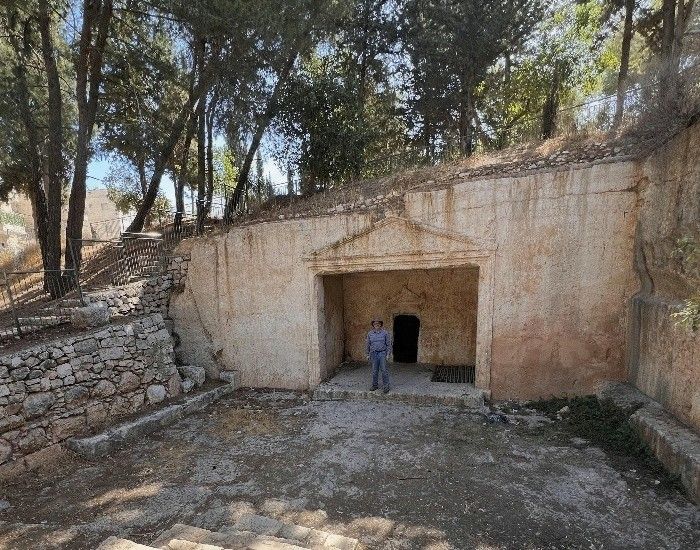
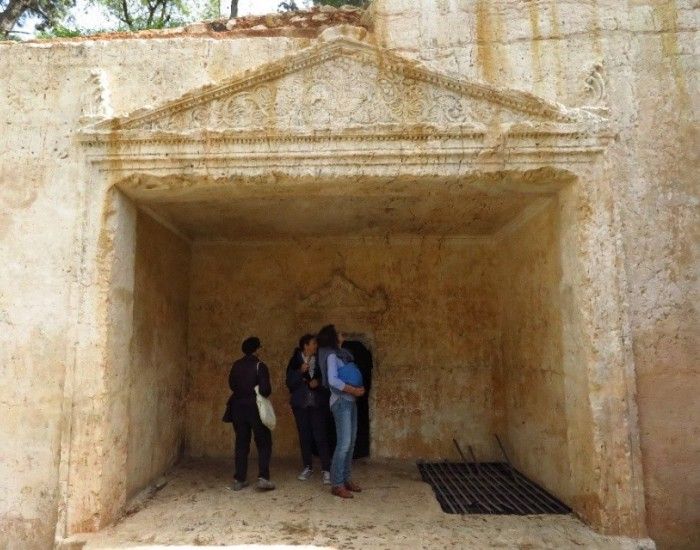
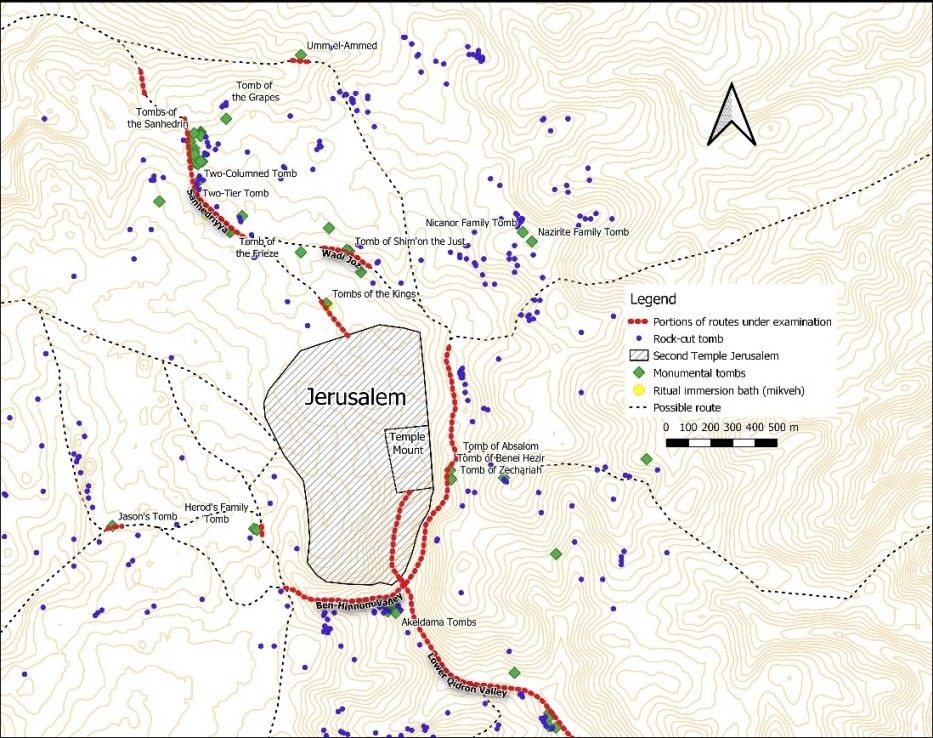
The northern necropolis (lit. “city of the dead”) is the extensive belt of rock-cut tombs extending across the hills north and northwest of Second Temple-period Jerusalem. It offers particularly clear evidence for the relationship between monumental tombs and the principal approaches to the city.[8] The Sanhedria area formed an important part of this cemetery zone. Travelers coming from the central hill country and regions farther north would have reached Jerusalem through routes passing this sector.[9] That made the area a natural threshold between city and hinterland.
Some of these numerous tombs are architecturally ambitious, with carefully cut, decorated façades and formal forecourts. Their elaboration has long been connected with status display, elite family identity, and broader artistic influences.[10] What deserves more emphasis is that these monuments also occupied a zone of approach. In modern terms, they functioned somewhat like prominent roadside displays: their architectural elaboration addressed not only those entering the tomb but also people moving through the surrounding landscape. Even where individual façades were not visible from a great distance, the repeated presence of such monuments would have created a cumulative effect. Before travelers reached the built city, they were already passing through a built landscape of memory.
The Eastern Road: The Kidron Valley
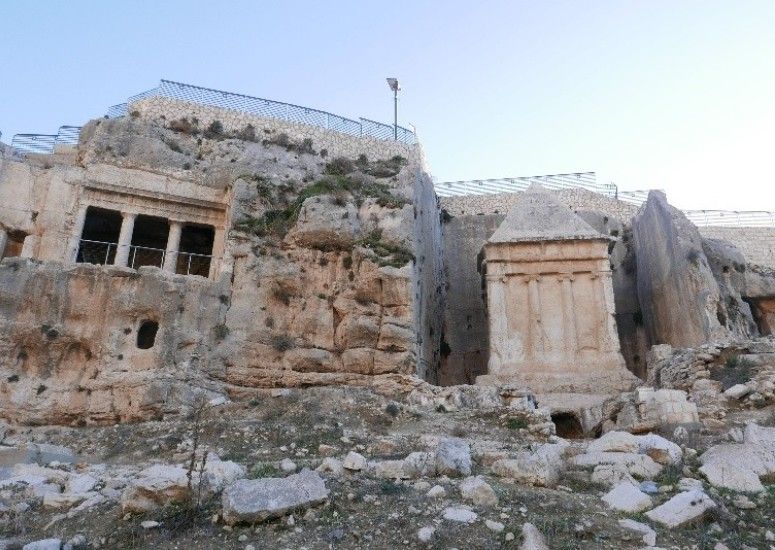
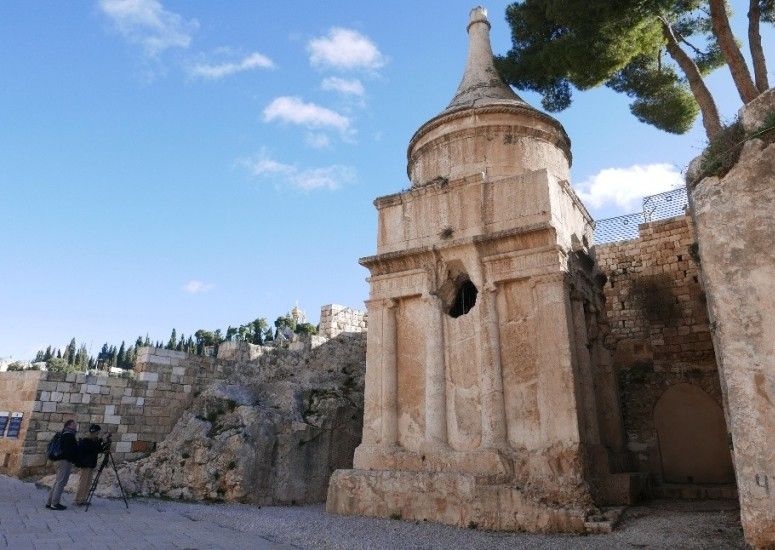
If Sanhedria illustrates the power of clustering along a northern approach, the Kidron Valley exhibits some of Jerusalem’s most famous monuments: The so-called Tomb of Absalom, the Tomb of Zechariah, and the Tomb of the Sons of Hezir.[11] Their forms are highly conspicuous, combining rock-cut and built elements with architectural features such as columns, cornices, pediments, and other forms derived from Greco-Roman architectural traditions with some Egyptian and perhaps Nabataean elements.[12]
The topography here differs sharply from that of the northern approaches. In the Kidron, monuments are disclosed through movement along the valley floor and slopes. They can dominate the local field of vision even when they are not meant for long-distance viewing in the same way as monuments on an open ridge. The effect is more dramatic and immersive: the traveler enters a corridor of topography in which the tombs appear as commanding presences near the Temple Mount itself.
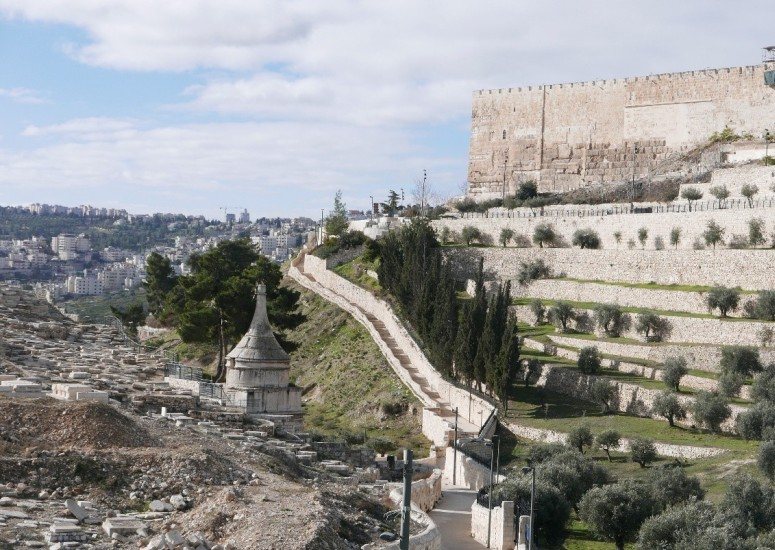
This area was also closely tied to movement from the east, including routes connecting Jerusalem with the Judean Desert and the Dead Sea region,[13] and formed part of the broader pilgrimage environment of Jerusalem.[14] In this setting, the Kidron monuments both proclaimed family prestige and inserted burial architecture into the landscape. The result was a topographically dramatic sequence: pilgrims moving southward through the Kidron passed the monumental tombs before reaching the southern entrance to the city; from the vicinity of the Siloam Pool, the monumental, stepped street then led northward and upward toward the Temple Mount.[15]
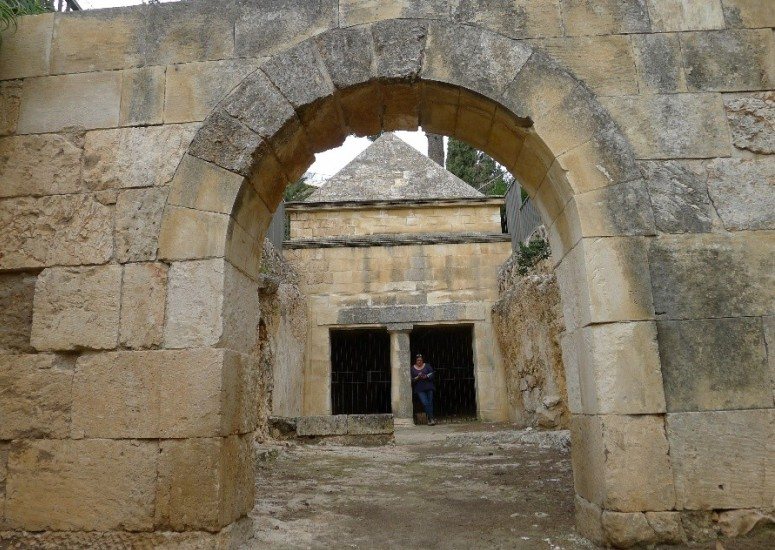
The pattern is not confined to Sanhedria and the Kidron Valley. Smaller tomb clusters appear along other routes approaching Jerusalem from the west and southwest as well.[16] These tombs are often less spectacular than the best-known monuments east of the city, but they can still occupy visually strategic positions close to roads or above them. Jason’s tomb is one such structure.
How Do We Know the Tombs Were Meant to Be Seen by Travelers?
Various wealthy families deliberately placed their tombs where they would enter the visual world of those coming to Jerusalem. This claim is not based on psychological speculation but the empirical evidence in the tombs’ placement, orientation, scale, and repetition.
A tomb cut into an obscure slope and visible only at close range would not offer the same kind of public display as one placed where an approach road opens a clear view of its façade. Not every tomb was placed according to a single master plan, of course, and sometimes practical considerations overrode display ones: Tomb cutting depended on suitable bedrock,[17] plus access, family land, and local topography all played a role. But geology alone does not explain why some tombs also achieved such strong visual relationships with roads. Moreover, we are not talking about a single tomb or one accidental concentration, but clusters of monuments on all of the roads, creating an entire funerary landscape.
Of the approximately 900 family tombs known from Jerusalem’s late Hellenistic and Early Roman necropolis, only several dozen—perhaps 30–40 complexes—can reasonably be classified as monumental. Preliminary spatial analysis suggests that a substantial majority of these conspicuous monuments were situated in close visual or topographical relationship with major approach roads, perhaps exceeding half of the known corpus. This pattern suggests that visibility to travelers approaching Jerusalem was an important consideration in the placement of elite funerary monuments.
This is especially significant in Jerusalem because the city was approached through a varied topography. Some roads rise gradually over hills; others narrow into valleys and suddenly disclose what lies ahead. In such settings, visibility is never abstract. It is directional and experiential. What a traveler sees depends on where the road bends, how steeply it climbs, and whether the monument appears from afar or only at close quarters.[18]
Jerusalem in a Wider Mediterranean Perspective
The placement of these tombs fits a broader Mediterranean pattern, found in the Hellenistic and Roman worlds, where tombs were often situated along roads entering and leaving cities.[19] Such placement made the dead visible at moments of arrival and departure and turned roadsides into corridors of commemoration.[20]
Such placement made the dead visible at moments of arrival and departure. As travellers approached or left a city, they passed successive funerary monuments displaying the names, status, and memory of prominent individuals and families; in this sense, the roads themselves became corridors of commemoration.
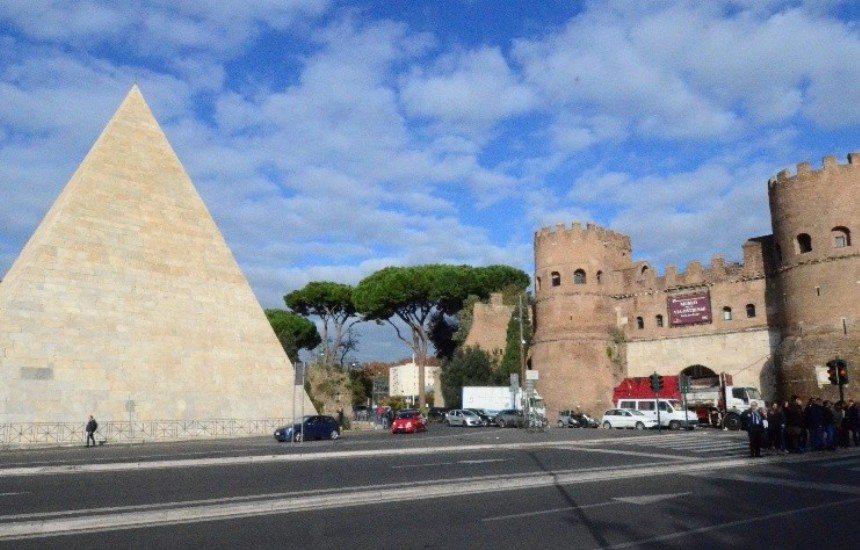
Jerusalem, however, adds a further dimension. Elsewhere, roadside tombs marked movement into the city. The added layer in Jerusalem is that many visitors were on a religious, festival pilgrimage,[21] and would associate these families with their God’s Temple. That sacred destination gave the approach roads unusual symbolic intensity.
Death on the Road to the House of Life
Tombs are family subterranean spaces. Their chambers, kokhin, and repeated use all point to kinship, lineage, and private remembrance.[22] Yet the more elaborate these tombs became, the more they addressed an audience beyond the family. This is precisely why façades, tomb markers, monumental steps and courtyards matter: They are the visible threshold of burial architecture, translating a private commemorative space into a public-facing monument.[23]
This does not mean that tombs and pilgrimage were symbolically harmonious in any simple way. Burial monuments represent death, memory, and lineage; the Temple represented divine presence, sacrifice, and communal worship. Yet, once set along roads, such monuments communicated wealth, cultural affiliation, and family prestige to a broad stream of viewers.
There is a paradox here: On the approach to Jerusalem, monumental tombs publicly displayed the prestige of the dead—and of their living families—to pilgrims heading toward a Temple they could not enter after contracting corpse impurity.
TheTorah.com is a 501(c)(3) nonprofit organization.
We rely on the support of readers like you. Please support us.
Published
|
Last Updated
September 22, 2026
Previous in the Series
Next in the Series
Before you continue...
Thank you to all our readers who offered their year-end support.
Please help TheTorah.com get off to a strong start in 2025.
Footnotes


Prof. Boaz Zissu is Professor of Classical Archaeology in the Martin (Szusz) Department of Land of Israel Studies and Archaeology at Bar-Ilan University, where he also heads the Jeselsohn Epigraphic Center for Jewish History. He received his Ph.D. from the Hebrew University of Jerusalem and subsequently held postdoctoral fellowships at the University of California, Berkeley, and the Calgary Institute for the Humanities. His research focuses on the archaeology of Judea and Jerusalem during the Hellenistic, Roman, and Byzantine periods, with particular emphasis on the Bar Kokhba Revolt, underground hiding complexes, burial customs, numismatics, epigraphy, and the archaeology of the Hellenistic, Roman and Byzantine East. He has directed and co-directed archaeological excavations and surveys and has published extensively on these subjects. His books include The Necropolis of Jerusalem in the Second Temple Period and The Bar Kokhba Revolt: The Archaeological Evidence. He is a member of the Israel Archaeological Council.

Dr. Omri Yitzhak Abadi is a historian and archaeologist of ancient Judaism and a Research Fellow at the Zinman Institute of Archaeology at the University of Haifa (2026–2027). He received his Ph.D. from the Martin (Szusz) Department of Land of Israel Studies and Archaeology at Bar-Ilan University, where his dissertation examined the social dimensions of burial in Judea and Jerusalem during the Hellenistic and Early Roman periods. His research combines archaeological evidence, historical sources, and social and anthropological approaches to the study of ancient Jewish society.
Essays on Related Topics: