


 Edit article
Series
Who Were the Tribe of Dan?


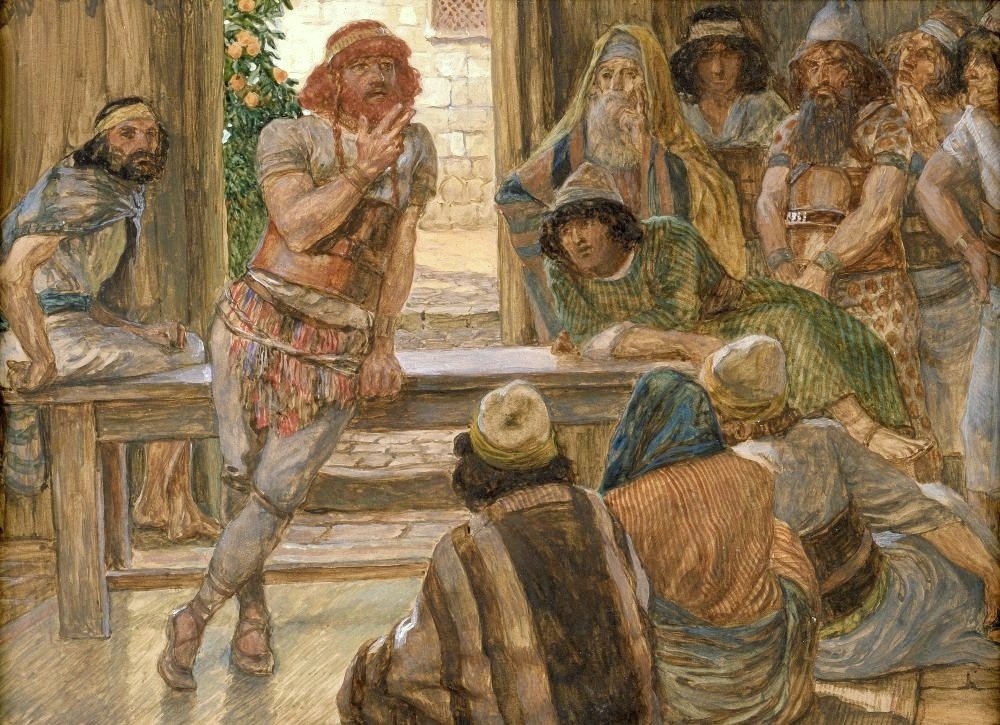
Samson Puts Forth a Riddle, James Jacques Joseph Tissot, ca. 1896-1902. Completed by Michel Simonidy (1870- 1933), Paris, France. The Jewish Museum
The Birth of Dan
Rachel, frustrated by her inability to have children, tells Jacob to take her handmaid Bilhah, so she can have children through her.[1] When Bilhah gives birth to a son, Rachel names him Dan:
בראשית ל:ד וַתִּתֶּן לוֹ אֶת בִּלְהָה שִׁפְחָתָהּ לְאִשָּׁה וַיָּבֹא אֵלֶיהָ יַעֲקֹב.ל:ה וַתַּהַר בִּלְהָה וַתֵּלֶד לְיַעֲקֹב בֵּן. ל:ו וַתֹּאמֶר רָחֵל דָּנַנִּי אֱלֹהִים וְגַם שָׁמַע בְּקֹלִי וַיִּתֶּן לִי בֵּן עַל כֵּן קָרְאָה שְׁמוֹ דָּן.
Gen 30:4 So she gave him Bilhah her handmaid as a wife, and Jacob cohabited with her. 30:5 Bilhah conceived and bore Jacob a son. 30:6 And Rachel said, “God has vindicated me (דָּנַנִּי, danani), and has heeded my plea, and given me a son.” Therefore, called she his name Dan.[2]
In the ancestral narratives, when a patriarch conceives a child with a woman who is not his wife, with the wife’s acquiescence, the “offspring” may have a non-Israelite origin.[3] The matriarch’s claim of the child as her own bolsters the tribe’s legitimacy.
The need to legitimate Dan resurfaces in Jacob’s blessing:
בראשית מט:טו דָּן יָדִין עַמּוֹ כְּאַחַד שִׁבְטֵי יִשְׂרָאֵל.
Gen 49:16 Dan shall judge his people, as one of the tribes of Israel.
Were Dan clearly part of Israel, the second half of the verse would be superfluous. The verse may indeed imply that, in some quarters at least, Dan was not considered a tribe of Israel, a perception that needed to be overcome.
Dan the Viper
The negative description of Dan in Jacob’s final address to his sons is also puzzling:
בראשית מט:יז יְהִי דָן נָחָשׁ עֲלֵי דֶרֶךְ שְׁפִיפֹן עֲלֵי אֹרַח הַנֹּשֵׁךְ עִקְּבֵי סוּס וַיִּפֹּל רֹכְבוֹ אָחוֹר.
Gen 49:17 Dan shall be a serpent by the road, a viper by the path, that bites the horse's heels, so that his rider is thrown backward.[4]
Perhaps this blessing suggests that Danite warriors specialized in guerilla warfare—but the date of this text is uncertain, and thus the enemies whom Dan opposes cannot be identified.
Danites as Master Craftsmen
A very different depiction of the Danites appears in relation to the construction of the Tabernacle:[5]
שמות לה:לד...נָתַן בְּלִבּוֹ הוּא וְאׇהֳלִיאָב בֶּן־אֲחִיסָמָךְ לְמַטֵּה דָן. לה:לה מִלֵּא אֹתָם חׇכְמַת לֵב לַעֲשׂוֹת כׇּל מְלֶאכֶת חָרָשׁ וְחֹשֵׁב וְרֹקֵם בַּתְּכֵלֶת וּבָאַרְגָּמָן בְּתוֹלַעַת הַשָּׁנִי וּבַשֵּׁשׁ וְאֹרֵג עֹשֵׂי כׇּל מְלָאכָה וְחֹשְׁבֵי מַחֲשָׁבֹת.
Exod 35:34 (YHWH) has endowed him (Bezalel) and Oholiab son of Ahisamach of the tribe of Dan 35:35 the skill to do any work—of the engraver, the designer, the embroiderer in blue, purple, crimson yarns, and in fine linen, and of the weaver—as workers in all crafts and as makers of designs.
Oholiab, chief assistant to Bezalel, is skilled in all areas related to designing and creating the tabernacle and its contents.
Building the Temple
This association of the Danites with artisanship also appears in Chronicles, which describes the King of Tyre sending craftsmen to help build Solomon’s temple.[6] The mention of metalworking among Huram’s skills is particularly interesting in light of the archaeological finds at Tel Dan, as we shall see later:
דברי הימים ב ב:יב וְעַתָּה שָׁלַחְתִּי אִישׁ חָכָם יוֹדֵעַ בִּינָה לְחוּרָם אָבִי. ב:יג בֶּן אִשָּׁה מִן בְּנוֹת דָּן וְאָבִיו אִישׁ צֹרִי יוֹדֵעַ לַעֲשׂוֹת בַּזָּהָב וּבַכֶּסֶף בַּנְּחֹשֶׁת בַּבַּרְזֶל בָּאֲבָנִים וּבָעֵצִים בָּאַרְגָּמָן בַּתְּכֵלֶת וּבַבּוּץ וּבַכַּרְמִיל וּלְפַתֵּחַ כׇּל פִּתּוּחַ וְלַחְשֹׁב כׇּל מַחֲשָׁבֶת אֲשֶׁר יִנָּתֶן לוֹ עִם חֲכָמֶיךָ וְחַכְמֵי אֲדֹנִי דָּוִיד אָבִיךָ.
2 Chron 2:12 Now I am sending you a skillful and intelligent man, my master Huram, 2:13 the son of a Danite woman, his father a Tyrian. He is skilled at working in gold, silver, bronze, iron, precious stones, and wood; in purple, blue, and crimson yarn and in fine linen; and at engraving and designing whatever will be required of him, alongside your craftsmen and the craftsmen of my lord, your father David.
This passage also notes consanguineous relations between Dan and the Tyrians, whose close ties, we shall see later, have been borne out by archaeological finds from both the Iron Age and the Persian and Hellenistic periods.[7]
Huram’s parents are not the only case of the tribe of Dan intermarrying with non-Israelites. The blasphemer in Leviticus is also the product of a mixed marriage in which his mother was a Danite and his father, an Egyptian (Lev 24:10-23).[8]
The best known Danite is Samson, who also marries a non-Israelite and cavorts with Philistines and a Philistine woman, Delilah. Scholars have pointed out that Samson’s character resembles that of a Helladic (Greek Bronze Age) hero—superhuman strength, long hair, the posing of riddles, and being undone by a woman (we will return to Samson later).[9]
How Dan Got Its Territory in Israel
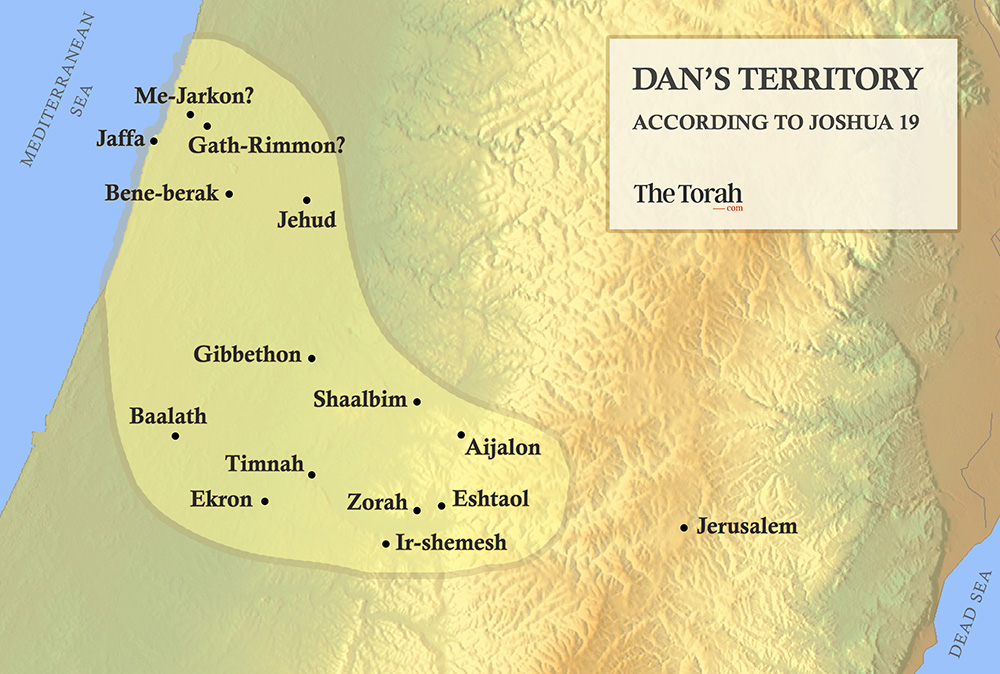
In the book of Joshua, following the conquest of the Land of Israel, Dan’s allotted territory is located on the seashore, in the area of Tel Aviv and its suburbs of today, and west up to towns in the lower Shephelah:
יהושע יט:מ לְמַטֵּה בְנֵי דָן לְמִשְׁפְּחֹתָם יָצָא הַגּוֹרָל הַשְּׁבִיעִי. יט:מא וַיְהִי גְּבוּל נַחֲלָתָם צׇרְעָה וְאֶשְׁתָּאוֹל וְעִיר שָׁמֶשׁ יט:מב וְשַׁעֲלַבִּין וְאַיָּלוֹן וְיִתְלָה יט:מג וְאֵילוֹן וְתִמְנָתָה וְעֶקְרוֹן יט:מד וְאֶלְתְּקֵה וְגִבְּתוֹן וּבַעֲלָת יט:מה וִיהֻד וּבְנֵי בְרַק וְגַת רִמּוֹן יט:מו וּמֵי הַיַּרְקוֹן וְהָרַקּוֹן עִם הַגְּבוּל מוּל יָפוֹ.
Josh 19:40 The seventh lot fell to the tribe of Dan, according to its clans. 19:41 The territory of their inheritance included: Zorah, Eshtaol, Ir-shemesh, 19:42 Shaalabbin, Aijalon, Ithlah, 19:43 Elon, Timnah, Ekron, 19:44 Eltekeh, Gibbethon, Baalath, 19:45 Jehud, Bene-berak, Gath-rimmon, 19:46 Me-jarkon and Rakkon, with the area facing Joppa.
Dan’s Migration
That chapter also notes that Dan loses its territory and conquers Leshem further north:[10]
יהושע יט:מז וַיֵּצֵא גְבוּל בְּנֵי דָן מֵהֶם וַיַּעֲלוּ בְנֵי דָן וַיִּלָּחֲמוּ עִם לֶשֶׁם וַיִּלְכְּדוּ אוֹתָהּ וַיַּכּוּ אוֹתָהּ לְפִי חֶרֶב וַיִּרְשׁוּ אוֹתָהּ וַיֵּשְׁבוּ בָהּ וַיִּקְרְאוּ לְלֶשֶׁם דָּן כְּשֵׁם דָּן אֲבִיהֶם. יט:מח זֹאת נַחֲלַת מַטֵּה בְנֵי דָן לְמִשְׁפְּחֹתָם הֶעָרִים הָאֵלֶּה וְחַצְרֵיהֶן.
Josh 19:47 But the territory of the Danites was lost to them, so the Danites migrated and made war on Leshem. They captured it and put it to the sword; they took possession of it and settled in it. And they changed the name of Leshem to Dan, after their ancestor Dan. 19:48 That was the inheritance of the tribe of the Danites, according to their clans—those towns, with their villages.
The description of Dan’s territory[11] raises a question: If the Danites are no longer residing in their original territory, why go to the trouble of describing it in so much detail? As usual, we can only suggest hypotheses. One possible explanation is that the Danites who migrated to Leshem preserved the records of their original holdings, in the hope of one day reclaiming them. The author, by including these details, acknowledges their claim.
The book of Judges also describes Dan’s conquest up north, though the conquered town has a slightly different name, Laish:
שופטים יח:כז ...וַיָּבֹאוּ עַל לַיִשׁ עַל עַם שֹׁקֵט וּבֹטֵחַ וַיַּכּוּ אוֹתָם לְפִי חָרֶב וְאֶת הָעִיר שָׂרְפוּ בָאֵשׁ. יח:כח וְאֵין מַצִּיל כִּי רְחוֹקָה הִיא מִצִּידוֹן וְדָבָר אֵין לָהֶם עִם אָדָם וְהִיא בָּעֵמֶק אֲשֶׁר לְבֵית רְחוֹב וַיִּבְנוּ אֶת הָעִיר וַיֵּשְׁבוּ בָהּ. יח:כט וַיִּקְרְאוּ שֵׁם הָעִיר דָּן בְּשֵׁם דָּן אֲבִיהֶם אֲשֶׁר יוּלַּד לְיִשְׂרָאֵל וְאוּלָם לַיִשׁ שֵׁם הָעִיר לָרִאשֹׁנָה.
Jud 18:27 …They proceeded to Laish, a people tranquil and unsuspecting, and they put them to the sword and burned down the town. 18:28 There was none to come to the rescue, for it was distant from Sidon and they had no dealings with anyone; it lay in the valley of Beth-rehob. They rebuilt the town and settled there, 18:29 and they named the town Dan, after their ancestor Dan who was Israel’s son. Originally, however, the name of the town was Laish.[12]
Leshem and Laish are close enough that they could be variants of the same name. Moreover, in the Septuagint, the town conquered in the Joshua account is called Laish.[13]
Danites the Seafarers
The Song of Deborah provides still different information about the Danites:
שופטים ה:יז גִּלְעָד בְּעֵבֶר הַיַּרְדֵּן שָׁכֵן וְדָן לָמָּה יָגוּר אֳנִיּוֹת אָשֵׁר יָשַׁב לְחוֹף יַמִּים וְעַל מִפְרָצָיו יִשְׁכּוֹן.
Jud 5:17 Gilead tarried beyond the Jordan; and Dan, why did he linger by the ships?[14] Asher remained at the seacoast, and tarried at his landings.
Apparently, the Danites are seafarers. This fits with their initial allotment near the seacoast with ports at Jaffa and the Yarkon estuary.
Who Were the Danites?
A synthesis of these texts suggests that the Danites were worldly, cosmopolitan and consorted and intermarried with non-Israelites. They were skilled and well-connected, politically and commercially. The Danites became part of Israel, but they remained culturally distinct, and perhaps somewhat suspect.
Archeological evidence from Tel Dan sheds light on who the Danites were.
Tel Dan
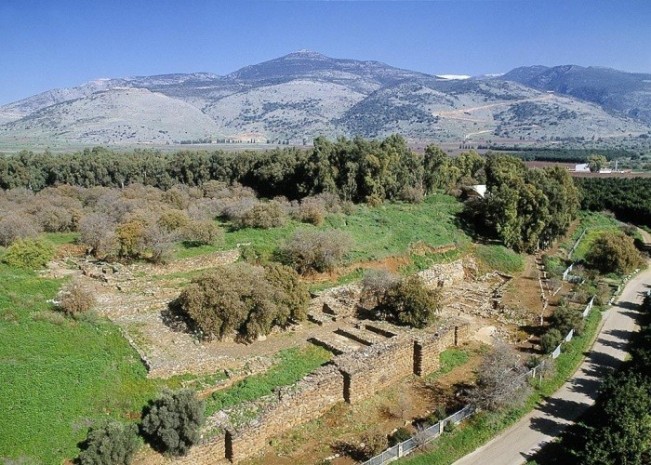
William Lynch and Edward Robinson in mid-19th century identified the archaeological site of Tell el Qadi, as it is called in Arabic, in the upper Galilee region, as the city of Dan.[15] Tell el Qadi in Arabic means “mound of the judge”, qadi meaning judge, as does the Hebrew דין (din). The Byzantine bishop and historian Eusebius (ca. 260-340) already identified the site as ancient Dan in the fourth century C.E.[16]
Archaeological excavations at Tel Dan began in 1966 under the direction of Avraham Biran, who was then the director of the Israel Department of Antiquities and Museums (today the Israel Antiquities Authority). Biran moved the project to the Nelson Glueck School of Biblical Archaeology at the Hebrew Union College in 1974 and continued his work at the site until 1999, when he was 90 years old! I worked under Biran from 1986 and then replaced him as director of the Nelson Glueck School in 2002.
Biran was an old-time archaeologist who excavated with the Bible in one hand and a trowel in the other. For him the Bible was history (and law and poetry, of course). This perspective greatly influenced his interpretations, something apparent in his popular book, Biblical Dan, published in 1994.
Proof of Dan’s Migration?
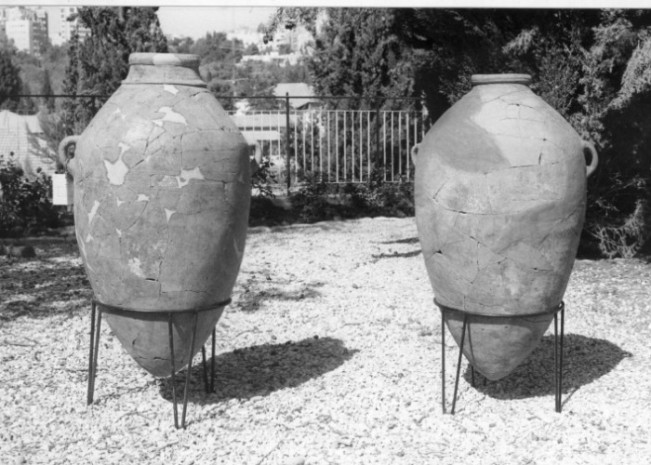
When, for example, collared pithoi—large ceramic storage vessels with a thickened ring, or collar, of clay around the neck—were discovered in a thick destruction layer at the site in the 1960s, on the basis of the biblical account alone, Biran identified this layer as comprising the settlement of the migrating tribe of Dan described in Judges 18.
This type of vessel was considered archetypal of the Israelite settlement in the central highlands of Israel, dated to the late 13th-11th centuries B.C.E, the archaeological period called the Iron Age I.[17] Their appearance at Tel Dan seemed to confirm the migration narrative of Judges 18: the Danites brought the collared pithoi tradition with them from the south.
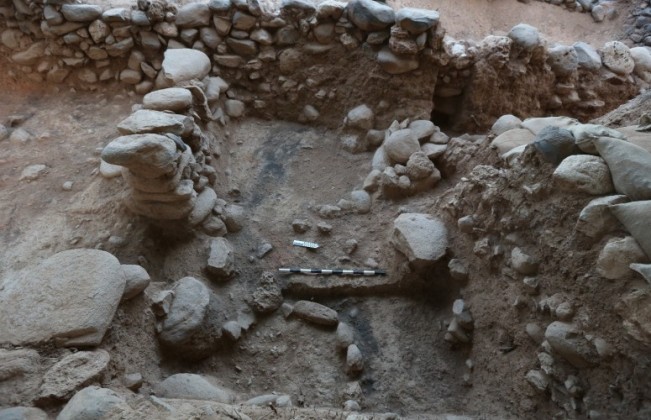
This period and these archaeological strata of Tel Dan (Strata VIIA-IVB) were the subject of my doctoral dissertation, written in the 1990s. My own conclusions differed from Biran’s. While much of the material culture excavated at the site was similar to that of the central highlands—what one might call an indigenous Canaanite material culture—in other ways the pottery assemblage differed from that found in the central highlands.
Anomalous Archaeological Finds at Dan
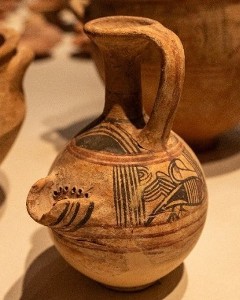
Some archeological finds from Tel Dan were more at home in Cyprus or Greece. Fragments of figurines and some ceramic vessels looked like things found in the Philistine heartland, on the southern coastal plain of Israel and the Gaza Strip.[18] But there were also subtle differences between these vessels and the Philistine ones.[19] For example, the necks of the painted birds on the pottery were painted with one line, and not with two lines as was usual of birds on Philistine painted pottery.[20] Birds with one-lined necks are found in Cyprus and in the Greek islands. Almost all the birds in Philistine pottery have two-lined necks, over a period of at least a hundred years or so. These are not just different potters; they are different traditions.
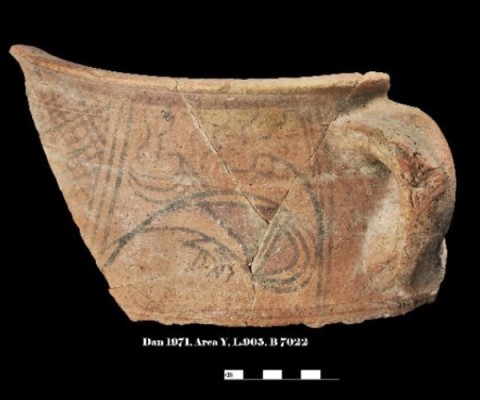 Painted bird, Sea People pottery, Tel Dan Painted bird, Sea People pottery, Tel Dan |
|

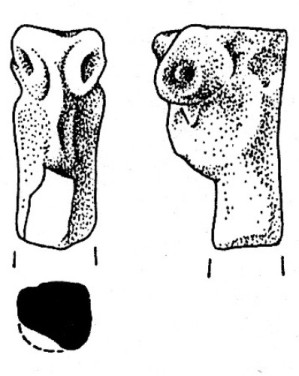
Several broken heads of “Ashdoda” figurines, in which a stylized female head and torso merge directly into a high backed seat or throne, were found.
 |
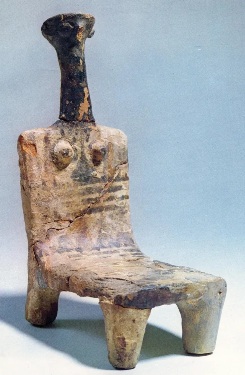 |
| Ashdoda head, Tel Dan | Philistine Ashdoda figurine, Tel Ashdod |
The Ashdoda figurines are Philistine cult objects derived from an Aegean Mycenean tradition. What were they doing so far north, at Tel Dan? Other figurines looked Aegean too.[21]
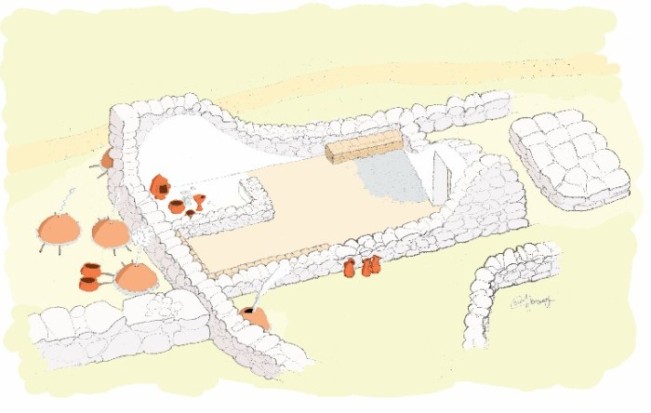
Metallurgy was prominent in the Iron Age I levels at Tel Dan. This was a recycling metallurgy, based on the scavenging of metals in a time of shortage. The furnaces and installations of the metallurgy workshop are very similar to those found in the metallurgy complex at the contemporaneous site of Kition on the eastern coast of Cyprus.[22]
This workshop at Dan was mostly for copper/bronze, but it also produced some of the earliest iron objects found in Israel.[23] The metallurgy installations surrounded a small unassuming structure that had a small corner chamber that contained a model silo shrine which would have had a figurine of the grain god Baal or Dagon.[24]
Such figurines have been found in proximity to such model shrines, for example at Hazor. But being precious and powerful, they would have been removed by those who escaped the site’s destruction. Since no dead bodies were found at the site, the inhabitants either got out in time or were taken out under duress.
.jpg?alt=media&token=4248e466-7776-4174-96b9-ffdb28b057d3)
Such corner chambers are a feature of Aegean and Cypriot sanctuaries and there is even one in a Philistine temple at Tel Qasile, in Tel Aviv, which dates to about the same time.[25]
This evidence suggests that people of Aegean or Cypriot origins lived at Tel Dan and preserved their cultural heritage over many generations.[26] But that is only part of the story. Only when I finished my dissertation and began preparing the Tel Dan material for final publication, did I realize that quite a few objects in the assemblage are Egyptian!
Egyptians at Dan, Too
.jpg?alt=media&token=0d3df744-3ec9-416a-a4f8-4578bf9c887a)
Hundreds of small cooking pots excavated at Tel Dan can only be Egyptian; their globular form and narrow openings are typical in Egypt and they are found in a few other Egyptian-controlled sites in Canaan, but nowhere else.[27] But these are not imports; they were manufactured at Tel Dan itself.
Additional Egyptian finds included: a barber’s razor, bone arrowheads for target practice, several Egyptian beer jars and some ceramic bowls.[28] This suggests that Egyptians were living at Tel Dan too.
Egyptians, Aegean populations, and people of indigenous origins were all living together at Tel Dan circa 1200-950 B.C.E. The following historical scenario explains this mixture.
Dan’s Origins: An Egyptian Outpost
Starting around 1500 B.C.E. or so, the Egyptians ruled Canaan until about 1140 B.C.E.[29] In the last century and a half of their rule, ca. 1300-1140 B.C.E., they constructed tens of outposts and several command centers to consolidate their control over an occupied Canaan that contained quite a few belligerent people in the hill country, in the deserts and even in the cities.[30]
Foreign Soldiers Recruited
But there were not enough Egyptians willing or able to man all these outposts and command centers. And after a weakening of control in the 14th century Amarna Period,[31] the Egyptians realized that could not rely solely on loyal local vassal kings and their retainers to maintain control over these areas.[32]
They then supplemented their manpower with foreign soldiers from Syria, Turkey, Cyprus, the Greek world, and perhaps other places. The Egyptians were the commanders, but some, perhaps many, of these foreign soldiers proved their loyalty and worth and were promoted. Many also married local women and had children.
This is why we find Egyptian, Canaanite and Aegean material culture at Tel Dan and other places in the southern Levant. The Egyptians maintained an administrative center/military base at Tel Dan, as they did in Gaza, Jaffa, Beth Shean and Kamid el Loz in Lebanon, and elsewhere. But around 1140 B.C.E., Egypt could no longer maintain their occupation of Canaan.[33]
This was a period of political and social chaos and also a period of climate change, with droughts and famine. Most of the people in the erstwhile Egyptian centers remained where they were and prepared to defend themselves against the chaos around them. They made alliances and brought in reinforcements, likely in the form of countrymen posted elsewhere, in less defendable or otherwise less amenable places.
Tel Dan was one of the places that absorbed refugees and reinforcements. The Book of Judges contains a series of narratives describing ad hoc tribal alliances: Judges 4-5 (the Song of Deborah), Judges 6-8 (Gideon’s campaign), and others. These stories are at least an echo, but perhaps even a somewhat accurate historical account of post imperial geopolitics in 12th-11th century B.C.E Canaan.
Sea Peoples at Dan
The foreign soldiers hired by the Egyptians at Tel Dan (and initially perhaps in the area of the central coastal plain) in the 13th and 12th centuries B.C.E. were referred to as Denyen or Danuna in the Egyptian records.[34] The Denyen (or Danuna) were one of the Sea Peoples, a diverse coalition of tribes who were known for their attacks on Egypt and other Eastern Mediterranean lands in the late Bronze Age, around 1200 B.C.E.[35] Several scholars, including Yigal Yadin, have identified them with the Greek tribe called the Danaoi.[36] We are not sure where their homeland was, but some identify it in the Adana region on the southern Mediterranean coast of Turkey.[37]
Since the 1960s a few scholars have posited that the Danites were in fact Denyen/Danuna, based on limited textual evidence. Now there is archaeological evidence to support this claim. The Helladic (Greek) material culture at Tel Dan, which is not quite Philistine, is that of the Denyen/Danuna.
Hellas in Israel
The Dan migration narrative of Judges is likely an echo of something that really happened, albeit with some tailoring to adapt the tradition to the realities that the author(s) and contemporary readers knew.
The old Egyptian/Denyen center may have been captured by locals in the 12th century B.C.E. and then retaken and destroyed by Denyen warriors from the central coastal and Shephelah region. These Denyen warriors then resettled the site with their own families, establishing a prosperous town that was itself destroyed in the 11th century B.C.E. But we’re speculating.
In the Book of Kings, Jeroboam I, the first king of Israel after Israel separated from Judah, is said to have established at temple at Dan (and another at Bethel) which competed with the temple in Jerusalem (I Kings 12). This was considered a sin, for which Israel paid a great price thereafter (among other things, exile to Assyria).
But there is some doubt whether there really was an Israelite temple at Tel Dan in the 10th and 9th centuries B.C.E.[39] In fact, it is possible that Dan may have become part of Israel as late as the 8th century B.C.E. with the defeat of the Arameans by Jehoash and Jeroboam II and the (re?)establishment of a national Israelite cult center at Dan (the counterpart of the cult center at Bethel).[40] Annexing the Danites to Israel, together with the construction (or usurpation) of a temple to El-YHWH, may have been political moves designed to legitimize the conquest of territories that were formerly Aramaean.
The relatively long and detailed Samson story (Judges 13-16) is another aspect of Dan’s amalgamation into Israel. Originally it was likely a Greek hero myth which was an important piece of Danite oral history. Later it was included in Israel’s sacred text, thereby sealing Dan’s incorporation into Israelite peoplehood.[41]
Of course, the above scenario creates a major conundrum regarding how we read and understand the biblical text. If the Danites were latecomers who originated in the Aegean coast of Anatolia or in Cyprus, they couldn’t have been with the tribes of Israel in Sinai as narrated in Exodus and Numbers. Needless to say, the whole exodus story is problematic from an archaeological perspective, something that is far beyond the purview of this article.[42] Readers will have to make up their own minds.
Postscript
Tel Dan Today
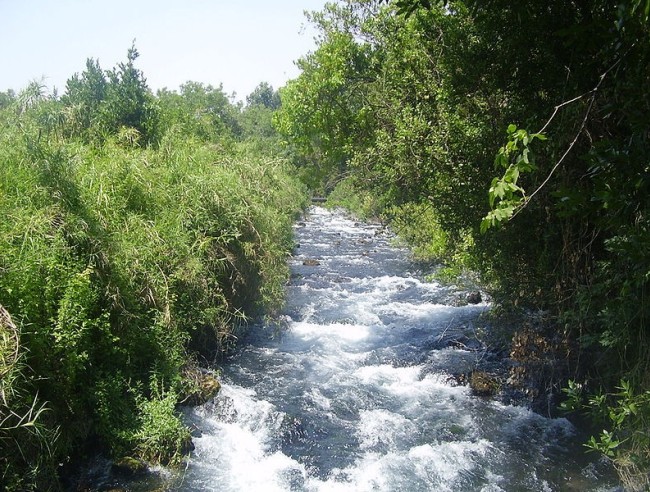
Tel Dan is a national park, located at the source of the Jordan River—one of the most beautiful places in Israel. Its temple (Iron Age, Persian and Hellenistic) and fortifications have been reconstructed such that the visitor can experience something of its ancient grandeur and beauty. After walking along the rushing waters of the Dan River, and cooling your feet in the Ein Leshem spring, walk up to the archaeological site—maybe go to the High Place—find a shady spot, and open your Tanach.
TheTorah.com is a 501(c)(3) nonprofit organization.
We rely on the support of readers like you. Please support us.
Published
June 8, 2026
|
Last Updated
October 8, 2026
Previous in the Series
Next in the Series
Before you continue...
Thank you to all our readers who offered their year-end support.
Please help TheTorah.com get off to a strong start in 2025.
Footnotes


Dr. David llan was the director of the Nelson Glueck School of Biblical Archaeology at the Hebrew Union College in Jerusalem from 2003 to 2025 and directed the excavations at Tel Dan in northern Israel from 2005 to 2022. His BA and MA degrees are from Hebrew University, and his PhD is from Tel Aviv University (supervisor Prof. Israel Finkelstein). Aside from the Tel Dan excavations, David has excavated at Tel Arad and Tel Megiddo. David still teaches at Hebrew Union College and has taught at Tel Aviv University, Hebrew University and at Johns Hopkins University. He specializes in mortuary archaeology, religion and ritual in the Chalcolithic period, the Middle Bronze Age and the early Iron Age of the southern Levant. He has authored or co-authored four books and more than 60 peer-reviewed papers. He is the editor of the journal NGSBA Archaeology.
Essays on Related Topics: