


 Edit article
Series
Benjamin: A Wolf, but in a Good Way


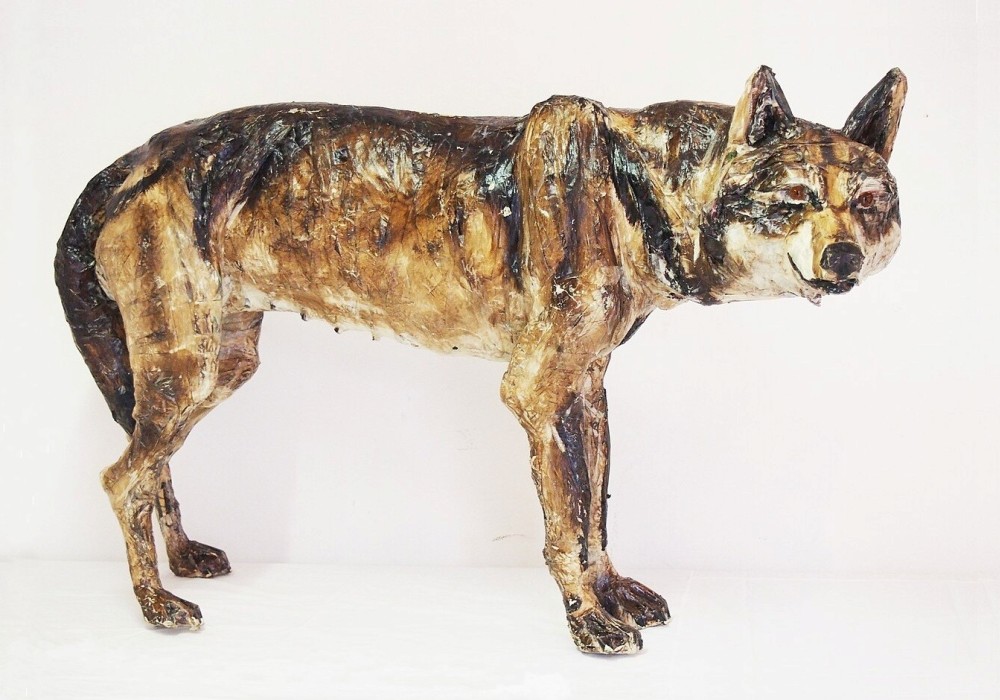
She-Wolf (Mixed media: newspaper clippings on the dispersion of wolves, masking tape, iron frame, and bitumen) Alvetti Alberto, 2017. Wikimedia.
Throughout the Bible, wolf imagery is generally negative, focusing on their ruthless, predatory nature and their tendency to target defenseless populations.[1] For example, Ezekiel likens Judah’s corrupt officials who mistreat their people to wolves:
יחזקאל כב:כז שָׂרֶיהָ בְקִרְבָּהּ כִּזְאֵבִים טֹרְפֵי טָרֶף לִשְׁפׇּךְ־דָּם לְאַבֵּד נְפָשׁוֹת לְמַעַן בְּצֹעַ בָּצַע.
Ezek 22:27 Her officials are like wolves rending prey in her midst; they shed blood and destroy lives to win ill-gotten gain.[2]
Similarly, Zephaniah likens Jerusalem’s corrupt judges to them:
צפניה ג:ג שָׂרֶיהָ בְקִרְבָּהּ אֲרָיוֹת שֹׁאֲגִים שֹׁפְטֶיהָ זְאֵבֵי עֶרֶב לֹא גָרְמוּ לַבֹּקֶר.
Zeph 3:3 The officials within her are roaring lions; her judges are wolves of the steppe; they leave no bone until morning.[3]
The vision of the wolf living peacefully beside the lamb in Isaiah’s prophecies (11:6 and 65:25) anticipates a reversal in the messianic future of the wolf’s predatory nature, but that only underscores the threat emanating from the wolf at the time when these prophecies were uttered.[4]
Benjamin the Wolf
In Jacob’s final words to his sons (Genesis 49), a mix of blessings (v. 8-12), chastisements (v. 3-7), and pronouncements about their tribal futures, animal imagery is used to characterize their tribal traits:[5] Judah is a young lion (v. 9-10), Issachar a strong donkey (v. 14), Dan a snake (v. 17), and Naphtali a doe (v. 21).[6] Jacob ends with Benjamin, his youngest son:
בראשית מט:כז בִּנְיָמִין זְאֵב יִטְרָף בַּבֹּקֶר יֹאכַל עַד וְלָעֶרֶב יְחַלֵּק שָׁלָל.
Gen 49:27 Benjamin is a ravenous wolf; in the morning he consumes the foe, and in the evening he divides the spoil.
Many interpreters have understood the wolf metaphor as a negative reference to individuals (e.g., Saul)[7] or incidents associated with the tribe of Benjamin. For example, Rashi (R. Shlomo Yitzhaki, 1040-1105) comments:
רשי על בראשית מט:כז זְאֵב הוּא אֲשֶׁר יִטְרָף; נִבָּא עַל שֶׁיִּהְיוּ עֲתִידִין לִהְיוֹת חַטְפָנִין, וַחֲטַפְתֶּם לָכֶם אִישׁ אִשְׁתּוֹ בְּפִלֶגֶשׁ בְּגִבְעָה (שופטים כא).
Rashi on Gen 49:27 He is a wolf that tears; He (Jacob) prophesied that they (Benjamin’s descendants) will be rapacious in the future; “and catch you every man his wife” (Judges 21:21), in the story of the concubine of Gibeah.[8]
But how was likening of Benjamin to a wolf understood in its original (social) setting? Could there be a different, perhaps even positive, association with wolves reflected here?
Wolf Imagery in the Ancient Near East
In Mesopotamian literature in general, just as in the Bible, the wolf is perceived negatively, as a ravenous, intimidating predator, living outside the civilized world and posing a constant threat to it.[9]
In the Gilgamesh epic (late 2nd millennium B.C.E.), when the god Ea reprimands another god, Enlil, for bringing a flood to destroy humankind, wolves are paired with lions as lethal animals that decimate populations (cf. Jer 5:6; Zech 3:3 for the same pairing):
Instead of the Deluge you caused, a lion could arise to diminish the people! Instead of the Deluge you caused, a wolf could arise to diminish the people![10]
Earlier in the Gilgamesh epic, the goddess Ishtar is described as callously punishing her shepherd lover by turning him into a wolf, reversing his nature from protector of the herds to one they must be protected against:
You struck him and turned him into a wolf,
so his own shepherd boys drive him away,
and his dogs take bites at his thighs.[11]
Babylonian Proverbs
A collection of proverbial sayings dating to the height of the Old Babylonian period, the 18th century B.C.E., negatively characterizes the wolf:
lines 9-11 Did you not see, in the (time of) becoming fat(?) during the night, (how) the wolf is swollen up because of hunger in (his) belly? He constantly acts like a shibbu-snake, like a snare.
lines 12-13 For whom, after all, does the wolf feed a wife? Has (his) son (ever) built a house and become great with respect to possessions?
lines 14-18 At his hunger, who could possibly match him as to his hand? If he is not sated with flesh, he knows to lurk. Against his hunger . . . (could) an army of shepherd(s) (do anything in the shelter)?
lines 19-20 He roams about all night long, he is too hard for you (to catch).[12]
The wolf is portrayed here as active at night, when people are at rest, and insatiably rapacious, which makes him a dangerous enemy of human civilization.
Mari Letters
Another negative wolf reference is found in a letter sent by an official to King Zimri-Lim of Mari[13] around the beginning of his second regnal year in the spring of 1765 B.C.E. The official, discussing a revolt by the Yaminite tribal union (Maru Yamina), complains about the residents of the town of Mishlan:
lines 10-13 As for the people of Mishlan – (they are) like a wolf’s cub (whom) one [ra]ises and (then) lets loose [on the shee]p.[14]
The image of raising a wolf’s cub only to have it prey on one’s sheep seems to be a proverb, expressing the same message as later Aesop’s fable The Farmer and the Viper, which famously ends with the moral: “Kindness is thrown away upon the evil.”[15]
A Neutral View of Wolves
Yet another letter from Mari around the same time offers a neutral view of the wolf and its hunting activities. It was sent by Idin-Annu, the governor of a district on the Middle Euphrates, to king Zimri-Lim sometime in his first regnal year (1766/5 B.C.E).
This letter describes an attack carried out by members of the Uprapu tribe (also part of the Yaminite tribal union) against the Suteans – a nomadic population that lived on the fringes of the Syrian desert,[16] who were herding their sheep.[17]
While the Suteans were distracted by the brawl that erupted among them while they were dividing their sheep, the sheep were apparently left unattended, presenting an opportunity:
lines 17-24 They (the Uprapeans) plundered those [shee]p [l]ike a wolf: everyone took what he could and went off straight away. Yahil-pi-el, of an Uprapean clan, was the raid’s chief, the one who inflamed the assault. It is about ten thousand sheep that they took away.[18]
Similarly to the wolf metaphor in Jacob’s blessing to Benjamin, the letter of Idin-Annu also describes dividing the spoils between the attackers, even if that action was carried out in a rather spontaneous fashion: “Everyone took what he could and went off straight away.”
The comparison of the attacking Uprapeans, also referred to as Ḫana, “nomads,”[19] to a wolf is made as a matter of fact, without either negative or positive overtones being attached to it. Idin-Annu likens the nomadic raiders to wolves doing what they naturally do, without passing judgement.[20]
We only find an explicitly positive attitude towards wolves in Arab tribal lore from a later period.[21]
The Wolf in Arabian Tribal Lore
A poem by ‘Amir ibn al-Tufayl, a chieftain of the Banu ‘Amir tribe of Arabia and a staunch enemy of the prophet Muhammad, around 630 C.E. (the first century of Islam) describes a dawn attack on the enemies of his tribe:
We came upon their host in the morning, and they were like a flock of sheep on whom falls the ravening wolf;
And there were left there on ground of them Amr, and Amr, and Aswad – the fighters are my witness that I speak true!
We fell on them with white steel ground to keenness: we cut them to pieces therewith until they were destroyed;
And we carried off their women on the saddles behind us, with their cheeks bleeding, torn in anguish by their nails.[22]
The story of the siege of Kamarjah in 728 C.E. is recorded by Abu Ja‘far Muhammad ibn Jarir al-Tabari in History of Prophets and Kings (Tarikh al-rusul w-al-muluk). He tells of how Kamarjah, a fortress in Transoxania (in central Asia), was guarded by an Arab garrison when the Turkic tribes, still not converted to Islam, attacked the Muslim strongholds in the region.
The Turkic leader sent an emissary to the walls of Kamarjah with an offer to the Arabs defending the town: if they opened the gates and joined the Turkic army, they would be treated as regular soldiers and receive a significant pay raise. The Arab negotiator responded to his offer with scorn:
This is a matter that will not come together. How can the Arabs, who are wolves, be with the Turks, who are sheep?[23]
A final example comes from an oral poem composed by Husayn bin ‘Id al-Tayaha in northeastern Sinai in the late 20th century C.E. It bewails the conditions of the Bedouin under the rule of the modern state, when the proud nomads are impoverished and cannot oppose the confident posture of sedentary dwellers:
What times! The ram accosts the wolf, puffs up and preens himself,
“What use” (says the ram), “have I for you? Please leave me to myself!”
Yet, even when the Bedouin “wolf” has to acknowledge the self-contained position of the sedentary “ram,” he remains a predator ready to strike at the latter if and when an opportunity offers itself.[24]
The Wolf’s Image Among Nomadic Populations
The texts surveyed above span a broad period, from the 7th century C.E. (the Arab conquests) down to the late 20th century C.E. They have in common a social background in which tribal affiliation, determined by a man’s descent – real or perceived – held paramount importance.[25] Much of Arabia’s population at the time of the emergence of Islam consisted of Bedouin nomads. While towns and large cities, such as Mecca and Yathrib (later Medina), also played a role in identity, tribal affiliation remained important for urban dwellers.[26]
The nomadic way of life, characterized by tribal organization (even though the latter was not exclusive to it), was based economically on the raising of flocks. In such conditions, plundering the flocks that belonged to other groups – trading caravans, other nomadic populations, or sedentary villagers and townsmen –provided an important source of revenue. Hence, raids by one tribal group on another were tolerated or even glorified.
This can explain the positive image of the preying wolf in these sources. The wolf metaphor was especially suitable for attacks carried out by members of a tribe, since the wolf is the top predator in the Near East that hunts in packs – in contrast to the lion, which is mostly a lone hunter.
Benjamin the Wolf: A Positive Association
The composition history of Genesis 49 is complex. While the text itself is relatively late, it incorporates earlier material. To be sure, the beginning of Jacob’s farewell address (Gen 49:2-27) presumes the existence of monarchy in Judah – a tribe that is promised the royal scepter and is compared to a preying lion (Gen 49:9-10), in line with the common use of the leonine metaphor for gods and kings in the ancient Near East.[27]
Yet the words addressed to Benjamin (Gen 49:27) may point to a time when parts of the ancient Israelite population still lived as nomads or semi-nomads, raising flocks of their own and waging surprise attacks on the flocks and other belongings of the neighboring populations in order to enrich themselves.[28] In historical terms, this might correspond to Iron Age I (the 12th-11th centuries B.C.E), and more likely to the earlier part of that period.[29] Within such a context, the comparison of the tribe to a wolf could reflect a positive association, similar to the view of this predator in Arab sources.
The negative image of the wolf in the biblical prophetic texts, however, reflect the reality of the kingdom of Judah shortly before the Babylonian exile of 586 B.C.E.[30] This fits the perceptions of a sedentary population living in cities and villages administered by state officials.
Dedicated to Kevin Wolf, with gratitude for his friendship —David D. Steinberg
TheTorah.com is a 501(c)(3) nonprofit organization.
We rely on the support of readers like you. Please support us.
Published
December 30, 2025
|
Last Updated
October 4, 2026
Previous in the Series
Next in the Series
Before you continue...
Thank you to all our readers who offered their year-end support.
Please help TheTorah.com get off to a strong start in 2025.
Footnotes


Dr. Yigal Bloch is a curator at the Bible Lands Museum Jerusalem. He holds an M.A. and Ph.D. in Jewish History, with specialization in the biblical period, from the Hebrew University of Jerusalem. Bloch is the author of Alphabet Scribes in the Land of Cuneiform: Sēpiru Professionals in Mesopotamia in the Neo-Babylonian and Achaemenid Periods (Gorgias Press, 2018), and co-author (with Prof. Nathan Wasserman) of The Amorites: Mesopotamia in the Early Second Millennium BCE (Carmel, 2019 [Hebrew]).
Essays on Related Topics: