

 Edit article
Series
Gemstones of the Gods: The Symbolism of the High Priest’s Breastpiece


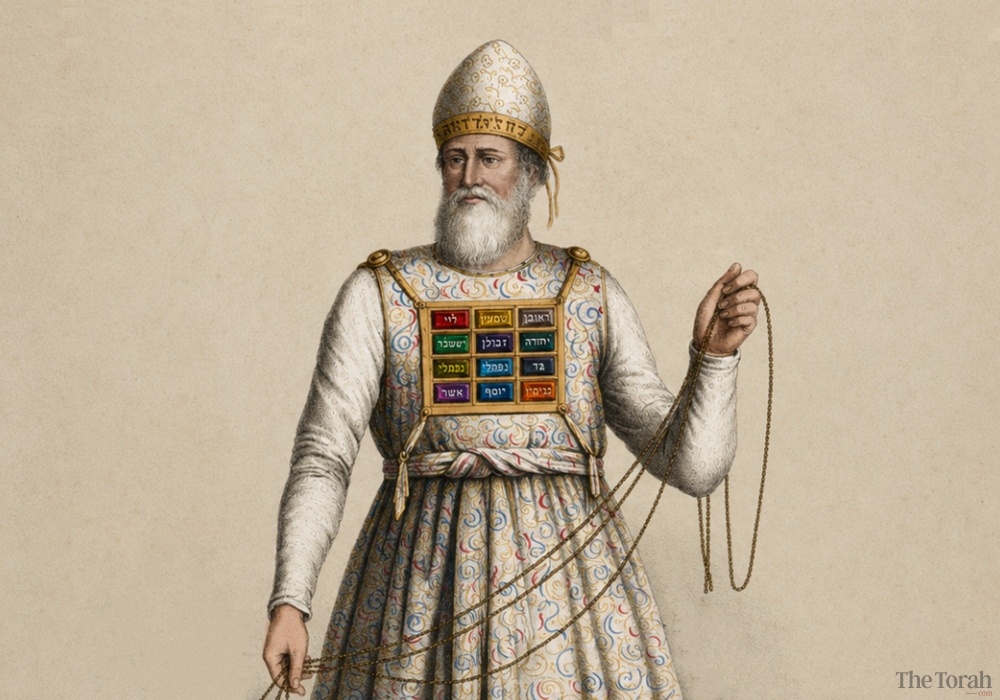
The high priest in his robes (colored), lithographer Augustus Köllner; printer Henry Camp, 1840-1860. LOC
YHWH’s Jewel Garden and the High Priest’s Breastpiece
Ezekiel begins his dirge over the King of Tyre by painting a picture of Tyre as a beautiful city, using the image of Eden, the גַּן אֱלֹהִים, gan elohim, “garden of God,”[1] depicted as a luxurious gem garden:
יחזקאל כח:יג בְּעֵדֶן גַּן אֱלֹהִים הָיִיתָ כׇּל אֶבֶן יְקָרָה מְסֻכָתֶךָ אֹדֶם פִּטְדָה וְיָהֲלֹם תַּרְשִׁישׁ שֹׁהַם וְיָשְׁפֵה סַפִּיר נֹפֶךְ וּבָרְקַת וְזָהָב מְלֶאכֶת תֻּפֶּיךָ וּנְקָבֶיךָ בָּךְ בְּיוֹם הִבָּרַאֲךָ כּוֹנָנוּ.
Ezek 28:13 You were in Eden, the garden of God; every precious stone was your adornment: carnelian, chrysolite, and milky quartz; beryl, amethyst, and jasper; lapis lazuli, turquoise, and emerald; and gold beautifully wrought for you, mined for you, prepared the day you were created.[2]
Notably, all nine of the gemstones in Ezekiel’s garden of the gods are on the high priest’s breastpiece, which is set with twelve precious stones arranged in four rows with three stones in each row to represent the twelve tribes:
שמות כח:יז וּמִלֵּאתָ בוֹ מִלֻּאַת אֶבֶן אַרְבָּעָה טוּרִים אָבֶן טוּר אֹדֶם פִּטְדָה וּבָרֶקֶת הַטּוּר הָאֶחָד. כח:יח וְהַטּוּר הַשֵּׁנִי נֹפֶךְ סַפִּיר וְיָהֲלֹם. כח:יט וְהַטּוּר הַשְּׁלִישִׁי לֶשֶׁם שְׁבוֹ וְאַחְלָמָה. כח:יכ וְהַטּוּר הָרְבִיעִי תַּרְשִׁישׁ וְשֹׁהַם וְיָשְׁפֵה מְשֻׁבָּצִים זָהָב יִהְיוּ בְּמִלּוּאֹתָם.
Exod 28:17 Set in it mounted stones, in four rows of stones. The first row shall be a row of carnelian, chrysolite, and emerald; 28:18 the second row: a turquoise, a lapis lazuli, and a milky quartz; 28:19 the third row: a jacinth, an agate, and a crystal; 28:20 and the fourth row: a beryl, an amethyst, and a jasper. They shall be framed with gold in their mountings.
The LXX version of this passage has twelve gemstones, in addition to the gold and silver:
Ezek 28:13 In the delight of the orchard of God you were born; you have bound on every fine stone, carnelian and topaz and emerald and carbuncle and lapis lazuli and jasper and silver and gold and ligyrion and agate and amethyst and chrysolite and beryl and onyx. And you filled with gold your treasuries and your storerooms among you.[3] (NETS)
Moshe Greenberg suggested that the list of only nine stones in the MT was the result of a scribal error.[4] While the exact identity of each gemstone is tentative in both the Hebrew and the Greek,[5] the picture is clear: The High Priest’s breastpiece showcases the gems from YHWH’s Garden.
The Gods and Their Gemstone Trees
Ezekiel’s garden of God is part of an ancient Near Eastern literary motif depicting the regions where gods live or travel as containing trees made of (or resembling) jewels:
The Jewel Forest—The best-known example of this motif is the “Jewel Forest” described in the Epic of Gilgamesh. In his wanderings, Gilgamesh arrives at Mount Mashu, and the Scorpion-Men who guard it let him pass through the mountain’s tunnel of darkness. After a full day’s march, he arrives at a forest of trees with gemstones as fruit. While the text is fragmentary, the overall image is clear:
Gilgamesh, 9.172–190 [George trans.] He went straight, as soon as he saw them, to ... the trees of the gods. A carnelian tree was in fruit, hung with bunches of grapes, lovely to look on. A lapis lazuli tree bore foliage, in full fruit and gorgeous to gaze on …[6] cypress… cedar … its leaf-stems were of pappardilu-stone and ... Sea coral ...... sasu-stone, instead of thorns and briars [there grew] stone [or crystal] vials. He touched a carob, [it was] abashmu-stone, agate and hematite....[7]
The Kiškanu Tree—A first millennium B.C.E. incantation from the series Udug-hul,[8] contains a description of the magical kiškanu tree which grows in a garden in Eridu, a sacred land associated with the gods:
Udug-hul, tablets 13-15: 95 Incantation. A black kiškanu-tree grew in Eridu, created in a pure place, 96 the appearance of which is pure lapis, which extends into the Apsu.[9] 97 Ea’s activities in Eridu are full of abundance, 98 his dwelling is right on the Netherworld, 99 and his sanctuary is Nammu’s couch. 100 In a pure temple, which is like a forest with its extended shadows, (where) no one shall enter its midst…[10]
The incantation continues with instructions for a healing exorcism ritual which includes putting black kiškanu-wood on the patient’s head (lines 102–121).[11]
Trees of Turquoise—In the Papyrus of Ani (a manuscript of the Egyptian Book of the Dead),[12] ca. 1250 B.C.E., one of the spells, for “knowing the Easterners” (i.e., the solar deities) refers to gemstone trees:
Book of the Dead, spell 109 I know the northern gate of the sky. Its south is in the lake of waterfowl. Its north is in the waters of geese, the place in which Ra navigates by wind or by rowing. I am the whipmaster and the ship of the god. I am one who rows and does not tire in the bark of Ra. I know those two trees of turquoise between which Ra goes forth, which have grown up at the supports of shu at the gate of the lord of the east from which Ra goes forth.[13]
The message of these texts is that in the far away realms of the divine, gemstones are encountered as part of nature. We see this also in the Second Temple period Jewish text, when Enoch (ca. 2nd cent. B.C.E.) describes what he saw when visiting the divine realm:
1 Enoch 18:6 And I went toward the south—and it was burning day and night—where [there were] seven mountains of precious stones, three toward the east and three toward the south. 18:7 And those toward the east [were] of coloured stone, and one [was] of pearl and one of healing stone; and those toward the south [were] of red stone. 18:8 And the middle one reached to heaven, like the throne of the LORD, of stibium, and the top of the throne [was] of sapphire.
Enoch speaks of this again later:
1 Enoch 24:2 And I went toward it and saw seven magnificent mountains, and all were different from one another, and precious and beautiful stones, and all [were] precious and their appearance glorious and their form beautiful...
Here Enoch finds the divine throne surrounded by trees with a fragrance and beauty he had never before experienced.
A Gemstone Serpent
An especially fantastic example comes from the Egyptian text, Tale of the Shipwrecked Sailor, in which the protagonist is marooned on a desert island filled with delicious fruit, where he encounters a giant serpent, whose body was made of gemstones:
Then I heard a sound as if an approaching storm, and I assumed it was another great green sea wave. Trees were breaking, and the ground was quaking. I buried my face and found it was a serpent coming my way. The thing was over fifty huge feet long. Its beard hung down a yard. Its flesh was gilt. Its eyebrows were lapis lazuli, and it reared up in front. It bared its mouth at me, lying prone in fear and trembling, and spoke: "What brings you, little man? What brings you? If you delay to tell me what brings you to this isle, I promise that you shortly shall be ashes, become like something that has never been."[14]
Thus, divine beings live among trees and even animals who are part gem, distinguishing their world from ours in its splendor.
Etiology for the Importance of Gemstones
To explain why gemstones are so precious, the Sumerian myth, Ninurta’s Exploits, in which Ninurta determines the fate of all the stones who took part in the mythical battle between the god Ninurta and his enemy, the demon Azag. After defeating Azag, Ninurta judges each stone individually: some stones are condemned to menial and destructive work, but others are honored by being used for the construction of temples or made into objects of offering and praise.
The blessings and curses of the stone are etiological in nature, explaining how they received their distinct features. For example, the fate of the kagena stone (=hematite), which supported Ninurta in the battle, is to give it brilliance like the sun god Utu, explaining hematite’s reflective qualities.[15]
Later, Ninurta addresses a group of gemstones, blessing them for their support of him by making people bow to them, which explains why they are so prized:
Ninurta’s Exploits 497-499 528-533 My king turned to the dušia stone. He addressed the nir, the gug (cornelian) and the zagin (lapis lazuli); the amaš-pa-e, the šaba, the ḫurizum, the gug-gazi and the marḫali; the egi-zaga, the girin-ḫiliba… [and the gazi-musud stones]. Lord Ninurta, son of Enlil, fixed their destinies…
534-542 "How you came to my side, male and female in form, and in your own way! You committed no fault, and you supported me with strength. You exalted me in public. Now in my deliberation, I shall exalt you. Since you made yourself general of the assembly, you, nir, shall be chosen for syrup and for wine. You shall all be decorated with precious metal. The principal among the gods shall cause the foreign lands to prostrate themselves before you, putting their noses to the ground."
Divine Dwellings Made of Gemstones
In the case of the marḫuša stone (possibly marcasite or chlorite), Ninurta rewards it with the merit of being praised in temples.[16] This connects to yet another trope with gemstones, that they are used to build the gods’ celestial temples.
Enki’s Temple—in the Sumerian myth Enki’s Journey to Nibru (ca. 2000 B.C.E.), the god Enki is described building his temple:
Enki’s Journey to Nibru 1 In those remote days, when the fates were determined; 2 in a year when An brought about abundance, 3 and people broke through the earth like herbs and plants – 4 then the lord of the Apzu, king Enki, 5 Enki, the lord who determines the fates, 6 built up his temple entirely from silver and lapis lazuli. 7 Its silver and lapis lazuli were the shining daylight. Into the shrine of the Apzu he brought joy…11 He built the temple from precious metal, decorated it with lapis lazuli, and covered it abundantly with gold.[17]
Baʿal’s Temple—In the Ugaritic Baʿal Cycle (ca. 1400–1200 B.C.E.), the goddess Anat joyfully conveys the news to her brother, the god Baʿal, that he is going to get a house:
Baal Cycle, CAT 1.4 V, 25–26 Adolescent Anat laughed; She raised her voice and declared: 26–27 “Receive the news, O Baʿal, good news I bring you! 27–29 (quoting the gods Athirat and El) ‘Let a house be given you like your brothers’, a court, like your kin’s. 29–31 Call a caravan into your house, wares inside your palace. 31–33 Let the mountains bring you abundant silver, the hills, the choicest gold. 33–35 And build the house of silver and gold, The house of purest lapis lazuli.’” Mightiest Baʿal rejoiced.[18]
YHWH Surrounded by Lapis Lazuli—Lapis is also the what the Israelites who encounter God on Mount Sinai see below the divinity’s feet—in other words, the paving stones of the divine temple:
שמות כד:טוַיַּעַל מֹשֶׁה וְאַהֲרֹן נָדָב וַאֲבִיהוּא וְשִׁבְעִים מִזִּקְנֵי יִשְׂרָאֵל. כד:יוַיִּרְאוּ אֵת אֱלֹהֵי יִשְׂרָאֵל וְתַחַת רַגְלָיו כְּמַעֲשֵׂה לִבְנַת הַסַּפִּיר וּכְעֶצֶם הַשָּׁמַיִם לָטֹהַר.
Exod 24:9 Then Moses and Aaron, Nadab and Abihu, and seventy elders of Israel ascended; 24:10 and they saw the God of Israel—under whose feet was the likeness of a pavement of lapis lazuli,[19] like the very sky for purity.
Ezekiel too, in his encounter with the divine chariot, describes seeing lapis, except this time above the deity as opposed to below:
יחזקאל א:כווּמִמַּעַל לָרָקִיעַ אֲשֶׁר עַל רֹאשָׁם כְּמַרְאֵה אֶבֶן סַפִּיר דְּמוּת כִּסֵּא וְעַל דְּמוּת הַכִּסֵּא דְּמוּת כְּמַרְאֵה אָדָם עָלָיו מִלְמָעְלָה.
Ezek 1:26 Above the expanse over their heads was the semblance of a throne, in appearance like lapis; and on top, upon this semblance of a throne, there was the semblance of a human form.[20]
In sum, Ezekiel’s garden of god is of a piece with ancient Near Eastern mythological tropes about the gods living among gemstones, which helps clarify the symbolism in the High Priest’s breastpiece.
Dressed to Impress: Precious Gemstones and Priestly Garments
Just as sacred space needed to be differentiated from secular, the officiants of ancient Near Eastern sanctuaries had to be distinguishable from the other the worshippers. Thus, throughout the ancient Near East, officiates dressed lavishly.
For example, a relief from the palace of the Assyrian king Ashurnasirpal II (r. 883–859 B.C.E.) depicts a king (left) receiving an object from an attendant (right), a standard depiction of courtly ritual. The official is richly dressed, with jewelry including rosette bracelets, armbands, a collar of beads, probably of semiprecious stone, pendant earrings, and a crescent-shaped pectoral. At the ends of his short sleeves are bands of incised plant motifs representing embroidery; another incised band below the waist shows further plants but also birds, possibly ostriches. He carries a sword whose scabbard, like the king's, ends in the image of two roaring lions.
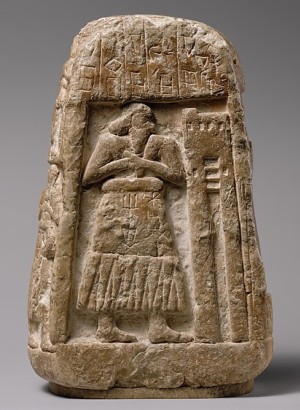
Sumerian priests of their deities also wore elaborate robes. For example, Ushumgal, a pab-šeš priest of the god Shara, is depicted in elaborate uniform, hands clasped at the chest in a gesture of reverence or attention, wearing a fringed skirt (a kaunakes-style garment), a marker of elite or priestly status.
.jpg?alt=media&token=49bb2ab9-87ef-4b40-bd90-c30fb88c2202) |
 |
|
The king receives something from an attendant. From the Northwest Palace of Ashurnasirpal II at Nimrud. Metropolitan Museum of Art Accession # 32.143.4. (PD) |
Carving of Ushumgal, a priest of Shara (2900–2700 B.C.E.). Sumerian. Metropolitan Museum of Art. Accession Number 58.29. (PD) |
The Israelite priesthood also had to have fancy clothes, especially the high priest, who dressed in the most lavish attire, including an ephod and breastpiece studded with precious gems:
שמות כח:דוְאֵלֶּה הַבְּגָדִים אֲשֶׁר יַעֲשׂוּ חֹשֶׁן וְאֵפוֹד וּמְעִיל וּכְתֹנֶת תַּשְׁבֵּץ מִצְנֶפֶת וְאַבְנֵט וְעָשׂוּ בִגְדֵי קֹדֶשׁ לְאַהֲרֹן אָחִיךָ וּלְבָנָיו לְכַהֲנוֹ לִי.
Exod 28:4 These are the vestments they are to make: a breastpiece, an ephod,[21] a robe, a fringed tunic, a headdress, and a sash. They shall make those sacral vestments for your brother Aaron and his sons, for priestly service to Me.
The high priest was to wear this full uniform, wearing gemstones as part of his clothing, specifically when entering the Tabernacle, YHWH’s abode, to offer service in the presence of the divine:
שמות כח:כטוְנָשָׂא אַהֲרֹן אֶת שְׁמוֹת בְּנֵי יִשְׂרָאֵל בְּחֹשֶׁן הַמִּשְׁפָּט עַל לִבּוֹ בְּבֹאוֹ אֶל הַקֹּדֶשׁ לְזִכָּרֹן לִפְנֵי יְ־הֹוָה תָּמִיד.
Exod 28:29 Aaron shall carry the names of the sons of Israel on the breastpiece of decision over his heart, when he enters the sanctuary, for remembrance before YHWH at all times.
As noted by Søren Lorenzen in his “Colors of Holiness: Clothing the High Priest to Match the Tabernacle,” (TheTorah 2023), the color scheme of the high priest’s clothing makes him a match for the divine world. This is especially true when it comes to his wearing gemstones, which functions as a symbolic way of presenting the high priest as a natural member of the divine world.
At the same time, the narrative depiction of the high priest with a breastpiece covered in gemstones emphasizes the great importance and dignity of the Israelite high priest, which is part of the Torah’s presentation of YHWH in general, as a being that ultimately surpass all foreign deities.
TheTorah.com is a 501(c)(3) nonprofit organization.
We rely on the support of readers like you. Please support us.
Published
August 6, 2026
|
Last Updated
September 16, 2026
Previous in the Series
Next in the Series
Before you continue...
Thank you to all our readers who offered their year-end support.
Please help TheTorah.com get off to a strong start in 2025.
Footnotes


Prof. Ilona N. Rashkow is Professor (Emerita) at the State University of New York at Stony Brook and teaches regularly at New York University. She holds a Ph.D. in Comparative Literature from the University of Maryland and she is the author of Taboo or Not Taboo: The Hebrew Bible and Human Sexuality (Fortress, 2000); The Phallacy of Genesis: A Feminist-Psychoanalytic Approach (Westminster John Knox, 1993); Upon the Dark Places: Sexism and Anti-Semitism in English Renaissance Biblical Translation (Almond, 1990).
Essays on Related Topics: