


 Edit article
Series
YHWH’s Attributes: What Moses Learns


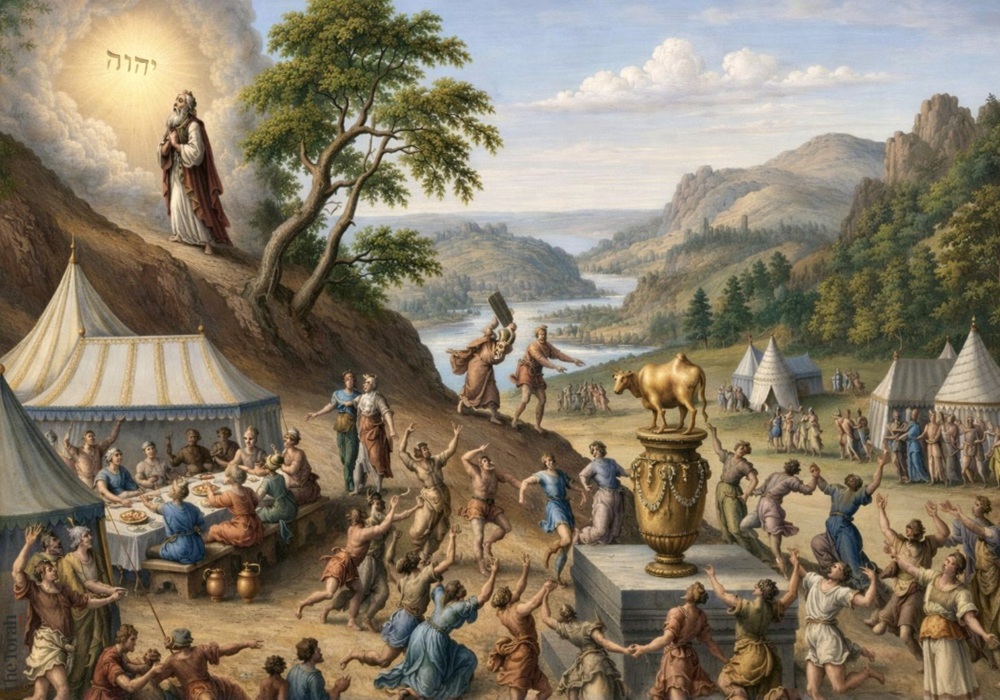
Moses Receives the Tablets as Israel Worships the Golden Calf (adapted), Pieter van der Borcht, ca. 1590. Rijk Museum
Moses, at the burning bush, requests that God reveal to him the divine name, but God is reluctant. God first responds אֶהְיֶה אֲשֶׁר אֶהְיֶה “ehyeh asher ehyeh” (Exod 3:14), generally translated as “I am what I am,”[1] which is not a name at all, or at least, not the one Moses needs to establish his credentials with the Israelites.[2]
Moses does not respond to this answer,[3] so God speaks again (וַיֹּאמֶר “and he said”). When this second response is met by Moses’ further silence, God is “forced” to speak a third time (וַיֹּאמֶר עוֹד “and he said further”), when God finally complies and reveals the name YHWH (v. 15).
God Resists Explaining God’s Ways
This pattern of initial divine reluctance to fulfil Moses’ request, followed by a subsequent acceptance, is repeated in the aftermath of the Golden Calf episode, when Moses conducts a delicate negotiation in an attempt to restore God’s relationship with the people.[4]
Moses asks to understand God’s derachim “ways,” presumably to learn how to ensure that God will continue to remain with the people:
שמות לג:יג וְעַתָּה אִם נָא מָצָאתִי חֵן בְּעֵינֶיךָ הוֹדִעֵנִי נָא אֶת דְּרָכֶךָ וְאֵדָעֲךָ לְמַעַן אֶמְצָא חֵן בְּעֵינֶיךָ וּרְאֵה כִּי עַמְּךָ הַגּוֹי הַזֶּה.
Exod 33:13 “And now,[5] if indeed I have found favor in Your eyes, please teach me Your ways, that I may know You so that I may continue to find favor in Your eyes, and look, this nation is Your people!”[6]
Moses repeats the phrase “I have found favor in Your eyes,”[7] emphasizing the unique relationship he has experienced with YHWH, who, instead of complying with Moses’ request, responds by addressing Moses in the singular, that YHWH will be with him, personally:
שמות לג:יד וַיֹּאמַר פָּנַי יֵלֵכוּ וַהֲנִחֹתִי לָךְ.
Exod 33:14 And He said, “My face will go with you and I will give you rest.”
After Moses’ repeated use of חן (ḥen) “favor” (v. 13), YHWH’s use of the verb נוח (noaḥ) “to rest”[8]—an inversion of consonants—suggests a deliberate word play.[9] Perhaps God is testing Moses’ resolve to remain with the people but Moses repeats the seriousness and urgency of his request, in the plural.
Extending YHWH’s Favor to the Israelites
As if smuggling the people into his special relationship with God, Moses insists that he cannot really know that YHWH is with him if YHWH is not at the same time, among the people he leads:
שמות לג:טו וַיֹּאמֶר אֵלָיו אִם אֵין פָּנֶיךָ הֹלְכִים אַל תַּעֲלֵנוּ מִזֶּה. לג:טז וּבַמֶּה יִוָּדַע אֵפוֹא כִּי מָצָאתִי חֵן בְּעֵינֶיךָ אֲנִי וְעַמֶּךָ הֲלוֹא בְּלֶכְתְּךָ עִמָּנוּ וְנִפְלִינוּ אֲנִי וְעַמְּךָ מִכׇּל הָעָם אֲשֶׁר עַל פְּנֵי הָאֲדָמָה.
Exod 33:15 But (Moses) said to Him: “If Your presence does not go with us, do not take us up from this place. 33:16 How will it be known that I have found favor in Your eyes, I and Your people, surely it is by Your going with us that I, and Your people, are distinguished from all the people on the face of the earth.”
Moses here emphasizes that the favor must extend to the people, and YHWH agrees to Moses’ request, even making use of Moses’ favored expression, and referring back to how YHWH taught Moses the divine name (at the burning bush):
שמות לג:יז וַיֹּאמֶר יְ־הֹוָה אֶל מֹשֶׁה גַּם אֶת הַדָּבָר הַזֶּה אֲשֶׁר דִּבַּרְתָּ אֶעֱשֶׂה כִּי מָצָאתָ חֵן בְּעֵינַי וָאֵדָעֲךָ בְּשֵׁם.
Exod 33:17 And YHWH said to Moses: “Also this word that you have just said I will do, because you have found favor in My eyes and I have known you by name.”
Seeing YHWH’s Kavod
Emboldened by a positive response, Moses further asks to be shown YHWH’s kavod— “Glory” or “Presence”[10]—implying that YHWH will continue to govern in person His difficult people:
שמות לג:יח וַיֹּאמַר הַרְאֵנִי נָא אֶת כְּבֹדֶךָ.
Exod 33:18 Then (Moses) said: “Show me your Glory (kavod).”
Moses’ request that God “show me” (the causative hiphil of the verb ר.א.ה/י “to see”) the divine kavod suggests that Moses wants a theophany as dramatic and powerful as at Sinai, in order to convince the people of God’s continuing presence amongst them.[11]
YHWH’s response, however, is first to switch kavod for tov “goodness” and offers to pronounce the divine name:
שמות לג:יט וַיֹּאמֶר אֲנִי אַעֲבִיר כׇּל טוּבִי עַל פָּנֶיךָ וְקָרָאתִי בְשֵׁם יְ־הֹוָה לְפָנֶיךָ וְחַנֹּתִי אֶת אֲשֶׁר אָחֹן וְרִחַמְתִּי אֶת אֲשֶׁר אֲרַחֵם.
Exod 33:19 And He said: “I will pass all my goodness before your face and call out in the name of YHWH before you. And I will be gracious to whom I will be gracious and compassionate to whom I will be compassionate.”
YHWH offers here a description of the divine “ways”—Moses previous request—but only gives a tautological description, employing once more the familiar ambiguous construction using the relative pronoun asher. The effective meaning this time is that “I alone determine when, and to whom, I show grace or compassion.”
This leaves Moses to face God’s apparent arbitrariness with no means of influencing God. But Moses wants a more precise awareness of the circumstances in which God is willing to act with compassion and grace in order to ensure the survival of the Israelites. God should spell out the basis on which these divine qualities operate. Fortunately, as at the burning bush, the initial divine reluctance to fulfil Moses’ request and reveal something that uniquely belongs to God, is followed by a subsequent readiness to provide the answer, but only after a break.
YHWH Declaims the Divine Attributes
In the next chapter, Moses goes atop Mount Sinai again with a second set of tablets to transcribe YHWH’s revelation. While there, YHWH descends, calls out the divine name again, and then lists the divine attributes—what tradition calls the “Thirteen Attributes”[12]—the conditions within which YHWH’s grace and compassion operate:
שמות לד:ו וַיַּעֲבֹר יְ־הֹוָה עַל פָּנָיו וַיִּקְרָא יְ־הֹוָה יְ־הֹוָה אֵל רַחוּם וְחַנּוּן אֶרֶךְ אַפַּיִם וְרַב חֶסֶד וֶאֱמֶת. לד:ז נֹצֵר חֶסֶד לָאֲלָפִים נֹשֵׂא עָוֺן וָפֶשַׁע וְחַטָּאָה וְנַקֵּה לֹא יְנַקֶּה פֹּקֵד עֲוֺן אָבוֹת עַל בָּנִים וְעַל בְּנֵי בָנִים עַל שִׁלֵּשִׁים וְעַל רִבֵּעִים.
Exod 34:6 And YHWH passed before his face and called: “YHWH / YHWH, God, compassionate and gracious, slow to anger, and great in covenant faithfulness and truth. 34:7 Showing covenant faithfulness to a thousand generations, forgiving habitual wrongdoing, rebellion and going astray but by no means holding guilty people innocent, visiting the wrongdoing of the fathers upon sons, and upon the sons’ sons to the third and fourth generation.[13]
What exactly is all this meant to communicate? What has YHWH clarified to Moses about the divine ways of forgiveness?
יְ־הֹוָה יְ־הֹוָה “YHWH / YHWH”[14]—From a theological perspective, the repetition can be read as a response to the two distinctive ways of understanding the nature of God’s love in the list that follows, which might raise the specter of a belief in a dualism that contradicts the divine oneness.[15] Liturgically, the repetition of the divine name makes for a solemn summons to attend to what follows.
אֵל “God”—both aspects of divine love—the two apparent YHWHs—are simply part of multiple dimensions of the Oneness that is God.
רַחוּם וְחַנּוּן “compassionate and gracious”—God governs human behavior with compassion, an intimate loving commitment to another person, and grace, the willingness to give generously, without expecting anything in return. This hendiadys[16] expresses a boundless, limitless, outpouring of love; God’s absolute freedom to act with compassion as listed in the initial ambiguous response to Moses’ request.
אֶרֶךְ אַפַּיִם “slow to anger”—From our limited human perspective, YHWH’s patience is, if not endless, at least long-lasting. The door remains open for a long time in which we can act to change our behavior if we come to recognize that it has distanced us from God.
וְרַב חֶסֶד וֶאֱמֶת “and/but great in faithfulness and truth”—chesed is the faithful love, loyalty and duty to another that exists within the framework of a covenant between them,[17] while emet, from the root א.מ.נ, expresses stability and reliability. It is not intellectual truth that is intended here, but rather trust and consistency, based on lived experience and confirmed over time.[18]
This second hendiadys counterbalances the previous “compassionate and gracious”, setting limits to the former’s implied boundlessness. Both sets are expressions of divine love, and together they complete the framework God has constructed in response to Moses’ request to learn the parameters within which God’s compassion will act and therefore, conditional and subject to evaluation and even sanctions if it is somehow betrayed by one of the partners.
נֹצֵר חֶסֶד לָאֲלָפִים “Showing covenant faithfulness to a thousand generations”—God’s boundless love is expressed by the promise of a thousand generations of continuing love and support from God.
נֹשֵׂא עָוֺן וָפֶשַׁע וְחַטָּאָה “forgiving habitual wrongdoing, rebellion and going astray”—YHWH expresses willingness to נֹשֵׂא “lift up, take away, or forgive” three forms of sin:
- עָוֺן—crookedness or habitual wrongdoing, as if unable to control the impulse.
- פֶשַׁע—rebellion, doing something deliberately, in full knowledge that it is forbidden (the strongest term).
- חַטָּאָה—failing to hit the mark, going temporarily astray (the weakest term).
The combination effectively defines the totality of such wrongdoing, all of which YHWH is prepared to forgive.
וְנַקֵּה לֹא יְנַקֶּה “but by no means holding guilty people innocent”—there needs to be some kind of calling to account in order to restore the former relationship, otherwise, YHWH would be breaking the terms of the covenant. YHWH may forgive a sinner, but such a person is not to be considered guiltless. And the consequences of such behavior—at least to the unrepentant[19]—is spelled out in what comes next.
פֹּקֵד עֲוֺן אָבוֹת עַל בָּנִים וְעַל בְּנֵי בָנִים עַל שִׁלֵּשִׁים וְעַל רִבֵּעִים“visiting the wrongdoing of the fathers upon sons, and upon the sons’ sons to the third and fourth generation”—The price that will be paid for habitual wrongdoing by the perpetrator is a punishment, which inevitably has consequences on all those who belong to him. The addressees here are the adult Israelite males, the patriarchs of a family, those who have legal responsibility for the behavior of Israel, individually and collectively, in this patriarchal society.[20] His power extends over all who are in his charge, as spelled out in the Decalogue’s Shabbat law:
שמות כ:י וְיוֹם הַשְּׁבִיעִי שַׁבָּת לַיְ־הֹוָה אֱלֹהֶיךָ לֹא תַעֲשֶׂה כׇל מְלָאכָה אַתָּה וּבִנְךָ וּבִתֶּךָ עַבְדְּךָ וַאֲמָתְךָ וּבְהֶמְתֶּךָ וְגֵרְךָ אֲשֶׁר בִּשְׁעָרֶיךָ.
Exod 20:10 But the seventh day shall be a day of rest of YHWH your God. You shall do no form of work, you, your son and your daughter, your servant, male or female, your cattle, and the resident alien who is within your gate.[21]
The four-generation punishment has been fashioned to be an exact counterpoint to the thousand generations promise of reward. It focuses on the ultimate existential concern of the patriarch, the growth and survival of his extended family that represents his own hopes and ambitions and therefore, it specifies the four generations he can hope to see in his lifetime.[22]
The use of the verb פ.ק.ד—generally translated with the noncommittal “visiting”—is designed to be menacing, but at the same time suitably vague as a threat. Overall, pakad expresses some kind of direct engagement with people or a particular activity, but whether the encounter is for good or for bad is left to the context.
This warning to the patriarchs in this precise context is intended to make them consider the possible consequence of their wrongdoing, and the suffering it will bring on their entire family and possessions. Removed from this context, the phrase “visiting the avon (wrongdoing or guilt) of the fathers upon the sons…” might be read literally, suggesting that it implies a direct divine attack on the first generation of the wrongdoers’ family. Presumably this kind of interpretation led Ezekiel to rebut this reading as not a true reflection of the divine way, which punishes only the guilty party:
יחזקאל יח:א וַיְהִי דְבַר יְ־הֹוָה אֵלַי לֵאמֹר. יח:ב מַה לָּכֶם אַתֶּם מֹשְׁלִים אֶת הַמָּשָׁל הַזֶּה עַל אַדְמַת יִשְׂרָאֵל לֵאמֹר אָבוֹת יֹאכְלוּ בֹסֶר וְשִׁנֵּי הַבָּנִים תִּקְהֶינָה. יח:ג חַי אָנִי נְאֻם אֲדֹנָי יְ־הֹוָה אִם יִהְיֶה לָכֶם עוֹד מְשֹׁל הַמָּשָׁל הַזֶּה בְּיִשְׂרָאֵל. יח:דהֵן כׇּל הַנְּפָשׁוֹת לִי הֵנָּה כְּנֶפֶשׁ הָאָב וּכְנֶפֶשׁ הַבֵּן לִי הֵנָּה הַנֶּפֶשׁ הַחֹטֵאת הִיא תָמוּת.
Ezek 18:1 The word of YHWH came to me: 18:2 What do you mean by quoting this proverb upon the soil of Israel, “Fathers eat sour grapes, but the sons’ teeth are blunted”? 18:3 As I live—declares the Sovereign YHWH—this proverb shall no longer be current among you in Israel. 18:4 Consider, all lives are Mine; the life of the parent and the life of the child are both Mine. Only the person who sins shall die.[23]
In this particular context, however, it is a warning to the patriarchs that the inevitable fallout from God’s punishment of them will be experienced by their entire living family, and may affect their dynastic ambitions, as expressed by the popular proverb quote above, “Fathers eat sour grapes but the sons’ teeth are blunted.” Their family will be the innocent victims of the patriarchs’ actions.
This latter view is powerfully expressed by those who suffered Nebuchadnezzar’s destruction of Jerusalem:
איכה ה:ז אֲבֹתֵינוּ חָטְאוּ (אינם) [וְאֵינָם] (אנחנו) [וַאֲנַחְנוּ] עֲוֺנֹתֵיהֶם סָבָלְנוּ.
Lam 5:7 Our fathers sinned and are no more; and we have borne their guilt.
Our passage, however, is not about divine punishment that continues through the generations long after the death of the wrongdoer,[24] but is a warning to the patriarch that the effect of his wrongdoing and punishment will have consequences, not just on himself alone but directly on all those for whom he has responsibility, who represent his extended self.[25] In contrast to the thousand generations for which YHWH’s faithfulness and trustworthiness is available, only the generations present during the patriarch’s lifetime are affected because of his persistent wrongdoing.[26]
The Theological Dimension
The power of this list of the divine attributes and the considerable extent of its influence can be measured by the number of occasions and ways in which it has been cited and reworked throughout the Bible.[27] On a practical level, the content of the Divine Attributes addresses the question posed by Moses, about how to understand, live, and survive within God’s expectations about Israel’s behavior. It is illustrated by this text through citing the two recognizable kinds of human and divine love that are placed side by side in the opening sentence of the divine attributes: compassion and grace / faithfulness and truthfulness.[28]
Behind the list of divine attributes stands the covenant between God and Israel, signed and sealed at Sinai. The episode of the Golden Calf is the first breach in the covenant by Israel. God’s reaction is to destroy them, only to be prevented by Moses’ intervention.[29] In this catastrophic situation Moses appealed to God to find another way to resolve such crises without violence. It is only then that God reveals, almost in passing, God’s great capacity for love and forgiveness (Exod 33:19) that finally found its expression in a remarkable compromise in the list of Divine Attributes.
God’s power to act with compassion and grace may be boundless, but for God to be able to have such an intimate relationship with Israel, both parties had to fulfil their commitments within the framework of the covenant. That is what is spelled out in the phrase ‘chesed ve-ʾemet, God commits to thousands of years of faithful love and loyalty, including forgiving wrongdoing, but conversely, the people must be willing to behave within the great legal structure that underpins Israel’s common existence.
The theological mystery that the covenant and the Divine Attributes seek to address, is how it is possible for the almighty God of Creation to enter into a contractual engagement with mere human beings. The biblical answer is to express it in terms of universal human experience, the reality and power of love and the familiarity of contractual obligations. God is willing, so to speak, to limit the divine power in order to engage directly and intimately with Israel.[30]
The reciprocity of love and faithful loyalty in the covenant model, between God and Israel, has found its expression throughout the centuries in expressions of theodicy, the view that Jewish suffering is regarded as an inevitable punishment for our failure to live up to God’s expectations of the people of Israel. But from the time of the biblical prophets, the Books of Job and Lamentations, to the medieval kinot, to the literature of protest about God’s absence during the Shoah, the right to challenge God is also part of the uniqueness of Jewish religious thought and experience. The great exemplar of both aspects of these traditions, as illustrated here, is the biblical Moses.
TheTorah.com is a 501(c)(3) nonprofit organization.
We rely on the support of readers like you. Please support us.
Published
August 20, 2026
|
Last Updated
September 20, 2026
Previous in the Series
Next in the Series
Before you continue...
Thank you to all our readers who offered their year-end support.
Please help TheTorah.com get off to a strong start in 2025.
Footnotes


Prof. Rabbi Jonathan Magonet is the former Principal of Leo Baeck College and Emeritus Professor of Bible. He received his Ph.D. from the University of Heidelberg and his ordination from Leo Baeck College. Magonet is the author of A Rabbi Reads the Torah, and is the editor of ‘Seder Ha-Tefillot‘ Forms of Prayer: Daily, Sabbath and Occasional Prayers as well as the journal, European Judaism. His latest book is, How Did Moses Know He Was a Hebrew?: Reading Bible Stories from Within (Hakodesh Press, 2021).
Essays on Related Topics: