


 Edit article
Series
Why Don’t Torah Scrolls Have Vowels?


Categories:
People who unroll a Torah scroll and peer inside at its letters are often struck by what is absent: the Torah’s letters are bare, with no punctuation separating sentences or clauses, and without any vowel signs to assist with pronunciation.
For many readers, the signs accompanying the Hebrew letters in standard printed editions of the Torah—both vowels (nequdot) and punctuation, or cantillation (te’amim)—are indispensable for making sense of the text. Boys and girls preparing for bar and bat mitzvahs often spend months memorizing the correct pronunciation and cantillation for the portions they will read from the Torah scroll.
Why do Torah scrolls, until today, persist in this stubbornly simple aesthetic, even to the detriment of the reader?
Vowels and Punctuation Marks: A Brief History
The vowel signs and cantillation marks familiar to us from modern printed Bibles first appear in the earliest biblical codices in our possession. Unlike a scroll, which is written on a continuous roll of parchment, papyrus, or paper, a codex is a book with pages that turn along a central axis.
Christians had readily adopted this textual technology by the 2nd century C.E.,[1] but the earliest extant Jewish codices are remarkably late, from the 9th century or later. Some scholars suggest that the Jewish avoidance of the codex and preference for the scroll was motivated by a desire to remain differentiated from Christians—though this explanation is likely incomplete (more on this later).[2]
Invariably, these earliest of Jewish books are Masoretic biblical codices:[3] They present the text with the full apparatus of vowels and cantillation marks, as well as with a large number of marginal notations, known as masorah,[4] which provide information about the rarity of a particular word in the Torah, and in some cases, other places where the same word appears.
The Masorete Ephraim, son of Rabbi Buya’a
The people responsible for adding this information to the biblical text identified themselves in colophons, short paragraphs at the beginning or end of the codex that identify the various scribes and scholars who helped to produce it.[5] For example, a colophon from a 10th century codex (fig. 1) reads:
אני אפרים בן רבי בויאעא נקדתי ומיסרתי וכללתי את התורה הזאת ובדקתי אותה כיד אלהי הטובה עלי.
I, Ephraim son of Rabbi Buya’a, vocalized, added Masorah, and decorated this Torah scroll, and I checked it thanks to God’s good help.[6]
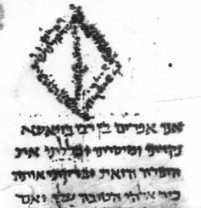
Ephraim and the other Masoretes are shrouded in some mystery. Clearly, they possessed tremendous knowledge of the biblical text, its systems of vocalization and punctuation, and they could even pinpoint where rare words appear throughout the biblical corpus, but of course, it is hardly the case that they simply invented the rules of biblical pronunciation and punctuation.
These appear, rather, to have been transmitted orally for many centuries before being committed to a written system of representation in the early Middle Ages.[7]
The Shared Islamic and Christian Context
Nick Posegay (University of Cambridge) has demonstrated that many of the Masoretes’ ideas about vowels were influenced by early medieval Christian scholars of the Syriac language and Muslim scholars of Arabic. For example, in our contemporary terminology, the shewa vowel is described as either “still” (נח), when it is not pronounced, or “moving” (נע), when it is pronounced. Posegay shows that this conceptual framework derives from the famed Arabic grammarian Sibawayhi (d. late 8th century), who portrayed vowels as providing a word with movement, as they endow the letters next to them with a vocalic force that they would not otherwise possess.[8]
Moreover, early Qur’anic codices, like their Hebrew biblical counterparts, feature graphic signs for vowels. The addition of such vowel markers to aid readers of the Qur’an seems to have occurred in roughly the same centuries as the first emergence of Masoretic codices.[9]
At the same time, Christian scholars of the Syriac [a dialect of Aramaic] Bible (known as the Peshitta) developed extensive lists and notations of unique words that appear in Christian scripture. A leading contemporary scholar of such Syriac texts labels them the “Syriac masorah,” evoking an affinity between them and the output of scholars such as Ephraim son of Buya’a.[10]
These affinities suggest that the Masoretic scholars who transformed the centuries-old oral tradition of biblical pronunciation and punctuation into a system of written representation were active participants in a culture of intensive linguistic scholarship that spanned these religions in the medieval Middle East.
Between Karaites and Rabbinic Traditionalists
One major difference, however, distinguishes Jews in their behavior towards scripture: Christians and Muslims inscribed their scripture, with complete apparatuses of punctuation and vocalization, in codices, which they then used in formal liturgical settings. But Jews, it seems, did not.
Instead, Jews continued to use scrolls when reading scripture as part of the synagogue liturgy, while codices, with all their helpful signs to assist the reader, were relegated to the domain of study. This division may now seem natural today—we study Torah in books, and we read the Torah in liturgical settings from a scroll—but in fact, it appears that some Jews were eager to supplant the Torah scroll with the biblical codex.
Some Karaite Jews—who rejected the authority of rabbinic tradition in favor of scripture alone—may have used biblical codices with punctuation and vocalization even for liturgical reading.[11] Evidently, for such Jews who prized the text of the Torah above all else, an accurate and easy reading of scripture was preferred over vestigial clinging to a traditional scroll format. Some medieval Torah scrolls (probably also produced by and for Karaites) also feature vocalization notation.[12]
The Minor Tractates: A Rabbinic Response
In this context, a group of rabbinic texts, including Masekhet Soferim (lit. “Tractate Scribes”), Masekhet Soferim II, and Masekhet Sefer Torah, were composed to confront the emergent popularity of such Torah codices.[13] These texts comprise a number of so-called “minor tractates” (masekhtot qetanot) nowadays included at the back of certain printed editions of the Babylonian Talmud.
While they are written in a linguistic register that approaches Mishnaic Hebrew, they were likely composed in the early Middle Ages, within the context of a Jewish culture absorbing the textual technologies of the codex.[14] These minor tractates demonstrate a concern with the production of liturgically-fit Torah scrolls. For example, Masekhet Soferim includes a prohibition against those paratextual notations that make the biblical codex a helpful innovation:
מסכת סופרים ב א:ד ספר המנוקד לא יקרא בו אף על פי שגורר את הנקודות שבו לא יקרא בו.
Masekhet Soferim II 1:4 One should not read from a dotted scroll; even if one scrapes off the dots one should not read from it.[15]
To be clear, this text is not proscribing the use of niqud entirely: one can still use a notated text to study the Torah. But in the context of liturgical reading, only a bare Torah scroll is appropriate.
Treating Torah Scrolls with Respect
Another rule addresses the worry that people would act with an unduly casual comportment towards a Torah scroll:
מסכת ספר תורה ג:ט לא יתננו על גבי הכסא ויתן אציליו עליו ויהא קורא בו כדברי רבי נחמיה. לא יתננו על גבי הכסא ויהא נוטלו וקורא בו כשם שקוראין בשטרות שאין נוהגין בזיון בספרים.
Masekhet Sefer Torah 3:9 One should not place it on a chair and put one’s elbows on it and read, as Rabbi Nehemiah said. One should not put it on a chair and pick it up and read it just as one reads documents, for we do not act with disrespect towards scrolls.[16]
The behavior described is rather hard to picture: the medieval Torah scrolls that are still in existence are monumental artifacts, huge documents that one cannot unfurl on-the-go or lying on a bed.[17] It seems, rather, that this text is worried about the portability of the codex.
With the increasing popularity of codices in the early medieval Islamic world, including the proliferation of Qur’anic codices and biblical codices, some rabbinic Jews were concerned that the Torah scroll might come to be treated like a portable book, too. Given the Christians’ and, more pertinently, the Karaites’ quick adoption the codex, some rabbis’ resistance to the use of codices for liturgical recitation may have been an attempt to maintain separation between these often rivalrous communities.
Moreover, as the codex made inroads as the textual technology of choice for casual reading among Jews and Muslims, perhaps certain rabbis saw an opportunity to invest the liturgical reading of the Torah with further ceremonial pomp. Rather than adopt the latest and greatest conveniences offered by the codex, the rabbinic authors of Soferim capitalized on the shift in reading culture to make the synagogue Torah service an especially memorable event—markedly different from Torah study in the Bet Midrash or relaxed reading at home. It is a testament to the success of these Torah-scroll tractates that the synagogue scrolls we know today do not contain any of the vocalization and punctuation appurtenances that were introduced via the biblical codex.
Yet the Torah scroll’s punctuation-free profile is not a simple case of tradition unfazed by new styles or technologies. The proof: Torah scrolls do display one type of ornamental indulgence on some of the letters, first added to the Torah scroll in precisely the same period that Masekhet Soferim and Sefer Torah forbid the addition of punctuation and vocalization notation.
Ornamented Letters
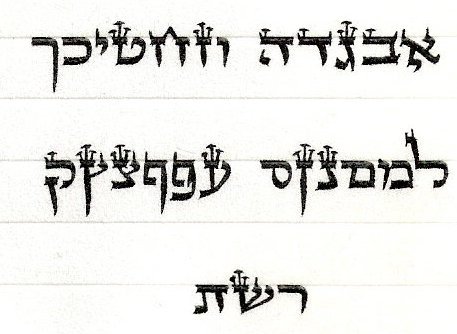 Look closely at a Torah scroll, and you will see that many of its letters seem to be decorated with curlicues and crowns that extend upwards from their extremities. The three tips of the letter shin and the top of the letter zayin, for instance, might be adorned with such flourishes.
The Torah fragments found among the Dead Sea Scrolls, the latest of which date to the 1st century C.E., do not contain these types of ornamented letters, but this decorative style had emerged by the early Middle Ages. The earliest Torah scrolls that survive, from the 7th or 8th centuries, exhibit crowns atop certain letters (shin, ayin, tet, nun, zayin, gimmel, tzadi).[18]
Rabbi Akiva’s Thorns and Crowns
Many associate the decoration of the Torah’s letters with a famous story that appears in the Babylonian Talmud:
בבלי מנחות כט: אָמַר רַב יְהוּדָה, אָמַר רַב: בְּשָׁעָה שֶׁעָלָה מֹשֶׁה לַמָּרוֹם, מְצָאוֹ לְהַקָּדוֹשׁ בָּרוּךְ הוּא שֶׁיּוֹשֵׁב וְקוֹשֵׁר כְּתָרִים לָאוֹתִיּוֹת, אָמַר לְפָנָיו: רִבּוֹנוֹ שֶׁל עוֹלָם, מִי מְעַכֵּב עַל יָדֶךָ?
b. Menahot 29b Rav Yehuda says that Rav says: When Moses ascended on High, he found the Holy One, Blessed be He, sitting and tying crowns on the letters. [Moses] said before Him: Master of the Universe, who is delaying You?
אָמַר לוֹ: אָדָם אֶחָד יֵשׁ שֶׁעָתִיד לִהְיוֹת בְּסוֹף כַּמָּה דּוֹרוֹת וַעֲקִיבָא בֶּן יוֹסֵף שְׁמוֹ, שֶׁעָתִיד לִדְרוֹשׁ עַל כׇּל קוֹץ וָקוֹץ תִּילִּין תִּילִּין שֶׁל הֲלָכוֹת.
[God] said to him: There is a man who is destined to be born after several generations, and Akiva ben Yosef is his name; he is destined to derive from each and every thorn mounds upon mounds of halakhot.
In the conventional reading of this tale (which culminates with Moses witnessing Akiva’s martyrdom), the “crowns” that God ties refer to the decorative tips on some of the letters of the Torah scroll. Rabbi Akiva’s exegetical capacities are so prolific that he can extract meaning even from the smallest decorative elements in the letters’ appearances.[19] Though assigning a date to Talmudic stories is a complicated task,[20] this story seems to give us a literary anchor for the ornamented letters in late antiquity that precedes the earliest material evidence of extant Torah scrolls from the 7th/8th centuries.
An important study by Shlomo Naeh (The Hebrew University of Jerusalem), however, has shown that the קוֹץ, “thorns” (sometimes translated “jot” or “tittle”), in the story—which are said to provide Rabbi Akiva with grist for the exegetical mill—do not refer to the ornamented tips of letters, but to the Torah’s sections, or paragraphs—parashiyot—that are divided by breaks and spaces in the scroll’s layout. This reading coheres well with representations of Rabbi Akiva’s exegetical powers in rabbinic literature: nowhere in the many traditions associated with him is the great sage celebrated for making midrash on the basis of the letters’ graphic appearance.[21]
Building upon Naeh’s argument, Yakir Paz (The Hebrew University of Jerusalem) has demonstrated that the כְּתָרִים, “crowns,” that God ties to the letters are also not the decorative flourishes. Rather, these crowns are coronices, paragraph breaks in the text that in the ancient world were represented with the image of a diadem—a crown that one ties. Rabbi Akiva’s exegetical prowess is not, then, demonstrated by his astonishing ability to derive meaning from the letters’ orthographic oddities, but from his perception of the divisions within the text—paragraph breaks, in particular—as exegetically pregnant.[22]
The Tannaitic midrash to Leviticus known as Sifra, the midrash most associated with the school of Rabbi Akiva, devotes discussion to the derivation of exegesis from the paragraph breaks in between the parashiyot of the Torah.
ספרא, דבורא דנדבה א:ט וכי מה היו הפיסקות משמשות? ליתן ריווח למשה להיתבונן בין פרשה לפרשה ובין עינין לעינין.
Sifra, Dibbura DeNedevah 1:9 What is the purpose of the paragraphs? To give space for Moses to meditate between each and every parasha and each and every topic [in the Torah].
והרי הדברין קול וחומר: ומה אם מי שהוא שומע מפי הקודשא ומדבר ברוח הקודש צריך להתבונן בין פרשה לפרשה ובין עינין לעינין, על אחת כמה וכמה הידיוט מיהידיוט.
Behold, this is an a fortiori: If the man who heard from the mouth of the Holy One and spoke with holy spirit had to meditate between each and every parasha and each and every topic [in the Torah], how much more so must a regular person![23]
In other words, this midrash credited to Rabbi Akiva and the followers of his midrashic method sees the markings between textual units as material for midrash because they reflect real pauses in Moses’ reception of revelation. This is the intellectual stance that aligns with the story in Menahot, wherein God adds the כתרים so that Rabbi Akiva will later base his derashot upon them.
Thus, since the story about Rabbi Akiva does not refer to the ornamentation atop the letters’ tips, it cannot offer us a chronological starting point for locating this scribal practice.
Sefer Tagin
Another important source for probing the origins and diffusion of the letters’ decorative elements is a text known as Sefer Tagi (sometimes called Sefer Tagin), which can be translated as the “book of tips.”[24] This text catalogs every letter in the Pentateuch that should be inscribed with ornamental strokes, detailing multiple numbers and configurations of these vertical strokes for each letter of the alphabet. For instance, Sefer Tagin instructs the reader that sometimes the top of the letter ḥet ח should be adorned with three vertical strokes, sometimes with just one, and often with none.
The earliest external attestation to Sefer Tagin is in Sa’adya Gaon’s 10th century commentary on Sefer Yetzirah.[25] It would therefore seem that this systematic work on the letters’ ornamented appearance dates to roughly the same centuries as that decisive period in which the first Masoretic codices were produced and in which certain rabbinic Jews sought to protect the Torah scroll from the infringement of notations.
Evidently, while additional notations to vocalize and punctuate the text would have drawn the Torah scroll dangerously close to the quotidian codex in the eyes of some rabbinic Jews, adding ornamental flourishes to the Torah scroll’s letters could distinguish the Torah scroll from the standard and mundane letters of the codex.
Revering the Torah Scroll
That Torah scrolls do not have any markings to help their readers punctuate or vocalize the text was not an inevitability. The avoidance of such convenient markings, bemoaned by many a bar and bat mitzvah tween, instead has its roots in the politics of Jewish society in the early medieval Middle East, as rabbinic Jews aimed to fend off the challenges to rabbinic authority mounted by Karaites, who valorized Scripture alone—whether enshrined in a scroll or codex.[26]
At that precarious moment in the history of rabbinic authority and Jewish textuality, certain rabbis sought to maintain a distinction between the Torah scroll and a codex, protecting the Torah scroll as the privileged ritual object of liturgical reading.
TheTorah.com is a 501(c)(3) nonprofit organization.
We rely on the support of readers like you. Please support us.
Published
|
Last Updated
October 3, 2026
Previous in the Series
Next in the Series
Before you continue...
Thank you to all our readers who offered their year-end support.
Please help TheTorah.com get off to a strong start in 2025.
Footnotes


Dr. Eliav Grossman is the Blaustein Postdoctoral Associate in Ancient Judaism at Yale University. He holds a PhD from the Department of Religion at Princeton University, and formerly served as a Visiting Assistant Professor at Vanderbilt University (2024–2026). He studies Jews and Judaism in late antiquity and the early Middle Ages, and his research explores rabbinic literature as it developed from the product of a narrow class of provincial elites to the dominant cultural idiom for Jews across the eastern Mediterranean.
Essays on Related Topics: