


 Edit article
Series
Proverbs in Egyptian Scribal Style


Painted limestone statue of scribe from Saqqara, Egypt, 5th Dynasty (ca. 25th–24th century B.C.E.) Wikimedia
Proverbs 22:17–23:11 and the Instruction of Amenemope
In an article from 1924 entitled “An Egyptian Source for the Proverbs of Solomon,” Berlin Egyptologist Adolf Erman demonstrated that nearly every verse of Proverbs 22:17–23:11 has a parallel in a newly edited Egyptian wisdom teaching, the Instruction of Amenemope.[1] The Instruction of Amenemope is a piece of Egyptian wisdom literature in which a scribe, Amenemope, gives his son moral and ethical instructions to ensure his success and well-being.
The poetic text, comprising a prologue and thirty chapters, was likely composed during the Ramesside period in the late second millennium B.C.E. However, the earliest extant manuscript evidence dates to the early first millennium B.C.E, while the only complete papyrus was produced in the seventh or sixth century B.C.E.
In his 1924 article, Adolf Erman not only pointed to similarities between Proverbs 22:17–23:11 and Amenemope but also suggested an emendation of the Hebrew text that has shaped research to the present day. Erman changed the wording of the Hebrew text in Proverbs 22:20 based on the Egyptian instruction.
משׁלי כב:כ הֲלֹא כָתַבְתִּי לְךָ שִׁלְשׁוֹם בְּמוֹעֵצֹת וָדָעַת.
Prov 22:20 Have I not written for you formerly (“the day before yesterday”) with advice and knowledge?[2]
Instead of שִׁלְשׁוֹם (“the day before yesterday”) provided by the ketiv of the Masoretic text, Erman read שְׁלוֹשִׁים (“thirty”) because the Instruction of Amenemope contains thirty sayings (§ 30, 27.8):[3]
משׁלי כב:כ הֲלֹא כָתַבְתִּי לְךָ שְׁלוֹשִׁים בְּמוֹעֵצֹת וָדָעַת.
Prov 22:20 Have I not written for you thirty (sayings) with advice and knowledge?[4]
This idea was taken up by Erman’s Old Testament colleague at the University of Berlin, Hugo Gressmann, who argued in an article from 1924 that the whole section of Proverbs 22:17–24:22 was composed using the Egyptian Instruction of Amenemope.
While Gressmann did not identify any additional parallels beyond those suggested by Erman, he sought to preserve the “thirty sayings” structure. Since Erman’s original section (Prov 22:17–23:11) did not contain thirty sayings, Gressmann reached this number only by extending the section to include Proverbs 23:12–24:22.[5]
Similarities and Differences
Over the more than 100 years since Erman and Gressmann, no other parallels have been found beyond the ones noted by Erman in 1924. Moreover, scholars have not only identified similarities but also characteristic differences between the two texts.[6]
On the one hand, Proverbs 22:17–23:11 contains words and motifs that clearly stem from the Egyptian instruction and cannot be explained from the terminology generally used in the book of Proverbs. This is evident, among other examples, in the motif of sitting down with an official:
Amenemope 23.13–14, 17 Do not eat in the presence of an official and then set your mouth before [him]; ...look at the plate that is before you.[7]
משׁלי כג:א כִּי תֵשֵׁב לִלְחוֹם אֶת מוֹשֵׁל בִּין תָּבִין אֶת אֲשֶׁר לְפָנֶיךָ.
Prov 23:1 When you sit down to dine with a ruler, consider well what is before you.[8]
And in the description of the “hothead” (בַּעַל אָף)—a characterization commonly associated with the unwise person in Egyptian wisdom literature but only rarely attested in the book of Proverbs:
Amenemope 11.12–13 Do not befriend the heated man, nor approach him for conversation.
משׁלי כב:כד אַל תִּתְרַע אֶת בַּעַל אָף וְאֶת אִישׁ חֵמוֹת לֹא תָבוֹא.
Prov 22:24 Do not associate with a hothead, or go about with one who is hot-tempered.
On the other hand, the Egyptian material was adapted and modified in order to suit the new Hebrew framework. In this way, for example, the goose commonly found in the Nilotic habitat became the eagle, characteristic of the mountainous landscape of the land of Israel:
Amenemope 9.15 They made themselves wings like geese and flew away into the sky.
משׁלי כג:ה התעוף [הֲתָעִיף] עֵינֶיךָ בּוֹ וְאֵינֶנּוּ כִּי עָשֹׂה יַעֲשֶׂה לּוֹ כְנָפַיִם כְּנֶשֶׁר ועיף [יָעוּף] הַשָּׁמָיִם.
Prov 23:5 You see it, then it is gone; it grows wings and, like an eagle, flies away heavenward.
Moreover, the Hebrew author referred at certain points to YHWH, as in Proverbs 22:19 (trusting in YHWH), and in 22:12 and 23:11 (YHWH as judge).
Given that nearly every saying in Proverbs 22:17–23:11 has a parallel in the Instruction of Amenemope, one can follow the majority of scholars in concluding that Proverbs 22:17–23:11 was written by using the Egyptian Instruction of Amenemope.[9] But how should one interpret not only the similarities but also the characteristic differences between the two texts?
Previous research has already noted that the order of motifs in Proverbs 22:17–23:11 does not follow the Instruction of Amenemope. Rather, the author of Proverbs appears to move selectively through the Egyptian instruction, beginning with the first chapter of Amenemope (3.9–16), then drawing on the prologue (1.5–6), before returning to the first chapter (4.4–5) and subsequently incorporating material from other sections, such as chapter 11 (11.13–14), and so forth:
Proverbs |
Amenemope |
Subject |
|
22:17–18 |
3.9–16 |
Call to Attention / retain words in belly |
|
22:19 |
no parallel |
Trust in YHWH |
|
22:20–21 |
1.5–6 |
Answering messages |
|
22:22 |
4.4–5 |
Do not rob the lowly |
|
22:23 |
no parallel |
YHWH will intervene |
|
22:24–25 |
11.13–14 |
Avoid the hot-headed |
|
22:26–27 |
no parallel |
Do not become surety |
|
22:28 |
7.12–13 |
Respect boundaries |
|
22:29 |
27.16–17 |
The skilled courtier |
|
23:1–3 |
23.13–18 |
Official dinners / social etiquette |
|
23:4–5 |
9.10–19 |
Do not strain for wealth / wings of bird |
|
23:6–8 |
14.5–8 |
Do not desire another’s food / vomiting |
|
23:9 |
22.11–12 |
Do not speak to everyone |
|
23:10–11 |
See above 7:12–13 |
Respect boundaries because God intervenes |
In the following, I will demonstrate that, rather than following earlier explanations,[10] one can explain the differences and similarities between the two texts through the literary technique by which wisdom literature was studied in ancient Egypt.
How Egyptian Scribes Studied Wisdom Texts
Crucial evidence for this literary technique is found in Papyrus Anastasi I (pBM 10247) from the Ramesside period. In this text, the author Hori writes to a scribe also named Amenemope—who is not to be confused with the author of the famous instruction—accusing him of professional incompetence:[11]
pAnastasi I 10.9–11.8 You have provided me with great secrets and have quoted to me one of Hordjedef’s maxims [ṯz.w], but you do not know whether it is good or bad. Which chapter [ḥw.t] precedes it and which one follows it? You are supposed to be an expert scribe, at the head of your colleagues having the lore of every book engraved in your heart.
Hori addresses a characteristic of Egyptian didactic literature. Wisdom instructions were studied over a long period of time. This is true for the Instruction of Hordjedef, which Hori mentions here. This instruction dates to the Old Kingdom (around 2500 B.C.E.) and was part of the scribal curriculum for centuries. It is even quoted in the Demotic Instruction of Khasheshonqy from the late Persian period.
But there is important additional information that Papyrus Anastasi I (10.9–11.8) provides: It was not just the knowledge of older sayings that was crucial but their context and meaning as well. The text mentions two different terms—ṯz and ḥw.t. The first refers to a “saying” (or a “maxim”), the latter to a “chapter.” Often, the term ṯz means the opening verse of a chapter (ḥw.t) that addresses its subject, the so-called “incipit verse.”
A Scribal Network of Quotations
The Egyptian wisdom tradition bases itself on a network of quotations. Individual sayings from older instructions were used by scribes when composing their own pieces of wisdom literature. Hence, teachings such as the instructions of Hordjedef, Ptahhotep, and Any were used as part of the scribal curriculum in the Egyptian schools for centuries. Examples of this literary technique can be found in many wisdom instructions, including the Instruction of Amenemope:[12]
Ptahhotep |
Amenemope 23 |
|
(119) If you are among guests at the (120) table of one greater than you, (121) take what he gives as it is set before your nose; (122) look at what is before you. (dgg=k r ntj m-b3ḥ=k).
|
(13) Do not eat in the presence of an official (14) and then set your mouth before [him]; (15) if you are sated pretend to chew, (16) content yourself with your saliva), (17) look at the plate that is before you (dgg=k r p3 q3j ntj m-b3ḥ=k), (18) and let it serve your needs. |
Amenemope 23 presents a variation of Ptahhotep 119–122, shifting the focus of social etiquette. While Ptahhotep addresses a general person “who is greater,” Amenemope explicitly refers to an official.[13] This adaptation is anchored by a direct citation: the phrase “look at what is before you” (dgg=k r ntj m-b3ḥ=k) from Ptahhotep 122 is incorporated verbatim into Amenemope 23.17, with only the specific addition of the word “plate” (q3j).
The same literary technique is documented in other passages of the Instruction of Amenemope that borrow from the Teachings of Any. In short, what can be found in Egyptian wisdom literature in general and in Amenemope in particular is a system of quotations where both individual sayings (ṯz.w) and whole chapters (ḥw.t) were used by scribes when composing their own instructions.[14]
By doing so, scribes anchored themselves in a tradition of texts. They used older wisdom instructions to develop thoughts that allude to these texts, but they shaped and framed them in their own ways.
Amenemope in Egyptian Scribal Schools
Several writing boards from ancient Egypt shed light on the didactic method used in scribal schools. Most interesting are the boards and ostraca with parts of the Instruction of Amenemope.[15] An ostracon, now in the Turin Museum (Turin Suppl. 4661), preserves the title of the Instruction of Amenemope.[16] A writing board from the Louvre collection contains the first three lines of the prologue of Amenemope.
Another writing tablet that is now in the Pushkin Museum in Moscow has parts of chapters 4 and 5 (Amen 6.10–7.1). Moreover, a writing board from the Louvre (E 17173) presents an eight-line exercise in which the odd lines from the prologue and the first chapter of Amenemope (such as 1.3, 1.5, etc.) were written first and, after that, the even lines (2.4; 2.6, etc.).
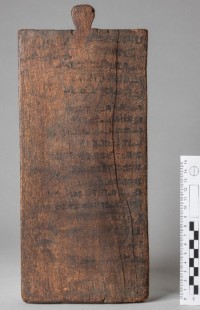
In short, what is documented in the writing boards and ostraca is a didactic method where passages from a wisdom instruction were memorized by writing down the opening verses (incipit verses, in Egyptian ṯz.w). The crucial point is that this learning of chapters and sayings from the Instruction of Amenemope was practiced over the course of several days.
A writing board from the Turin Museum (Turin Cat. 6237) contains a combination of single lines with date information. The student wrote down Amenemope 24.1 to 25.9 on this writing board in such a way that each line contains a single verse of the instruction. The text, however, is not equally distributed on the verso and recto sides of the tablet. The verso side begins with Amenemope 25.2, and, in line 9, the student jumps back to 24.1, which is continued on the recto side up to 25.1 in the correct order.
This text, written in hieratic script, preserves dates in the left margin. While the dates on the recto are somewhat obscured by the damaged papyrus, the verso offers important evidence: day 8 (verso, line 8), day 10 (verso, line 11), day 12 (verso, line 13), day 16 (verso, line 16), day 17 (verso, line 17). Apparently, the student copied the passage over a period of nearly ten days, starting in the middle of the tablet (verso) and writing down the rest of the text, after the recto side was filled, at the beginning of the verso side.[18]
By employing such a methodical approach, the student would almost automatically memorize both the broader context and specific maxims. This repetitive practice ensured that not only the general content of the chapters but also individual sayings of Amenemope became deeply ingrained in the scribe’s mind over the course of the exercise.
Reading Proverbs through Amenemope
Returning to the parallels in Proverbs 22:17-23:11, it becomes clear that the Hebrew author utilized the Instruction of Amenemope by employing the very same methods used in Egyptian scribal education. This means that the author’s engagement with the text varied: at times, they quoted a single saying (ṯz) in isolation; at others, they incorporated a saying within the context of its entire paragraph (ḥw.t). Furthermore, the author occasionally drew upon specific subjects or keywords from Amenemope, weaving them—in accordance with Egyptian wisdom tradition—into their own original reflections.
In other words, the method by which Egyptian wisdom literature was studied among scribal schools is nothing less than the key to understanding the similarities and differences between Proverbs 22:17–23:11 and the Instruction of Amenemope. The passage in Proverbs is neither a translation of the Egyptian text nor an unsystematic borrowing; rather, it is a deliberate adaptation that follows the principles by which wisdom literature was studied in Egyptian schools and utilized by scribes when composing their own instructions.
Furthermore, this literary technique can also explain the literary evidence presented above:
Proverbs |
Amenemope |
Subject |
|
22:17–18 |
3.9–16 (beginning of ch. 1) |
Call to attention / retain words in belly |
|
22:19 |
no parallel |
Trust in YHWH |
|
22:20–21 |
1.5–6 (beginning of prologue) |
Answering messages |
|
22:22 |
4.4–5 (beginning of ch. 2) |
Do not rob the lowly |
|
22:23 |
no parallel |
YHWH will intervene |
|
22:24–25 |
11.13–14 (beginning of ch. 9, compare 13.8–9; end of ch. 9) |
Avoid the hot-headed |
|
22:26–27 |
no parallel |
Do not become surety |
|
22:28 |
7.12–13 (beginning of ch. 6) |
Respect boundaries |
|
22:29 |
27.16–17 (end of ch. 30) |
The skilled courtier |
|
23:1–3 |
23.13–18 (beginning of ch. 23) |
Official dinners / social etiquette |
|
23:4-5 |
9.10–19 (beginning of ch. 7) |
Do not strain for wealth / wings of bird |
|
23:6-8 |
14.5–8 (beginning of ch. 11) |
Do not desire another’s food / vomiting |
|
23:9 |
22.11–12 (middle of ch. 12, but new paragraph) |
Do not speak to everyone |
|
23:10–11 |
See above, 7:12–13 (8:9–10) |
Respect boundaries because God intervenes |
Apart from two cases, all sayings come from the beginning of different chapters of the Instruction of Amenemope.[19] The two exceptions are Amenemope 27.16–17, which is the end of the last chapter of Amenemope, and Amenemope 22.11–12, which is in the middle of chapter 12 but introduces a new sub-paragraph.
In short, the author of Proverbs 22:17–23:11 primarily used the opening verses of different chapters from Amenemope, sometimes with their immediate contexts (the ḥw.t chapter), such as in 9.10–19 and 7.12–15, and sometimes only the saying itself (the ṯz verse), which runs over two lines (27.7–8; 1.5–6, etc.).
A Biblical Wisdom Instruction in Egyptian Style
To summarize: comparative analysis reveals Proverbs 22:17–23:11 to be a wisdom instruction in “Egyptian style.” The Hebrew author utilized the Instruction of Amenemope by following the same literary techniques used to study such texts in Egypt. This scribal practice explains not only the similarities and differences in subject matter, wording, and motifs but also provides a fresh perspective on the interpretation of Proverbs 22:20.
Since Egyptian wisdom instructions were studied over the course of several days—as evidenced by the Turin tablet—the prologue of Proverbs 22:17–23:11 appears in a new light. When the Masoretic text is read without Adolf Erman’s long-standing conjecture for verse 20 (שְׁלוֹשִׁים, “thirty”), the following wording emerges:
משׁלי כב:יט לִהְיוֹת בַּי־הוָה מִבְטַחֶךָ הוֹדַעְתִּיךָ הַיּוֹם אַף אָתָּה. כב:כ הֲלֹא כָתַבְתִּי לְךָ שִׁלְשׁוֹם בְּמוֹעֵצֹת וָדָעַת. כב:כא לְהוֹדִיעֲךָ קֹשְׁטְ אִמְרֵי אֱמֶת לְהָשִׁיב אֲמָרִים אֱמֶת לְשֹׁלְחֶיךָ.
Prov 22:19 In order that your trust may be in YHWH, I hereby am teaching them to you, even to you, today. 22:20 Have I not written for you formerly (“the day before yesterday”) with advice and knowledge 22:21 to teach you the truth, reliable words, so that you may bring back truthful words to those who sent you?[20]
The temporal reference שִׁלְשׁוֹם (shilshom, “the day before yesterday”) in verse 20 corresponds perfectly with הַיּוֹם (hayyom, “today”) in verse 19. This suggests that the instruction was part of a curriculum spanning several days. Moreover, the introduction in verses 19–20 makes clear that the teaching was presented to the student in written, rather than oral, form (v. 20a: “Have I not written...”).
In short, there is no need to emend the Hebrew text of verse 20 to fit the thirty sayings of Amenemope. Instead, the prologue of Proverbs 22:17–23:11 exhibits a logical system of time references consistent with the Egyptian school system, where wisdom texts were studied in written form over a period of time—as evidenced by the Turin tablet.
Consequently, the search for “thirty sayings“ in Proverbs 22:17–24:22, as Hugo Gressmann suggested, becomes unnecessary. Only Proverbs 22:17–23:11 depends directly on the Instruction of Amenemope. This section represents a biblical wisdom instruction in “Egyptian style,” where the Hebrew author skillfully employed the literary techniques of the Egyptian schools to compose a unique instruction.
TheTorah.com is a 501(c)(3) nonprofit organization.
We rely on the support of readers like you. Please support us.
Published
May 19, 2026
|
Last Updated
September 21, 2026
Previous in the Series
Next in the Series
Before you continue...
Thank you to all our readers who offered their year-end support.
Please help TheTorah.com get off to a strong start in 2025.
Footnotes


Prof. Bernd U. Schipper is Professor Old Testament/Hebrew Bible at the Humboldt University of Berlin. He received his Ph.D. in Egyptology from the University of Hamburg and his Th.D. in Hebrew Bible from the University of Bonn. His recent books include: The Hermeneutics of Torah: Proverbs 2, Deuteronomy, and the Composition of Proverbs 1–9 (SBL, 2021); Proverbs 1–15 for the commentary series Hermeneia (Fortress, 2019); and A Concise History of Ancient Israel: From the Beginnings through the Hellenistic Era (Eisenbrauns, 2019). He served as president of the International Organization for the Study of the Old Testament (IOSOT), 2022–2025, and has been an honorary member of the British Society for Old Testament Study (SOTS) since 2021.
Essays on Related Topics: