


 Edit article
Series
Moses’ Name Is Semitic, Not Egyptian


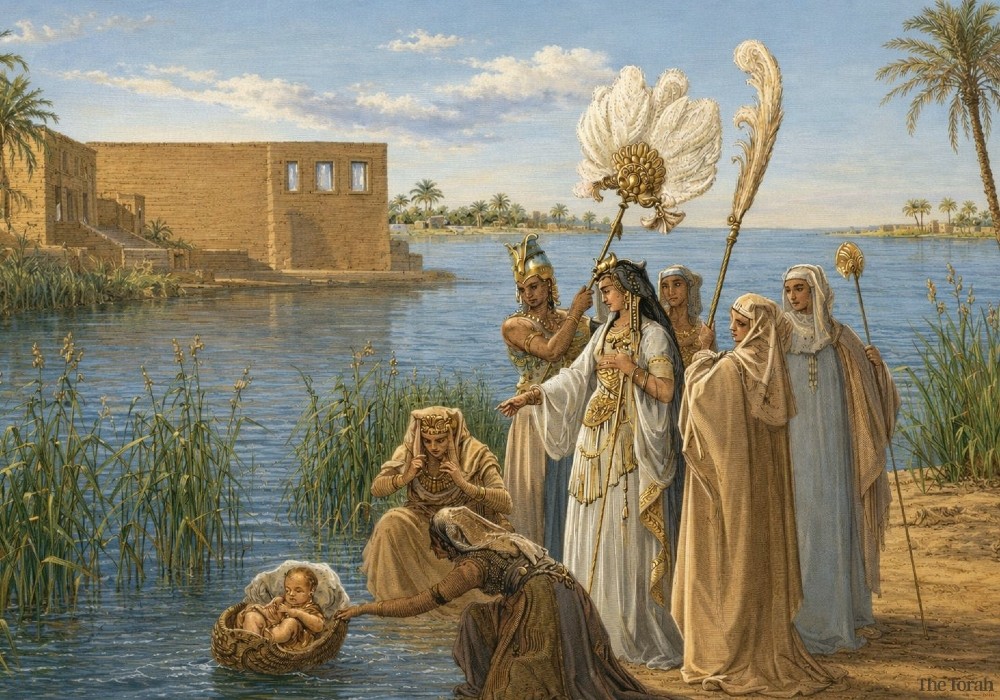
The Finding of Moses (colorized), Gustave Doré, 1866.
After his parents hide Moses for three months, they realize they cannot continue to conceal him indefinitely so his mother places him in a small ark, which she hides in the rushes of the Nile, where he is found by none other than the Pharaoh’s daughter.[1] She gives the baby to an Israelite woman to nurse—unbeknownst to her, Moses’ mother—after which, Pharaoh’s daughter adopts him and gives him a name, with a Hebrew wordplay:
שמות ב:י וַיִּגְדַּל הַיֶּלֶד וַתְּבִאֵהוּ לְבַת פַּרְעֹה וַיְהִי לָהּ לְבֵן וַתִּקְרָא שְׁמוֹ מֹשֶׁה וַתֹּאמֶר כִּי מִן הַמַּיִם מְשִׁיתִהוּ.
Exod 2:10 When the child grew up, she brought him to Pharaoh’s daughter, who made him her son. She named him Moses (Moshe), explaining, “I drew him (meshitihu) out of the water.”
To solve the problem of why an Egyptian princess would give a name based on a Hebrew word play, traditional commentators have gone in multiple directions:[2]
- Pharaoh’s daughter knew Hebrew.[3]
- A Hebrew woman—Yocheved or Miriam—gave him the name on her behalf.[4]
- Moshe is his Hebrew name; he had an equivalent Egyptian name.[5]
- Moshe is an Egyptian name; he had a different Hebrew name.[6]
- Moshe is an Egyptian name, but the Torah is retelling the account in adapted form for Hebrew speakers.[7]
Academic Speculation: Is “Moses” an Egyptian name?
In modern, critical scholarship, Karl Richard Lepsius (1810–1884), one of the founding fathers of Egyptology in Prussia, suggested that מֹשֶׁה mōšǽ is indeed an Egyptian name. He discounted the biblical explanation as a folk etymology and identified the name with forms derived from the Egyptian root mśy, “to give birth.”[8]
Egyptian Hieroglyphs, like Hebrew, does not include vowels, and the word is spelled 𓄟𓋴:
𓄟=the consonant sequence “ms”; the sign is a picture of three fox skins tied together.
𓋴= the letter “s” from the Egyptian alphabet, serving as a phonetic complement; the sign is a rendering of a folded cloth.[9]
As a result, Lepsius suggested two possible ways of parsing the name, both with the same consonantal writing 𓄟𓋴(𓅱)[10]:
mśw “Child”—This is the noun form of the root. It is found, for instance, in the name of the official Mes (𓄟𓋴𓀀),[11]
mś(y).w “Born”—This is the verbal, stative form. In names, it generally appears with a theophoric element, such as in the names:
- Ra-mose 𓇳𓄟𓋴(𓅱), Rc-mś(y).w “Reʿ is born”[12]
- Ah-mose 𓇋𓂝𓎛𓇹𓄟𓋴(𓅱) Yʿḥ-mś(y).w “Aḥ is born”[13]
- Ptah-mose 𓊪𓏏𓎛𓄟𓋴(𓅱) Ptḥ-mś(y).w “Ptaḥ is born”[14]
In this context, “born” does not refer to the physical birth of the deity but rather to the manufacturing of a divine statue during a festival: “(a statue of) Reʿ/Ah/Thoth has been manufactured.” These are feast names, perhaps implying that the baby was born during the festival, and named after the divine statue’s consecration event. The theory is that Moses could be a hypocoristic form of such a name (i.e. without the theophoric element), as we sometimes find in the records.[15]
This Egyptian etymology also seemed to provide a cogent argument in support of Moses as an ancient figure inexorably linked to the exodus narrative. In the words of the German Bible scholar Rudolf Smend (1882–1975):
We can most likely exclude later invention [of the name] because how could Israel possibly have given the man whom it regarded as its founder a name precisely in the language of those from whose oppression he had saved the people?[16]
Nevertheless, this understanding of Moses’ name comes up against some challenges:
The Consonantal Problem—The Hebrew name Moshe is written with a shin, but the Egyptian word is written with an ś. In theory, one could say that this is a sound transfer of a sibilant between languages, however, the name Ramesses—𓇳𓄟𓋴𓋴(𓅱) Rꜥ-ms(y)-sw “Reʿ is the one who bore him”[17]—appears in the Torah (Exod 1:11), and it is spelled with a samekh, רַעַמְסֵס, not a shin.
The Vowel Problem—The vocalized stative form of mśy, “to give birth,” was mắśi̯y. For the alternative etymology of the name Moses as mśw “child,” the earlier vowel quality in the 19th dynasty was likely either *mĭ́s or *mŭ́s, while the 1st millennium B.C.E vocalization pattern would have been *mĕ́s. None of these options match the vowel pattern in the biblical name, mōšǽ.
While Egyptian did make a phonological shift to mŏ́se “born,”[18] this occurred only in the mid-1st millennium B.C.E.[19] Admittedly, in Hebrew, there was also the Canaanite vowel shift ā > ō, but this took place gradually after the 15th century B.C.E., hundreds of years before the same shift in Egypt. So the Egyptian would only have the o sound around the Persian Period, long after the figure of Moses entered Israelite historiography. If ancient Israelites were remembering a name from the Bronze or Iron Ages, it should not have been pronounced Moshe.
The Stress Problem—The position of stress of the two terms was different: mŏ́se (first syllable) in Egyptian vs. mōšǽ (last syllable) in Hebrew.
No Ancients Suggested It—No ancient Jewish (like Jospehus, Artapanus, or Philo), Christian (like Origen of Alexandria), or Greco-Roman (like Apion or Tacitus) author in the reception history of the book of Exodus associated the Hebrew Moshe and Egyptian Ramesses name forms with each other. This is conspicuous as in their time, the two forms mŏ́se (Egyptian) and mōšaé (Hebrew) had almost fully converged phonetically. And yet, none of them saw the kind of relationship that modern scholarship tries to insinuate.
Biblical scholar Erhard Blum wrote: “The historical implications of the name ‘Moses’ cannot be dissociated from the history of the exodus tradition.”[20] But if the name is not Egyptian, the nexus with the exodus tradition becomes fragile, and “Moses the Egyptian” might indeed be a later construct.
Semitic Name
In contrast to the dubious assumption of an Egyptian origin to the name, a Semitic etymology appears plausible, as has been argued by a minority of scholars such as the British Egyptologist, Kenneth A. Kitchen (1932–2025).[21] The root מ.שׁ.י mšy “to draw,” as used in the story of the naming of baby Moses, would not be a folk etymology but instead provide the correct root underlying the name.
Granted, the verse itself, which is suggesting a backstory to the name, does not really work, given that Moses is the one drawn, while mōšǽ is an active participle, meaning “the drawer.” Nevertheless, the root is a real word—Syriac mšy “to collect, to glean” would appear to be a suitable Semitic cognate—which appears again in the Bible, in a psalm ascribed to David:
תהלים יח:יז (=שמואל ב כב:יז) יִשְׁלַח מִמָּרוֹם יִקָּחֵנִי יִמְשֵׁנִי מִמַּיִם רַבִּים.
Ps 18:17 (=2Sam 22:17) He reached out from the height and seized me; he drew me from the mighty waters.
Looking at the name without a narrative context, מֹשֶׁה Mōšǽ would then be either a standalone name “gleaner, collector, drawer” or the shortened form of a theophoric name, “(God/YHWH is) a collector,” i.e., savior.[22]
Preservation of Ancient Israelite Names
As we do not know when the historiographic figure of Moses dates from, and we cannot be entirely certain that the name מֹשֶׁה Mōšǽ in its canonical form is identical to the name the actual historical figure bore. Nevertheless, several factors point us to the likelihood that Israelite cultural memory preserved the names of its early figures in their original form.[23]
-
Aaron (אַהֲרֹן) and Miryam (מִרְיָם), from the same biblical account as Moses, and described as his siblings,[24] defy any linguistic explanation. They have no obvious Semitic etymology and are not Egyptian, either.
-
Abram (אַבְרָם) is a simple Hebrew name meaning “Father (=divine epithet) is august.” But it is restricted to the biblical figure. Moreover, the extension of the name by the syllable /ha/—Abraham אַבְרָהָם—is unique.
-
Isaac (יִצְחָק, יִשְׂחָק) is also restricted to the biblical persona. It means “(God) laughs” but probably not in a joyful way, rather in the sense of deriding or ridiculing opponents – “may (God) deride (my opponents).”
-
Jacob (יַעֲקֹב) comes from a root ע.ק.ב which was no longer productive in Biblical Hebrew. For parallels, we have to go back to the Amurrite onomasticon of the earlier 2nd millennium where the root means “to protect” – the name meant originally, “(God) protects (or, may protect).”
-
David (דָּוִד Dāwîd) continues to be obscure. Scholarship usually perceives the name as a bisyllabic by-form of dôd (“darling”, or “paternal uncle”) or else a passive participle, “the beloved.” However, no bisyllabic variants of the two nouns (like bisyllabic מָוֶת māwaet “death” vs. the status constructus, מוֺת môt) are attested, nor is a bisyllabic passive participle, *dāwîd of the root dwd, “to love.”[25]
-
Solomon (שְׁלֹמֹה Šəlōmō) quite certainly contains the root שׁ.ל.מ and maybe the noun šālôm, “wellbeing, peace,” although the ending -ō seems restricted to this name and is of unclear significance. A reference to the city deity of Jerusalem, the god Šalim, has also been suggested, but the form of the name would be odd.
It is improbable that these linguistic and onomastic peculiarities could have been made up at a later stage; they seem rather to point to the fact that these names were old and no longer easily understandable in the 1st millennium when the Pentateuch was compiled.
Considering this situation, a linguistically transparent Semitic etymology of the name מֹשֶׁה Mōšǽ – either as a profane name “gleaner, collector” or the shortened form of a theophoric name, “(God is) a collector (= saviour)” – appears satisfactory. It may not have concurrent parallels using the same root and morphological form, but in this regard, it presents similar difficulties to other names preserved for figures of Israel’s early history.
TheTorah.com is a 501(c)(3) nonprofit organization.
We rely on the support of readers like you. Please support us.
Published
August 31, 2026
|
Last Updated
October 7, 2026
Previous in the Series
Next in the Series
Before you continue...
Thank you to all our readers who offered their year-end support.
Please help TheTorah.com get off to a strong start in 2025.
Footnotes


Prof. Thomas Schneider is Professor of Egyptology and Near Eastern Studies at the University of British Columbia and currently serves as Chief Executive of the Association of Pacific Rim Universities (APRU). He studied Egyptology, Hebrew Bible and Ancient History at the University of Zurich, the University of Basel and the École Pratique des Hautes Études in Paris, earning a Lizentiat (1990), a doctorate (1996), and a Habilitation (1999) in Egyptology at the University of Basel. Schneider is the founding editor of the “Journal of Egyptian History” (2008-2014) and was the editor of “Culture and History of the Ancient Near East” (Brill, 2006-2013) and “Near Eastern Archaeology” (American Schools of Oriental Research, 2012-2017). He is the author of Language Contact in Ancient Egypt (2023); and co-editor of Prophecy in the Hebrew Bible and Ancient Egypt (2025); The Gift of the Nile? Ancient Egypt and the Environment (2020); Israel's Exodus in Transdisciplinary Perspective - Text, Archaeology, Culture, and Geoscience (2015); Egyptology from the First World War to the Third Reich: Ideology, Scholarship, and Individual Biographies (2013).
Essays on Related Topics: