


 Edit article
Series
Shoo the Mother Bird Away to Live Longer


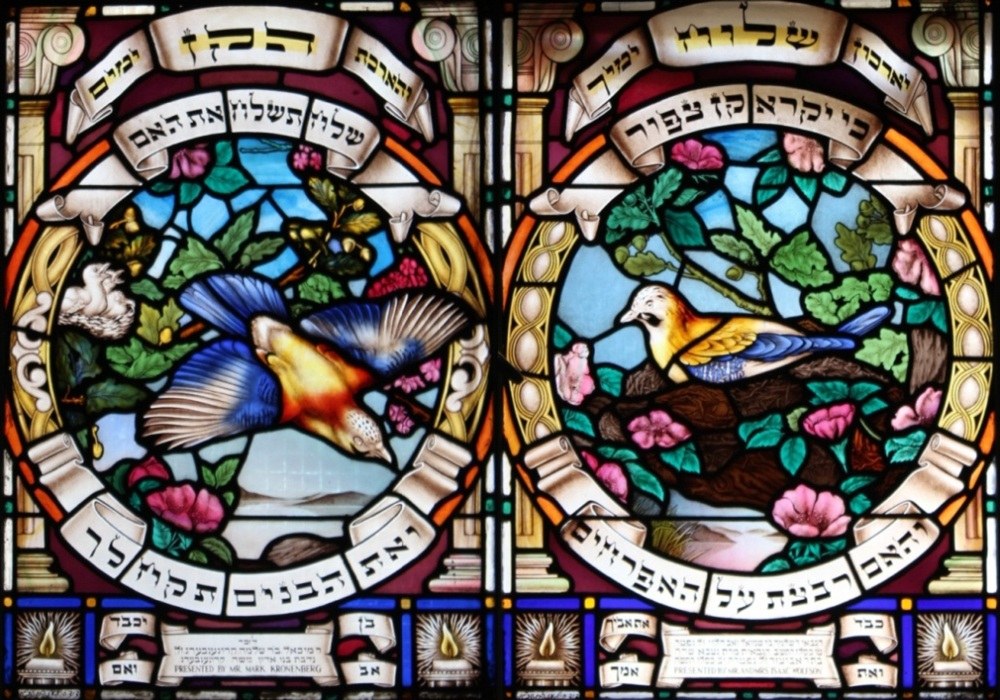
Stained-glass windows depicting the mitzvah of Shiluach HaKen (sending away the mother bird), Renanim Synagogue, Heichal Shlomo, Jerusalem. The right side depicts the verse, "If you happen upon a bird's nest along the way... and the mother is sitting on the fledglings," while the left side continues, "You shall surely send away the mother, but you may take the young for yourself" (Deuteronomy 22:6–7).
People go to great lengths to try to live longer. They do intermittent fasts and high-intensity exercise routines. They take vitamin supplements and wear health-monitoring rings and watches. Deuteronomy offers a unique opportunity for acquiring a long life: shooing the mother bird away from her nest before taking her eggs:[1]
דברים כב:ו כִּי יִקָּרֵא קַן צִפּוֹר לְפָנֶיךָ בַּדֶּרֶךְ בְּכׇל עֵץ אוֹ עַל הָאָרֶץ אֶפְרֹחִים אוֹ בֵיצִים וְהָאֵם רֹבֶצֶת עַל הָאֶפְרֹחִים אוֹ עַל הַבֵּיצִים לֹא תִקַּח הָאֵם עַל הַבָּנִים. כב:ז שַׁלֵּחַ תְּשַׁלַּח אֶת הָאֵם וְאֶת הַבָּנִים תִּקַּח לָךְ לְמַעַן יִיטַב לָךְ וְהַאֲרַכְתָּ יָמִים.
Deut 22:6 If, along the road, you chance upon a bird’s nest, in any tree or on the ground, with fledglings or eggs and the mother sitting over the fledglings or on the eggs, do not take the mother together with her young. 22:7 Let the mother go, and take only the young, in order that you may fare well and have a long life.[2]
In its concern with the parent-child relationship, the bird commandment may evoke the law of the insubordinate son found in the preceding chapter of Deuteronomy (21:18–21),[3] but it is even more explicitly connected to the Decalogue’s requirement to honor one’s parents, which offers the same promise of prosperity and long life:
דברים ה:טו כַּבֵּד אֶת אָבִיךָ וְאֶת אִמֶּךָ כַּאֲשֶׁר צִוְּךָ יְ־הֹוָה אֱלֹהֶיךָ לְמַעַן יַאֲרִיכֻן יָמֶיךָ וּלְמַעַן יִיטַב לָךְ עַל הָאֲדָמָה אֲשֶׁר יְ־הֹוָה אֱלֹהֶיךָ נֹתֵן לָךְ.
Deut 5:16 Honor your father and your mother, as YHWH your God has commanded you, that you may long endure, and that you may fare well, in the land that YHWH your God is assigning to you.
The repetition of the same reward using the same language (though in reverse order) suggests that honoring the bird’s mother-child relationship secures a good and long life in just the way honoring one’s own parents does.[4]
The Four “Animal Family” Laws
The mother bird commandment is one of four “animal family” laws,[5] scattered throughout the Torah, whose concern has been recognized since antiquity as thematically related, with the ancient Jewish philosopher Philo (ca. 20 B.C.E. – 50 C.E.) offering the first major discussion of them as a group. The laws focus on the parent-child relationship in four contexts:
Separation – The requirement to send off the mother bird (Deut 22:6–7, cited above).
This law is set apart from the next three animal family laws in several ways: the animal in question is not a mammal but a bird; the animal is not domesticated and owned but one whom “you chance upon”; and the law is justified or motivated, that is, you chase away the mother bird “in order that you may fare well and have a long life.” The concern of the mother bird commandment, however, is still essentially the same as that of the other three laws: recognition of family relationships in the animal world.
Slaughter – A prohibition against slaughtering a parent animal and child on the same day:
ויקרא כב:כח וְשׁוֹר אוֹ שֶׂה אֹתוֹ וְאֶת בְּנוֹ לֹא תִשְׁחֲטוּ בְּיוֹם אֶחָד.
Lev 22:28 However, no animal from the herd or from the flock shall be slaughtered on the same day with its young.
Sacrifice – An infant animal intended for sacrifice must be left with its mother for the first seven days of its life:
שמות כב:כט כֵּן תַּעֲשֶׂה לְשֹׁרְךָ לְצֹאנֶךָ שִׁבְעַת יָמִים יִהְיֶה עִם אִמּוֹ בַּיּוֹם הַשְּׁמִינִי תִּתְּנוֹ לִי.
Exod 22:29 You shall do the same with your cattle and your flocks: seven days it shall remain with its mother; on the eighth day you shall give it to Me.
A different formulation of this law appears in Leviticus (22:27).[6]
Consumption – Finally, the most well-known animal family law is the prohibition, לֹא תְבַשֵּׁל גְּדִי בַּחֲלֵב אִמּוֹ, “You shall not boil a kid in its mother’s milk” (Exod 23:19),[7] which is repeated verbatim two more times (Exod 34:26; Deut 14:21).
The laws present a conundrum in that they seem to require people to respect the parent-child bond in other animals even while violating it.
The Humanitarian Rationale
A long-standing explanation of the animal family laws is what I call the “humanitarian rationale.”[8] In his Guide of the Perplexed, Maimonides (1138–1204) offers a formulation infused with the philosophical thinking of his day. Focusing first on the prohibition against slaughtering parent and child animals on the same day (Lev 22:28), Maimonides proposes that the animal family laws are designed to prevent the animal mother from witnessing the slaughter of her child:
Guide 3:48 It is also prohibited to kill an animal with its young on the same day, in order that people should be restrained and prevented from killing the two together in such a manner that the young is slain in the sight of the mother.[9]
An animal mother whose child is killed before her eyes, Maimonides proposes, experiences “very great pain,” and, echoing similar perspectives in Islamic philosophers Avempace (ca. 1085–1138) and Avicenna (ca. 980–1037),[10] he argues that this maternal feeling, rooted in the “imaginative faculty,” is shared across species:
Guide 3:48 In these cases animals feel very great pain, there being no difference regarding this pain between man and the other animals. For the love and the tenderness of a mother for her child is not consequent upon reason, but upon the activity of the imaginative faculty,[11] which is found in most animals just as it is found in man. This law applies only to ox and lamb, because of the domestic animals used as food these alone are permitted to us, and in these cases the mother recognizes her young.
This principle applies not only to the most common kosher mammal species, sheep and cows, Maimonides says, but also to birds, and thus it also explains the mother-bird law:
Guide 3:48 This is also the reason for the commandment to let [the mother] go from the nest. For in general the eggs over which the bird has sat and the young that need their mother are not fit to be eaten. If then the mother is let go and escapes of her own accord, she will not be pained by seeing that the young are taken away.
The law’s ideal, however, in Maimonides’ presentation, is for passersby simply to leave the nest alone:
Guide 3:48 In most cases this will lead to people leaving everything alone, for what may be taken is in most cases not fit to be eaten.
Maimonides attributes to these two animal family laws a regard for the emotional lives of animal mothers and the integrity of animal families, but he closes on an anthropocentric note, proposing that the laws are meant to teach the magnitude of the moral claim that humans bear towards one another:
Guide 3:48 If the Law takes into consideration these pains of the soul in the case of beast and birds, what will be the case with regard to the individuals of the human species as a whole?
Maimonides’ approach to the animal family laws—that they foster compassion for animals with the ultimate aim of improving human character and society—is widespread, found from Jewish antiquity to modernity, across Ashkenaz and Sefarad.[12] Yet this explanation is unsatisfying.
But Is It Really about Humanitarianism?
One of the most vocal advocates of the humanitarian rationale is, ironically, also one of its chief opponents. In his commentary on the Mishnah (ca. 1161–1168), Maimonides takes a very different perspective on the mother bird commandment than he does later in his Guide (ca. 1185–1190).[13] In Maimonides’ reasoning, if God were merciful to animals, God would not have commanded Israel to slaughter them (as in the laws of sacrifice):[14]
Maimonides, m. Ber. 5:3 In mentioning the formula, “Your mercies extend to a bird’s nest,” they are referring to one who says, “As you have shown compassion upon a bird’s nest and commanded, ‘You shall not take the mother with the fledglings’ (Deut 22:6), so too show mercy upon us.”
Whoever says this in his prayer is to be silenced, since he is making the reason for this command dependent upon God's compassion for the bird. This is not really true, for if it were actually an expression of mercy, then He would not have commanded to slaughter beasts or birds at all. Rather, this is a traditional law,[15] for which there is no reason.[16]
In his commentary on the identical passage found elsewhere in the Mishnah, Maimonides says that the mother bird commandment is simply gezerat hakatuv, a decree of Scripture.[17]
Inconsistent and Selective Humanitarianism
Bible scholar Jacob Milgrom (1923–2010) presents an alternative set of arguments against the humanitarian rationale. Regarding same-day slaughter, Milgrom questions how it is more compassionate if one slaughters the mother today and her child tomorrow:
It may be true that one may not slaughter the dam [female parent] and its young on the same day (22:28) but it surely is permitted on successive days.
He observes that the eight-day-old baby is still nursing when it is removed from its mother and sacrificed on the altar:
The newborn must be permitted to suckle for seven days (22:27; Exod 22:29), but on the eighth day it may be brought to the altar—even though it is still suckling.
The mother bird law appears equally arbitrary: the mother will return to the nest and find it empty whether she witnesses the taking of the eggs or not:
The mother bird and her fledglings or eggs may not be taken together (Deut 22:6), but surely they may be taken separately.
Finally, for the prohibition on cooking a kid in his mother’s milk, it seems a strange and attenuated lesson in compassion if the mother in no way experiences it:
By the same token, the mother goat can in no way be aware that her kid is boiling in her milk…. In any event, the humanitarian theory must give way to another.[18]
Thus, the laws do not convincingly express compassion for or limit harm to animals. Instead, they reflect a complicated, in many ways contradictory set of concerns about kinship ties in the animal world and how humans should relate to them:
- a recognition of animal families;
- an understanding that animal families bear similarity to human families; and
- a discomfort with human interference in animal families.
Animal Personhood Among the L’nuk
The Canadian First Nations people the L’nuk (lit. “the people”), who have lived on the northeastern coast of North America for over 12,000 years, offer a helpful analogy. The L’nuk traditionally fish in coastal rivers in the warm season and hunt moose and caribou in the cold season.
According to Indigenous scholar Margaret Robinson, the L’nuk view humans and animals as essentially alike and equally important, all created by the Great Spirit and possessing individual relationships with that Spirit.[19] Animals are intelligent. They understand their environment and how to live effectively within it. Animals have their own spirits, social traditions, and emotional bonds with each other.
L’nuk hunting and fishing practices reflect those beliefs. L’nuk are taught never to hunt more animals than they need or to waste any part of a catch based on netukulimk, a philosophy of subsistence. The L’nuk differentiate their subsistence practices from hunting and fishing for profit or sport, which L’nuk consider immoral.
L’nuk return animal bones to their original habitats so that the animals can be reincarnated in their homes. L’nuk storytelling urges care for animals and discourages fear of them. The underlying principle of the L’nuk relationship to animals is that animals “sacrifice” themselves to feed people, and people must express gratitude and respect in return through ceremonies such as offerings and prayers and through protocols for animal procurement and use.
Note that L’nuwey (“belonging to the people”) beliefs about the equality and capacity of other species do not stop the L’nuk from killing, eating, and using them. The protocols developed by the L’nuk, such as returning bones to the original habitat, do not necessarily help animals. Yet the protocols form part of a broader worldview in which humans are similar and connected to other animals and must co-exist respectfully with them.
Along the same lines, the four animal family laws of the Torah do not prohibit violence against animals nor do they presume such violence to be unethical. The laws may minimize harm to animals, but they do not necessarily do so—Maimonides’ argument about the nest notwithstanding. The animal family laws do, on the other hand, highlight parallels between humans and animals when it comes to the formation of family bonds, and they require people to recognize those bonds even, perhaps especially, when violating them.
Bird Families in Mishnah Hullin
The treatment of the mother bird commandment in Mishnah Hullin embodies a similar approach, fostering not compassion towards animals so much as curiosity about them and consideration of their complex family configurations.[20] The Mishnah introduces scenarios that reflect known phenomena in the bird world:
Helpers at the Nest and Brood Parasitism
The Mishnah exempts the nest in which a mother bird broods eggs born from a mother of a different bird species when one species is pure and the other impure:[21]
משנה חולין יב:ב עוף טמא רובץ על ביצי עוף טהור וטהור רובץ על ביצי עוף טמא פטור מלשלח.
m. Hul 12:2 An impure bird lies on the eggs of a pure bird, a pure lies on the eggs of an impure bird, one is exempt from sending.[22]
The animal family that inhabits the nest might be constituted by “helpers at the nest”—the term coined by naturalist Alexander Skutch for birds’ cooperative breeding habits—or parasitic birds who drop their eggs into another bird’s nest.[23]
The ruling might seem to imply, surprisingly, that the commandment may apply even if the “mother” bird is not of the same species as the eggs or chicks she broods, so long as they are both of pure species—a chicken brooding duck eggs, for example, might still trigger the mitzvah. The Tosefta and Sifre Deuteronomy head off this possibility, ruling that the mother and children must be of the same pure species for the mitzvah to apply—a chicken must be brooding chicken eggs[24]—though it is worth noting that a passerby might not be able to reliably confirm that the “brooder” and “broodee” are biologically related.
Paternal Care
The Mishnah then considers the question of father birds in the species kore, probably a sand partridge, recognizing one of the distinguishing features of birds among vertebrates, their biparental care norm:[25]
משנה חולין יב:ב קורא זכר ר' אליעזר מחייב וחכמ' פוטרין.
m. Hul 12:2 A male qore: Rabbi Eliezer obligates [the passerby to shoo away the father], while the Sages exempt.
The Sages say that the mitzvah does not apply to fathers, with Rabbi Eliezer dissenting.
In raising these scenarios—the bird of one species who broods the chicks of another, and the father bird who broods—the Mishnah is exploring the rich diversity of animal families. Like the L’nuk, the Mishnah understands animals to have their own distinctive habits and their own bonds with each other. The Mishnah requires Jews to know those habits, to recognize those bonds, and to regulate their behavior accordingly. The mother bird mitzvah becomes the grounds not for compassion or pity towards animals but, in the Mishnah’s approach, for deep engagement with animal lives.
Animal Families Today
Some Jews today relate to the mitzvah of the mother-bird as a talisman for long life and prosperity. [26] Another approach, one more in line with the rabbinic legal tradition, is to be curious about and cognizant of the relationships that animals form with each other. Recognition of animal families may not prevent interference—though it might, as Maimonides argues in his Guide—but it should inform our behavior nonetheless.
The modern study of animal behavior and biology confirms the importance of kinship bonds to animal well-being.[27] The mother bird mitzvah, along with the Torah’s three other animal family laws, invites us to identify the practices today that most interfere with those bonds—industrial animal agriculture, land development, air and water pollution—and to modify our behavior accordingly, if not always to protect those families, then at least to acknowledge their value and recognize their similarities to our own human families.
TheTorah.com is a 501(c)(3) nonprofit organization.
We rely on the support of readers like you. Please support us.
Published
July 31, 2026
|
Last Updated
September 1, 2026
Previous in the Series
Next in the Series
Before you continue...
Thank you to all our readers who offered their year-end support.
Please help TheTorah.com get off to a strong start in 2025.
Footnotes


Prof. Beth A. Berkowitz is the Ingeborg Rennert Professor of Judaic Studies at Barnard College. She holds an MA from the University of Chicago Divinity School and a PhD in Religion from Columbia University. She is a Fellow of the American Academy for Jewish Research and Vice President of the Jewish Law Association. Berkowitz was awarded Salo Baron Prize for Outstanding First Book in Jewish Studies for Execution and Invention: Death Penalty Discourse in Early Rabbinic and Christian Cultures (Oxford University Press, 2007). Her most recent books include What Animals Teach Us About Families Kinship and Species in the Bible and Rabbinic Literature (University of California Press, 2026) and Animals and Animality in the Babylonian Talmud (Cambridge University Press, 2018).
Essays on Related Topics: