


 Edit article
Series
Did Esau Marry 3, 4, 5, or 6 Women?


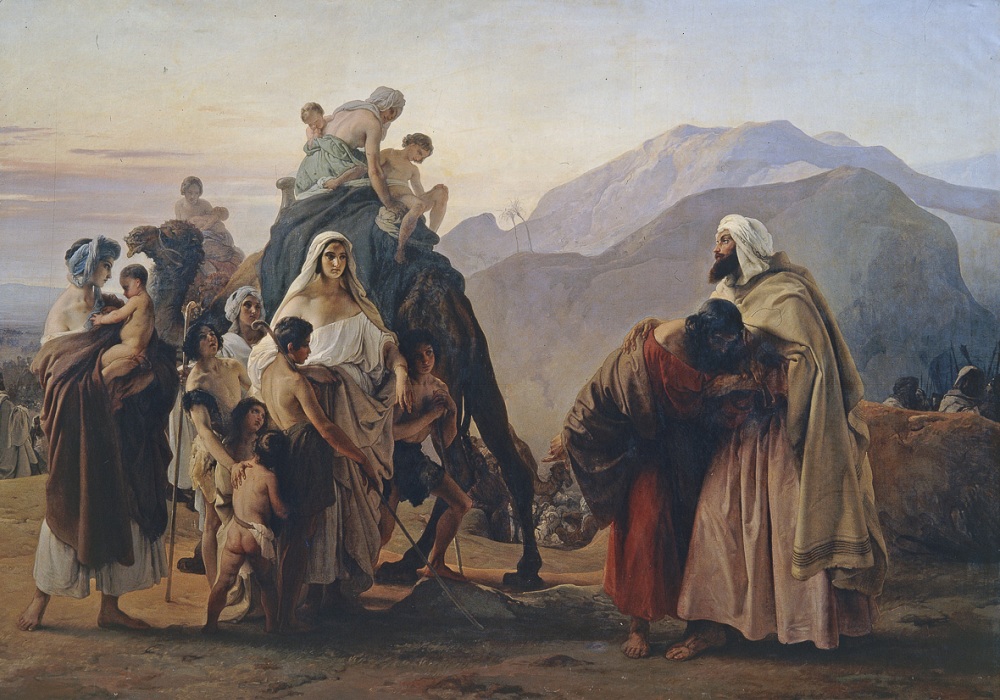
Esau and Jacob reconcile, Francesco Hayez, 1844. Wikimedia
Esau’s first marriages make his parents unhappy:
בראשית כו:לד וַיְהִי עֵשָׂו בֶּן אַרְבָּעִים שָׁנָה וַיִּקַּח אִשָּׁה אֶת יְהוּדִית בַּת בְּאֵרִי הַחִתִּי וְאֶת בָּשְׂמַת בַּת אֵילֹן הַחִתִּי. כו:לה וַתִּהְיֶיןָ מֹרַת רוּחַ לְיִצְחָק וּלְרִבְקָה.
Gen 26:34 When Esau was forty years old, he took to wife Judith daughter of Beeri the Hittite, and Basemath daughter of Elon the Hittite; 26:35 and they were a source of bitterness to Isaac and Rebecca.[1]
When Esau learns of their disappointment, he takes a third wife whom he thinks would be more to their liking:
בראשית כח:ח וַיַּרְא עֵשָׂו כִּי רָעוֹת בְּנוֹת כְּנָעַן בְּעֵינֵי יִצְחָק אָבִיו. כח:ט וַיֵּלֶךְ עֵשָׂו אֶל יִשְׁמָעֵאל וַיִּקַּח אֶת מָחֲלַת בַּת יִשְׁמָעֵאל בֶּן אַבְרָהָם אֲחוֹת נְבָיוֹת עַל נָשָׁיו לוֹ לְאִשָּׁה.
Gen 28:8 Esau realized that the Canaanite women displeased his father Isaac. 28:9 So Esau went to Ishmael and took to wife, in addition to the wives he had, Mahalath the daughter of Ishmael son of Abraham, sister of Nebaioth.
At this point, Esau has three wives: the two Hittite women, Judith and Basemath, and his first-cousin, Mahalath.
A few chapters later, right before the Joseph story, the Torah offers a long summary of Esau’s descendants, beginning with a list of Esau’s wives:
בראשית לו:ב עֵשָׂו לָקַח אֶת נָשָׁיו מִבְּנוֹת כְּנָעַן אֶת עָדָה בַּת אֵילוֹן הַחִתִּי וְאֶת אָהֳלִיבָמָה בַּת עֲנָה בַּת צִבְעוֹן הַחִוִּי. לו:ג וְאֶת בָּשְׂמַת בַּת יִשְׁמָעֵאל אֲחוֹת נְבָיוֹת.
Gen 36:2 Esau took his wives from among the Canaanite women—Adah daughter of Elon the Hittite, and Aholibamah daughter of Anah daughter of Zibeon the Hivite—36:3 and also Basemath daughter of Ishmael and sister of Nebaioth.
As in the earlier narrative, he marries three women, one a daughter of Ishmael, one a Hittite woman, and one a woman named Basemath. Yet, the details are different:
Esau’s Wives: Narrative (Gen 26, 28)
- Judith, daughter of Beeri, the Hittite;
- Basemath, daughter of Elon the Hittite;
- Mahalath, daughter of Ishmael.
Esau’s Wives: List (Gen 36)
- Adah, daughter of Elon the Hittite
- Aholibamah, daughter of Anah (daughter of Zibeon) the Hivite
- Basemath, daughter of Ishmael
Traditional commentators, who could not dismiss the discrepancies by saying that they represent competing traditions or scribal errors, had to come up with some way to make sense of these blatant contradictions. This led to several approaches, according to which Esau ends up having had anywhere between 3 and 6 wives.[2]
Three Wives, Each with a Nickname
Rashi (Rabbi Shlomo Yitzchaki, 1040–1105) identifies the three wives in the first list as identical to the three in the second, merely under different names. In his view, the list of wives in chapter 36 gives us the women’s actual names while the references to Esau’s wives in the narrative (chs. 26 and 28) offer Esau’s nicknames for each of them. Rashi provides a midrashic rationale for each name change:
Wife 1: Adah=Basemath
Rashi ignores the identical names Basemath—each with a different father—and instead identifies Adah in the list with Basemath in the narrative, since they share the same father, Elon the Hittite. He suggests that Adah was the woman’s actual name, while Basemath was her nickname:
רש"י בראשית לו:ב "עדה בת אלון" – היא בשמת בת אלון (בראשית כו:לד), ונקראת בשמת על שם בשמים שהיתה מקטרת לעבודה זרה.
Rashi Gen 36:2 “Adah daughter of Elon”—this is Basemath daughter of Elon (Gen 26:34), and she was known as Basemath since she would offer incense [בשמים, besamim] to foreign gods.
Wife 2: Aholibamah=Judith
Rashi again assumes that the name in Gen 36 is an actual name, and that the narrative in Gen 26 provides a nickname. He connects Aholibamah of Gen 36 with Judith of Gen 26, though in this case, the fathers also have different names (Anah the Hivite vs. Beeri the Hittite):
רש"י בראשית לו:ב "אהליבמה" – היא יהודית, אותו רשע כינה שמה יהודית, לומר: שהיא כופרת בעבודה זרה כדי להטעות את אביו.
Rashi Gen 36:2 “Aholibamah”—this is Judith. That wicked man (=Esau) nicknamed her Judith, implying that she denies foreign gods (like a Jew), in order to trick his father.
Rashi does not explain the name change of her father from Beeri to Anah (or vice versa), or how Judith/Aholibamah moved from being a Hittite to a Hivite.
Rashi’s student and personal attendant, R. Shemaiah of Soissons,[3] offers an explanation in a gloss that appears in the Leipzig manuscript on Rashi’s commentary that she was of unknown parentage:
רש"י בראשית לו:ב [כתב יד לייפציג 1] ת[וספת]: אף אני אומ' בארי החתי בא עליה ונעשית חוית וחתית. שמעיה. כ'כ' רב' שמ'.
Rashi Gen 36:2 [Leipzig 1] A gloss: “I also say that Beeri the Hittite had intercourse with her (Aholibamah’s mother?), so she became both Hivite and Hittite. Shemaiah” This is what R. Shemaiah wrote.
Chizkuni (R. Hezekiah ben Manoach, 13th cent.) offers another solution, that Beeri and Anah are the same person:
חזקוני בראשית לו:ב "אהליבמה בת ענה" – פירוש רבינו שלמה: היא יהודית. ואם תאמר: הרי יהודית בת בארי הייתה כדכתיב בפרשת תולדות (בראשית כו:לד) וכאן הוא אומר בת ענה. ואם יש בה ממזרות, אמאי לא פר"ש מבין שניהם יצאה, מבארי ומענה, כמו שפי' גבי ענה בת צבעון. אלא יש לומר: דבארי וענה אחד הם.
Chizkuni Gen 36:2 Rashi explained that this is Judith. But if you ask: Judith is the daughter of Beeri, as it says in Parashat Toledot (Gen 26:34), but here it says she’s the daughter of Anah? And if there is mamzerut here (i.e., both men slept with her mother and she doesn’t know which is the father), why didn’t Rashi just say that she was the product of both men as he does regarding Anah and Zibeon?![4] Thus it would appear that Beeri and Anah were the same person.[5]
Wife 3: Basemath=Mahalath
Rashi is consistent and thus assumes that her actual name was Basemath as stated in Gen 36, and that Mahalath is a nickname, derived from the idea that Esau’s sins were forgiven (mahal) on account of his marrying her:
רש"י בראשית לו:ג "בשמת בת ישמעאל" – ולהלן קורא לה: מחלת (בראשית כח:ט). מצאתי בהגדה מדרש ספר שמואל (מדרש שמואל פרק יז): שלשה מוחלין על כל עוונותיהם: גר משמתגייר, והעולה לגדולה, והנושא אשה. ולמד הטעם מיכן, לכך נקראת מחלת, שנמחלו עוונתיו.[6]
Rashi Gen 36:3 “Basemath daughter of Ishmael”—elsewhere it [the biblical text] calls her Mahalath (Gen 28:9). I found in an aggadic passage in Midrash Sefer Shmuel (§17): “There are three whose sins are forgiven: A convert who converts, one who ascends to greatness, and one who marries a woman. And they derive the proof (for the third one) from here, that this is the reason she is called Mahalath, for his sins were forgiven (nimhelu).
Esau marries Ishmael’s daughter to appease his parents and, indeed, his sins are forgiven. This is especially poignant, given that according to Rashi’s reading, Esau does not again marry outside the family, which is seemingly the very act that upset his parents.
Four Wives: Judith Died without Children
Rashi’s grandson Rashbam (R. Samuel ben Meir, c. 1085–1158) follows his grandfather’s approach for two of the women, Adah/Basemath and Basemath/Mahalath, though he does not offer any explanation for why the names are switched, noting only that biblical texts do this often:
רשב"ם בראשית לו:ב עשו לקח את נשיו מבנות כנען – המדקדק יתן לב כי בפרשה ראשונה של תולדות יצחק נאמר יהודית בת בארי החתי, בשמת בת אלון החתי (בראשית כ"ו:ל"ד), מחלת בת ישמעאל (בראשית כ"ח:ט'), ובפרשה זו לא הוזכר בת בארי כלל, לא שמה ולא שם אביה,
Rashbam Gen 36:2 “Esau took wives from among the daughters of Canaan”—one who reads carefully will note that in the first passage, in Toledot, it says it was Judith daughter of Beeri the Hittite, Basemath daughter of Elon the Hittite (Gen 26:34), and Mahalath daughter of Ishmael (Gen 28:9). In this passage, however, no mention is made of the daughter of Beeri at all, not her name nor her father’s.
אבל {אלון} וישמעאל אביהן של שתי נשיו הראשונות הוזכרו, שהוחלפו שמות הבנות כאשר מצינו בכמה מקומות. בשמת בת אלון נקראת כאן עדה בת אלון, ומחלת בת ישמעאל נקראת כאן בשמת.
Nevertheless, {Elon} and Ishmael, the fathers of the first two women, are mentioned, for the daughter’s names were exchanged, as we have seen in many places: Basemath daughter of Elon is called Adah daughter of Elon here, and Mahalath daughter of Ishmael is called Basemath here.
Rashbam, however, does not accept Rashi’s equation of Judith with Aholibamah, and offers instead a chronological solution: Aholibamah is absent from the first list because Esau had not yet married her, and Judith is absent from the second, genealogical list, because she founded no enduring clan:
רשב"ם בראשית לו:ב לכן יש לומר יהודית בת בארי מתה בלא בנים, אבל בת אלון ובת ישמעאל היו להם בנים המפורשים כאן. ואהליבמה בת ענה בת צבעון החוי לקח אחרי כן, אחר שהלך לו לשבת בהר שעיר ונתחתן בבני שעיר החו{ר}י, ככתוב לפנינו...
Rashbam Gen 36:2 Therefore, it would seem that Judith daughter of Beeri died without having children, but the daughters of Elon and Ishmael did have the children mentioned here. As for Aholibamah daughter of Anah daughter of Zibeon the Hivite, he married her afterwards, after he went to dwell in Mount Seir he married the children of Seir the Hurrian, and it says here…
This same approach is also taken by Rabbi Avraham Ibn Ezra (c. 1089–1167)[7] and makes its way into the late medieval chronicle Sefer HaYashar, which explicitly recounts the death of Judith before Esau’s marriage to Aholibamah.
ספר הישר ובשנה החמישית מתה יהודית בת בארי אשת עשו, בארץ כנען ובנים לא היו לה כי אם בנות. ואלה שמות בנותיה אשר ילדה לעשו, שם הגדולה מרצית ושם הקטנה פועית.
Sefer HaYashar And in the fifth year of Jacob’s dwelling in Haran, Judith, daughter of Beeri, Esau’s wife, died in the land of Canaan; and she had no sons, but two daughters. The name of the oldest was Marnith, and the name of the youngest was Puith.
ויהי כאשר מתה יהודית וינחם עשו, ויקם וילך שעירה לצוד ציד בשדה כפעם בפעם. וישב עשו בארץ שעיר ימים רבים. ובשנה השישית לקח עשו את אהלבימה בת ענה בת צבעון החוי על נשיו לו לאישה, ויביאה עשו ארצה כנען. ותהר אהלבימה ותלד לעשו את יעוש ואת יעלם ואת קרח, בנים שלושה.
And when Judith died, Esau went to Seir to hunt in the field as heretofore, and Esau dwelt in Seir for many days. And in the sixth year of Jacob’s dwelling in Haran, Esau took Aholibamah, daughter of Zibeon the Hivite, as a wife, in addition to his other wives, and Esau brought her unto the land of Canaan; and Aholibamah conceived and bore unto Esau three sons: Jaush, and Jaalon, and Korah.[8]
Five Wives: Judith and Basemath Both Died
R. Moses Nahmanides (Ramban, ca. 1195–ca. 1270) begins his discussion of the contradictions in question by critiquing Rashi’s harmonizations, noting that they do not explain the change of father’s names (as discussed above) and especially questioning how a single name, "Basemath," could function simultaneously as a literal name for one wife and a pejorative nickname for another.
Nahmanides takes Ibn Ezra’s interpretation one step further and suggests that both women mentioned in Gen 26, whom Esau had married when he turned forty, died early:
רמב"ן בראשית לו:ב–ג ויתכן לומר כי השתים נשים ההם מתו בלא בנים, אולי נענשו בעבור שהיו "מֹרַת רוּחַ לְיִצְחָק וּלְרִבְקָה" (בראשית כו:לה), ונשא אחות אשתו בת אילון ואחרת אהליבמה בת ענה.
Nahmanides Gen 36:2–3 And it is possible to say that those two wives [the earlier ones] died childless, perhaps as punishment because “they were a bitterness of spirit to Isaac and Rebecca” (Gen 26:35). And [afterward] he married [again]—the sister of his [former] wife, the daughter of Elon, and another [wife, namely] “Aholibamah daughter of Anah.”
Though Nahmanides does not explain why the two new wives—the Hittite Adah, sister of his previous wife Basemath, and the Hivite Aholibamah—did not also cause pain to Esau’s parents, he does emphasize the positive nature of the marriage to Ishmael’s daughter. Indeed, in this case, Nahmanides accepts that Basemath and Mahalath were the same woman, and that Esau renamed her because her given name, Mahalath, had bad connotations:
אבל בת ישמעאל אחות נביות בעבור שהיה לה שם כעור בלשון הקדש, מ"חולי", קרא את שמה בשם הנכבד אשר היה לאשתו הראשונה מלשון בשמים, כי היתה חביבה עליו בעבור שהיתה ממשפחתו ואיננה רעה בעיני יצחק אביו.
But [as for] “the daughter of Ishmael, the sister of Nebaioth”—because she had an unpleasant name in the Holy Tongue, derived from holi (“sickness”)—he called her by the more honorable name which his first wife had borne, [a name] derived from besamim “spices,” because she was beloved to him, since she was of his own family, and was not [as] displeasing in the eyes of Isaac his father.
In other words, Esau gave the nickname that he borrowed from one of his deceased wives to his beloved wife, his first cousin, because of the positive implications of the name.
Six Wives Is Six Wives
Rabbi Abraham Maimuni (1186–1237)—son of Maimonides—takes each list at face value and does not offer any reconstructive suggestions to reconcile the apparent contradiction. Although he first cites Rashi’s position—which he thinks is correct—Maimuni then suggests a possible alternative, i.e., that the two sets of sources list six different women:
ר' אברהם בן הרמב"ם בראשית לו:ב ואפשר [גם כן] שנשים אלה אינן אותן {הנשים}, ואלה השאירו בנים אחריהן, ואותן מתו בלא בנים.
R. Abraham Maimuni Gen 36:2 And it is also possible that these women [in Gen 36] are not the same [women mentioned earlier in Gen 24, 26], but that these [later ones] left behind sons after them, whereas those [earlier ones] died childless.
The first set of wives, according to this proposed interpretation, may have been infertile or bore only daughters or died earlier. They are mentioned only because they are part of a narrative of how Esau upset his parents with Hittite wives, and why he turned to Ishmael for his third wife. But they were excluded from the later genealogical record, which is only concerned with establishing patriarchal clans.
A Classic Biblical Problem
The issue of the Torah including seemingly contradictory lists of people is not unique to Esau and his wives.[9] For modern Bible scholars, this contradiction provides evidence that the Torah is composed of different sources. The two sets of verses certainly resist harmonization.
Yet the medieval commentators were working within the traditional assumption that the biblical text is consistent and harmonious. The commentators thus created backstories to make sense of the differences, each based on close reading, historical reasoning, and creative reconstruction—a good example of the dynamic engagement of the exegetical tradition with the Torah’s every detail.
TheTorah.com is a 501(c)(3) nonprofit organization.
We rely on the support of readers like you. Please support us.
Published
December 3, 2025
|
Last Updated
October 7, 2026
Previous in the Series
Next in the Series
Before you continue...
Thank you to all our readers who offered their year-end support.
Please help TheTorah.com get off to a strong start in 2025.
Footnotes


Rabbi Reuven Chaim Klein is an author and freelance editor/subject-matter expert, specializing in Jewish thought, language, and history. He holds an M.A. in Jewish Education from Middlesex University in conjunction with the London School of Jewish Studies and received rabbinic ordination from Rabbi Moshe Sternbuch (Yoreh Yoreh). He is the author of Lashon HaKodesh: History, Holiness, & Hebrew (Mosaica Press) and God versus Gods: Judaism in the Age of Idolatry. Klein's monthly column “Names & Numen” in the Jewish Press explores the etymology and significance of Jewish names, and his weekly column "What's in a Word?" about Hebrew synonyms appears in a range of publications including The 5 Towns Jewish Times (NYC), Jewish Tribune (UK), OhrNet (Online) and Times of Israel (Israel). He is currently a researcher for Oz V’Hadar’s Mishnayos Shearim project.
Essays on Related Topics: