


 Edit article
Series
“He Did Not Fear God”—Amalek or Israel?


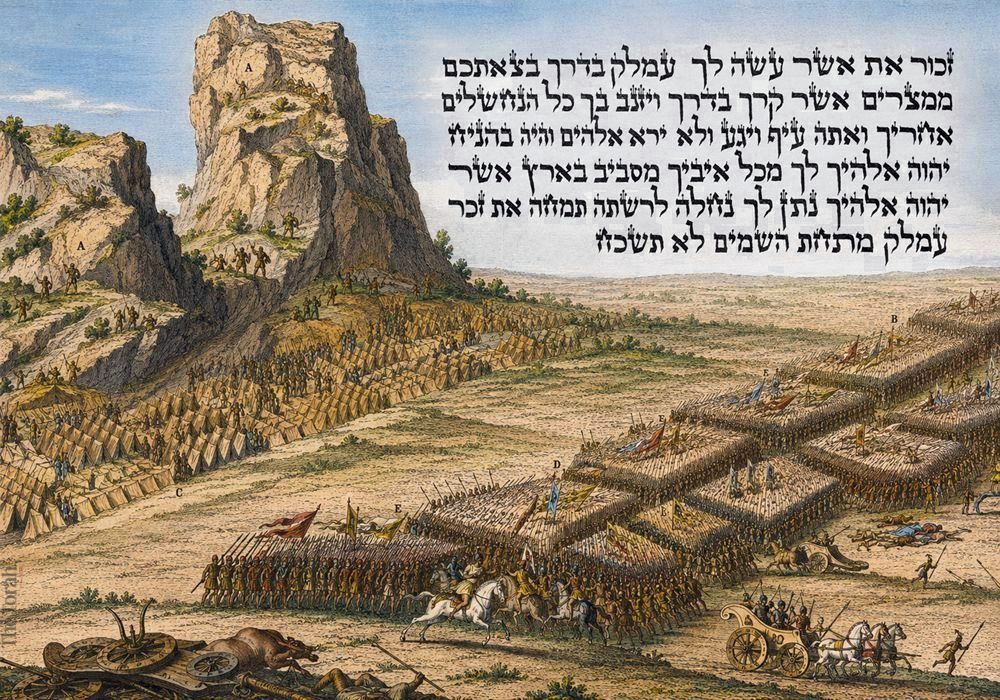
Defeating the Amalekites while camping at Rephidim, Exodus 17:14. From Augustin Calmet’s Dictionnaire historique, critique, chronologique, géographique et littéral de la Bible, vol. 1 (1730), Gallica BnF. With the Hebrew text of Deuteronomy 25:17–19, Parashat Zachor.
We first meet Amalek just after the exodus, when he attacks the newly freed Israelites just after their thirst‑driven outburst at Rephidim (i.e., at Massah and Meribah; Exod 17:1–7). The Israelites win the battle (vv. 8–13), and YHWH declares His intention to wipe out the memory of Amalek:[1]
שמות יז:יד וַיֹּאמֶר יְ־הֹוָה אֶל מֹשֶׁה כְּתֹב זֹאת זִכָּרוֹן בַּסֵּפֶר וְשִׂים בְּאׇזְנֵי יְהוֹשֻׁעַ כִּי מָחֹה אֶמְחֶה אֶת זֵכֶר עֲמָלֵק מִתַּחַת הַשָּׁמָיִם.
Exod 17:14 Then YHWH said to Moses, “Inscribe this in a document as a reminder, and read it aloud to Joshua: I will utterly blot out the memory of Amalek from under heaven!”[2]
Forty years later, Moses revisits the episode, adding a morally charged justification for the genocidal decree: Amalek targeted the stragglers at the rear of the camp—the weak, the slow, the exposed:[3]
דברים כה:יז זָכוֹר אֵת אֲשֶׁר עָשָׂה לְךָ עֲמָלֵק בַּדֶּרֶךְ בְּצֵאתְכֶם מִמִּצְרָיִם. כה:יח אֲשֶׁר קָרְךָ בַּדֶּרֶךְ וַיְזַנֵּב בְּךָ כׇּל הַנֶּחֱשָׁלִים אַחֲרֶיךָ וְאַתָּה עָיֵף וְיָגֵעַ וְלֹא יָרֵא אֱלֹהִים.
Deut 25:17 [NRSVue] “Remember what Amalek did to you on your journey out of Egypt, 25:18 how he attacked you on the way, when you were faint and weary, and struck down all who lagged behind you; he did not fear God.”
Modern translations invariably assume that Amalek is the subject of the final phrase:לֹא יָרֵא אֱלֹהִים, “he did not fear God,” a grammatically viable option in Hebrew. The NJPS translation even takes the liberty of relocating the phrase back to the beginning of the verse
Deut 25:18 “...how, undeterred by fear of God, he surprised you on the march, when you were famished and weary, and cut down all the stragglers in your rear.”
Ancient translations such as the Greek Septuagint and the Aramaic Targumim assume likewise. Thus, the Septuagint renders the verse:
LXX Deut 25:18 “...how he withstood you on the way and cut off your tail, all those who lagged behind you, but you were hungry and weary, and he did not fear God.”[4]
Godfearers are Non-Israelites?
Jeffrey Tigay (University of Pennsylvania) and others argue that “fear of God” likely refers to Amalek because that specific phrase appears elsewhere in stories involving non‑Israelites:
- Abraham bemoans the lack of the fear of God in Gerar (Gen 20:11);
- Joseph, presenting himself as an Egyptian, claims to fear God (Gen 42:18);
- And the midwives, fearing God, refuse to obey Pharaoh’s command to kill the Hebrew newborn males (Exod 1:17).[5]
In these cases, “fear of God” signals a basic moral conscience that is shared across cultures, and thus expected of non-Israelites as well.
It is true that Jews in the Hellenistic diaspora would deploy specific Greek terminology to describe non-Jews who sympathized with the Jewish community, including φοβούμενος τὸν θεόν (phoboumenos ton theon), “Godfearer.” These Gentile adherents—famously mentioned in the New Testament book of Acts (e.g., 10:1–2, 13:26) and in an inscription from Aphrodisias—admired Israel’s God, attended synagogue, and embraced Jewish ethics without full conversion.[6] But terminology about “fearing God” is hardly limited to pagans, either in Hellenistic times or in the Torah itself (more on this later).
But Is Amalek the Subject?
Despite the apparent consensus, the Hebrew text is not nearly so clear. The three predicates—עָיֵף, “tired,” יָגֵעַ, “weary,” and לֹא יָרֵא, “not fearing”—are all stative verbs in the masculine singular. In the standard reading, the first two describe Israel (“you were tired and weary”), while the third suddenly shifts back to Amalek (“and he did not fear God”). Such translations are entirely possible, but so is the alternative that Israel is the subject throughout—tired, weary, and themselves “not fearing God,” a failure that made Amalek’s attack possible:[7]
דברים כה:יח אֲשֶׁר קָרְךָ בַּדֶּרֶךְ וַיְזַנֵּב בְּךָ כׇּל הַנֶּחֱשָׁלִים אַחֲרֶיךָ וְאַתָּה עָיֵף וְיָגֵעַ וְלֹא יָרֵא אֱלֹהִים.
Deut 25:18 “...what happened to you along the way as he attacked the stragglers in your rear guard, when you were tired, and weary, and not fearing God.”
Amalek Attacked because Israel Didn’t Fear God
Though rare, reading Israel as the subject is not new. The Mekhilta d’Rabbi Ishmael (3rd century C.E.) gives pride of place to the view that Amalek lacked fear of God, but goes on to record:
מכילתא דרבי ישמעאל, מסכתא דעמלק א אֲחֵרִים אוֹמְרִים: "וְלֹא יָרֵא אֱלֹהִים", אֵלּוּ יִשְׂרָאֵל שֶׁלֹּא הָיוּ בְיָדָן מִצְווֹת.
Mekhilta d’Rabbi Ishmael, Amalek §1 Others say: “וְלֹא יָרֵא אֱלֹהִים,” this is Israel, who possessed no commandments.[8]
Chronologically in Exodus, this episode immediately precedes the Sinai pericope, and thus the issue is that Israel had not yet received the commandments to protect them from their enemies.
Lax Engagement in Torah
Midrash Tanhuma (mid-first millennium C.E.), playing on the name Rephidim, understands that Amalek attacked Israel because Israel weakened their engagement in Torah:
מדרש תנחומא, בשלח כה אֲחֵרִים אוֹמְרִים: אֵין רְפִידִים אֶלָּא שֶׁרָפוּ יְדֵיהֶם מִן הַתּוֹרָה, וּלְפִיכָךְ עֲמָלֵק בָּא עֲלֵיהֶם.
Midrash Tanhuma, Beshalach 25 Others say that refidim (Rephidim) means that their hands became lax (sherafu yedehem) in upholding the Torah. Therefore Amalek attacked them.
Desecrating Shabbat
The Talmud suggests that because some of the people did not properly observe the very first Shabbat after the exodus—they went out to gather manna—Israel became vulnerable, and Amalek was able to attack the Israelites soon afterward:
בבלי שבט קיח: אָמַר רַב יְהוּדָה אָמַר רַב: אִלְמָלֵי שָׁמְרוּ יִשְׂרָאֵל שַׁבָּת רִאשׁוֹנָה לֹא שָׁלְטָה בָּהֶן אוּמָּה וְלָשׁוֹן, שֶׁנֶּאֱמַר: ״וַיְהִי בַּיּוֹם הַשְּׁבִיעִי יָצְאוּ מִן הָעָם לִלְקוֹט״, וּכְתִיב בָּתְרֵיהּ: ״וַיָּבֹא עֲמָלֵק״.
b. Shabbat 118b R. Yehuda said that Rav said: Had Israel observed the first Shabbat, no nation or tongue would have dominated them, as it is stated: “Yet on the seventh day, some of the people went out to gather...” (Exod 16:27), and immediately afterward it is written: “And Amalek came.”
Yet this interpretation strains the narrative, since their complaint about water at Rephidim intervenes between the manna incident and Amalek’s strike.
Financial Corruption in the Wilderness
Noting that Moses reminds the Israelites about Amalek immediately after issuing laws of honest commerce (Deut 25:13–16), Da‘at Zekenim, 13th c. France, specifies the sin that demonstrated the Israelites’ lack of fear in God—dishonest weights and measures:[9]
דעת זקנים, דברים כה:יח ולא ירא אלהים. במשקולות לכך נסמך לפ' לא יהיה לך בביתך וגו' לפי שלא קיימו מורא דמשקולות דכתיב בהו ויראת מאלהיך לכך בא עמלק.
Da‘at Zekenim, Deut 25:18 “And he did not fear God.” [This refers to dishonest] weights. This is why it is juxtaposed with the passage, “You shall not have in your house [alternate weights]…” (Deut 25:14), because they did not observe the requirement to fear God regarding weights, as it is written concerning them: “You shall fear your God.” Therefore, Amalek came.[10]
On this view, Israel’s lack of fear of God, manifest in commercial dishonesty, invited Amalek’s attack. This explanation also strains the context, however. These Israelites had been slaves mere days earlier. Were they already running corrupt marketplaces in the wilderness?
If not Torah observance, Shabbat violations, or dishonest scales, then what sort of behavior might have warranted the accusation that the Israelites “did not fear God”?
Fear God, and Do Not Exploit the Vulnerable!
To answer that, we must consider what “fear of God” means in the Torah. Deuteronomy stresses repeatedly how important it is for the Israelites to learn to fear God:
דברים ח:ו וְשָׁמַרְתָּ אֶת מִצְוֺת יְ־הֹוָה אֱלֹהֶיךָ לָלֶכֶת בִּדְרָכָיו וּלְיִרְאָה אֹתוֹ.
Deut 8:6 Therefore keep the commandments of YHWH your God: walk in His ways and fear Him. (cf. 4:10; 6:2, 13, 24; 10:12, 20; 14:23; 17:19)
It is hard to tell, however, precisely what such fear entails. As Jeffrey Tigay explains, the phrase often seems to function as shorthand for obeying God’s commandments.[11]
Leviticus, however, gives the term a sharper edge.[12] Five of its laws end with the admonition וְיָרֵאתָ מֵאֱלֹהֶיךָ, “you shall fear your God,” and every one of them aims to protect someone who is vulnerable:
- Deaf and blind (Lev 19:14)
- Elderly (Lev 19:32)
- Cheated consumer (Lev 25:17)
- Debtor under duress (Lev 25:36)
- Indentured servant (Lev 25:43)
Taking advantage of certain victims is simply too easy. Who would know if an unprincipled person guided a blind traveler toward a treacherous path or cursed a deaf person behind his back? What resistance would one encounter when scamming the elderly, cheating a greenhorn, or pressuring a desperate man into a predatory loan? The aggrieved party may not even recognize the harm being done, much less have the capacity to seek redress.[13]
Fear of God, in this sense, is neither terror nor awe. It is ethical attention—the refusal to exploit someone simply because it can be done with impunity.
Fear of God Is Not Just for Pagans
The claim sometimes made by commentators that only non-Israelites are described as fearing God (rather than אֱלֹהֶיךָ, “your God” or יְ־הֹוָה, “YHWH”)[14]—which would suggest that the phrase וְלֹא יָרֵא אֱלֹהִים, “and he did not fear God” (Deut 25:18) cannot refer to Israel—does not withstand scrutiny. At the climax of the akedah, the angel describes Abraham as God-fearing, using the unqualified אֱלֹהִים:
בראשית כב:יב וַיֹּאמֶר אַל תִּשְׁלַח יָדְךָ אֶל הַנַּעַר וְאַל תַּעַשׂ לוֹ מְאוּמָה כִּי עַתָּה יָדַעְתִּי כִּי יְרֵא אֱלֹהִים אַתָּה וְלֹא חָשַׂכְתָּ אֶת בִּנְךָ אֶת יְחִידְךָ מִמֶּנִּי.
Gen 22:12 And he said, “Do not raise your hand against the boy, or do anything to him. For now I know that you are one who fears God, since you have not withheld your son, your favored one, from Me.”
If “fearing God” is a flexible moral category that can describe pagans, Israelites, and righteous Gentiles alike, then Israel, rather than Amalek, may be the the one described as “not fearing God” here in Deuteronomy.
Israel Did Not Protect Its Stragglers
Understanding Israel as not fearing God turns the moral lens of the verse inward. It forces us to ask a harder question, namely why the stragglers at the back of the camp were so exposed in the first place? Even if Amalek is a paradigmatic enemy who attacks the defenseless, why were the tired, the slow, the elderly, the sick—the very people Leviticus tells us to protect—allowed to fall behind and left undefended?
A community that truly “fears God” would not abandon its most vulnerable members, especially when exhausted, frustrated, or stretched thin. And that is precisely the point. When Israel is “tired and weary,” it is most susceptible to forgetting its obligations and most in need of remembering them. Read this way, Deuteronomy retelling of the attack at Rephidim is not only a condemnation of Amalek: It is a warning to Israel—and to us.
When we are worn down, depleted, or overwhelmed, we are most likely to neglect those who depend on us. Fear of God begins at the back of the camp. And perhaps that is why the Torah commands us to remember Amalek: not only to condemn that Amalek attacked the “stragglers,” but to exhort us to vigilance in protecting them, whenever and wherever they are.
Philology alone cannot decide whether וְלֹא יָרֵא אֱלֹהִים, “not fearing God” (Deut 25:18) refers to Amalek or Israel. Both readings are possible. But reading Israel as the subject offers a deeper, more challenging message.
If Amalek is the one who lacked fear of God, then the story is morally quite simple. Amalek is a villain, a reprobate who preyed on the weak. Israel is the innocent victim. The lesson is clear and comfortably external: beware of Amalek.
But reality is rarely so tidy.
TheTorah.com is a 501(c)(3) nonprofit organization.
We rely on the support of readers like you. Please support us.
Published
August 21, 2026
|
Last Updated
October 3, 2026
Previous in the Series
Next in the Series
Before you continue...
Thank you to all our readers who offered their year-end support.
Please help TheTorah.com get off to a strong start in 2025.
Footnotes


Dr. Rabbi Joshua Garroway is the Sol and Arlene Bronstein Professor of Judaeo-Christian Studies at HUC-JIR in Los Angeles. He holds a Ph.D. from the Religious Studies Department at Yale and ordination from HUC-JIR in Cincinnati. He is the author of, The Beginning of the Gospel: Paul, Philippi, and the Origins of Christianity.
Essays on Related Topics: