


 Edit article
Series
Kosher Torah Text? Three Generations of Maimonides—Strict to Lenient


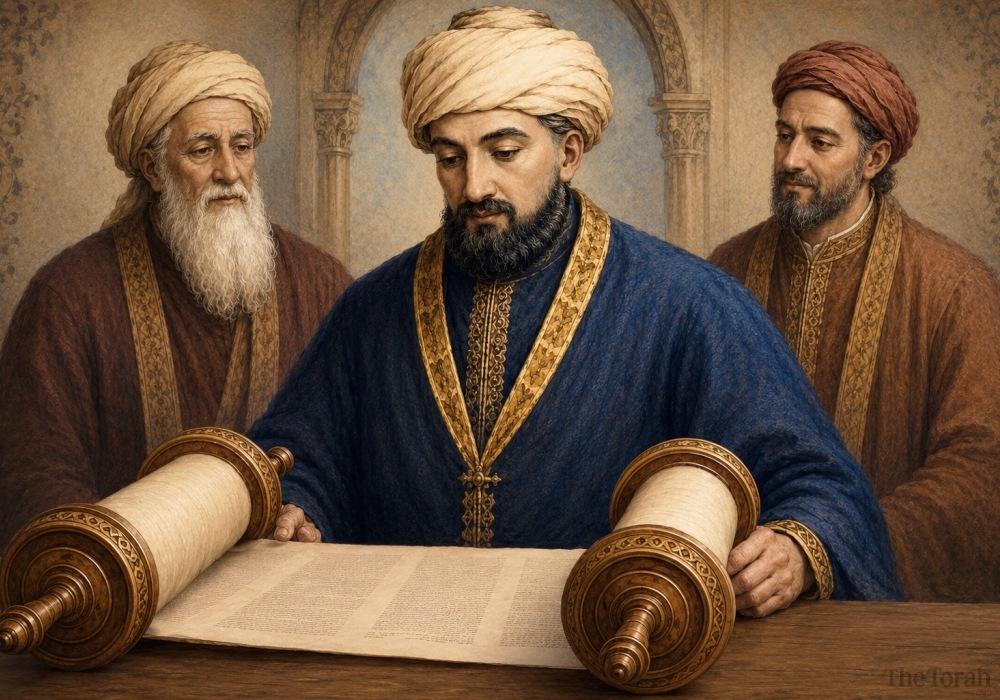
Moses Maimonides with his father, Rabbi Maimon, and his son, R. Abraham. AI
The requirement for absolute precision in reproducing the text of the Torah[1] is derived in the Talmud from breaking up the word וּכְתַבְתָּם in the Shema into two words כְּתַב־תָּם, ” perfect writing”:
בבלי שבת קג: [וטיקן 108] "וּכְתַבְתָּם" (דברים ו:ט, יא:כ)—שיהא כתיבה תמה.
b. Shabbat 103b [Vatican 108] “And you shall write them (ukhtavtam)” (Deut 6:9, 11:20)—the writing (ketivah) must be perfect (tamah).
While the passage in Deuteronomy is referring to some unit smaller than the entire Torah when commanding to write down “these words,” the rabbis understood it as a reference to the Torah as a whole. The Talmud then introduces a legal discussion, dealing with errors that are likely to occur in writing the letters,[2] and then moves to various requirements for proper paragraph spacing and formatting.
Maimonides’ Father: Every Letter Dictated
While the Talmud is making a straightforward halakhic statement, R. Moses Maimonides’ (1138–1204), in his little-known commentary on the Talmud,[3] offers a theological underpinning from his father, Rabbi Maimon (ca. 1110–1166), who is expressing what he learned from his teacher, Rabbi Joseph ibn Migash (1077–1141).[4]
פרוש הרמב"ם על בבלי מגילה לא: צריך אתה לידע[5] שהתורה כולה מבראשית עד לעיני כל ישראל כתובה לפני הקב"ה אלפ[ים] שנה קוד[ם] לבריית העו[לם] שאמרנו בכמה מקומ[ות].[6]
Maimonides’ Commentary on b. Megillah 31b You must know that the entire Torah, from “In the beginning” (Gen 1:1) to “before the eyes of all of Israel” (Deut 34:12) existed in writing before the Blessed Holy One 2,000 years before the creation of the world,[7] as we have said in several places.[8]
Rabbi Maimon then emphasizes that this refers not to the Torah in some general or abstract way, but to all the laws—even the ones that came in response to questions put to Moses in the Torah, such as those of Zelophechad’s daughters about inheritance or what to do with a blasphemer:
פרוש הרמב"ם על בבלי מגילה לא: ולא תאמ[ר] שהמצות שנאמרו לו למשה קודם שישאל הם שהיו כתובין אלפים שנה קודם לברייתו של עולם, כגון עשר הדברות ומילה ואכילת חלב ודם, אבל מצות ששאל ואחר כן נאמרו לו כגון פרשת פסח שני (במדבר ט:ו–יד) ופרשת נחלות (במדבר כז:א–יא) ופרשת מקושש (במדבר טו:לב–לו) ופרשת מקלל (ויקרא כד:י–כג) לא כ[תיב]ן. לא. אלא הכל כתוב היה.
Maimonides’ Commentary on b. Megillah 31b And do not say that it is only the commandments that Moses was given before he asked any questions that were written two thousand years before the creation of the world, such as the Decalogue, circumcision, and [the prohibition] to consume suet and blood. Rather [even] the commandments that [Moses] asked about and only afterwards informed about—such as the passage about the second Paschal offering day (Num 9:6–14), and the passage about inheritance (Num 27:1–11), and the passage about the wood gatherer (Num 15:32–36), and the passage about the one who cursed God (Lev 24:10–23)—were not written. No! Rather everything was written.[9]
He then adds that it also applies to all the narrative details, even the seemingly unimportant genealogies of people who were not yet born:
[ולא תאמר המצות כתובות לפני] המקום אבל יוחסין לא כתיבי, לא. אלא כל היוחסין כגון (בראשית י:ו): "(ובניהם) {ובני חם} כו[ש ומצרים ופוט] וכנען", ואע׳׳פ שלא נברא אדם שהוא הוליד את חם, ואלה בני שעיר, ואף על פי [שלא נברא שעיר], ולא נולדו בניו, וכל שכן [יחוסי ישראל], כולהו כתיבי לפני מי שאמר והיה העול[ם].
And don’t say that the commandments were written before God, but the genealogies were not written. No! Rather all the genealogies such as (Gen 10:6): “And the sons of Ham are Kush, Mitzrayim, Put, and Canaan,” even though Adam, who begot Ham, had not yet been born. And (Gen 36:20) “these are the sons of Seir,” even though Seir had not yet been born, and his sons were not yet born, and certainly the genealogies of Israel—all of them were written before the One who spoke and the world came into being.[10]
Mosaic Authorship of the Primordial Torah
Having established that the entire Torah as we have it existed before creation, Rabbi Maimon goes on to explain what it means that Moses wrote it:
ודבר ידוע וברור ואין בן מחלוקת שהתורה כלה מבראשית ועד לעיני כל ישראל כתבה משה רבינו מפי הקב"ה.
And the matter is known and clear, with no debate, that Moses wrote the entire Torah, from “in the beginning” (Gen 1:1) to “before the eyes of all of Israel” (Deut 34:12), from the mouth of the Blessed Holy One.
The divine dictation to Moses was so specific that it encompassed alternative words (qeri vs. ketiv),[11] paragraph marks (open vs. closed), spelling (defective vs. plene), and even how the letters should be decorated with taggin (the latter three will be explained at length in what follows):
תיבה שאמר לו הקב"ה לכותבה מלאה מלאה, חסרה חסרה, ואות שאמר לו לכתוב קרי וכתיב קרי וכתיב פרשה שאמר לו לכתבה פתוחה פתוחה, סתומה סתומה, ואות שאמר לו לכתבן בשלשה תגין כתבן [בשלשה], בארבעה תגין כתבן בד'.
When the Blessed Holy One said to write a word plene, [he wrote it] plene, defective, [he wrote it] defective; and a word that He told him to write as a qeri and ketiv, [he wrote it] with a qeri and ketiv… A parasha that [God] told him to write open, [he wrote it] open, closed, [he wrote it] closed, and a letter that he told him to write with three taggin he wrote them with three, with four taggin, he wrote them with four.
ומשום הכי אם נכתבו תפילין ומזוזות וספרים משונות מן הסדר הזה, כגון ששינה בתגין או במליאות וחס[רות] או בסתומות ופתוחות יגנזו.
For this reason, if tefillin, mezuzot, and scrolls are written in a different way than this, for instance, if he changed the taggin or defective/plene writing, or closed/open paragraph, they should be buried.
Rabbi Maimon clarifies that, according to this principle, whether the Torah is speaking as if from God or as if from Moses, it is all dictated by God in God’s exact words, and Moses is simply writing down precisely what he was told to write.[12]
He concludes by arguing that even though Moses is depicted as speaking on his own in Deuteronomy, הכל מפי הקב"ה “it is all from the Blessed Holy One.”[13] In contrast to other medieval thinkers, who were open to seeing the speeches in Deuteronomy as the words of Moses,[14] which God has him write down later, Rabbi Maimon, quoting his teacher, sees every word, indeed every paragraph break, spelling and even decorative feature, as the direct word of God.
Maimonides Turns the Doctrine into Law
In his Mishneh Torah, Maimonides codifies the necessity of writing all the paragraph marks, and the defective/plene spellings in line with the original masorah:
רמב"ם, משנה תורה, ספר אהבה "הלכות תפילין מזוזה וספר תורה" ז:יא ...אם כתב המלא חסר, או החסר מלא, או שכתב מלה שהיא קרא וכתב כקריאתה... [15] או שכתב פרשה פתוחה סתומה, או שכתב הסתומה פתוחה, או שכתב השירה כשאר הכתב, או שכתב פרשה אחת כשירה, הרי זה פסול, ואין בו קדושת ספר תורה כלל, אלא כחומש מן החומשין שמלמדין בהן התינוקות:
Maimonides, Mishneh Torah, Ahava, “Laws of Tefillin, Mezuzah, and Torah Scroll” 7:11 …[I]f a person wrote a plene word defective, or a defective word plene, or if he wrote the qeri of a word the way it is to be read out loud (instead of its ketiv, the way it is to be written)… or if he wrote an open parasha instead of a closed one, or a closed one instead of an open one, or if he wrote a poem as if it were prose or prose as if it were a poem—this renders the Torah scroll invalid. Such a Torah scroll has no holiness at all, and is akin to a chumash from which one teaches children scripture.
The rule about formatting—poetry/prose, open/closed paragraph (referring to the amount of spacing that comes at the end of a paragraph)[16]—comes from the Talmud itself:
בבלי שבת קג: [וטיקן 108] פרשה פתוחה לא יעשנה סתומה, סתומ[ה] לא יעשנה פתוחה, או שכתבה כשירה, או שכתב השירה כיוצא בה, או שכתב שלא בדיו, או שכתב האזכרות בזהב—הרי אלו יגנזו.
b. Shabbat 103b [Vatican 108] An open paragraph (petucha) may not be written as a closed paragraph (setuma), and a closed paragraph may not be written as an open paragraph. Or, if a person wrote a [regular] paragraph in the form of a poem, or if he wrote a poem like a regular text; or if he wrote without ink; or if he wrote God’s name with gold—these [texts] must be buried.[17]
But Maimonides adds here the category—which his father also mentioned—of plene versus defective spelling, referring to the use of the four consonants aleph, heh, vav, and yod as long vowels, which grammarians call אמות קריאה or matres lectionis (in Latin), literally “mother of reading.” If a word is spelled without a mater, it is called defective; with a mater, it is called plene. Regarding their use, biblical writing is quite inconsistent.[18] Maimonides’ claim that any deviation on this makes the Torah scroll invalid conspicuously conflicts with the ruling of a different Talmudic passage.
Maimonides Contradicts the Talmud
The Talmudic passage begins by stating certain traditions that imply we have an exact letter count of the Torah, which would only be possible if there was total agreement on every instance of defective and plene spelling:
בבלי קידושין ל. [כת"י אוקספורד] לפי כך נקראו ראשונים סופרים שהיו סופרים כל אותיות שבתורה, שהיו אומרין:
b Kiddushin 30a [MS Oxford Hebrew b. 1/8–9] For this reason, the ancient ones were called soferim, for they would count (sofer) all of the letters in the Torah. For they would say:
ו' ד"גחון" (ויקרא יא:מב) חציין של אותיות שבספר תורה.
The vav of גחון (“belly”; Lev 11:42) is half the letters in the Torah.[19]
The passage then moves to a discussion between Rav Joseph and his student Abaye about this example:
בעי רב יוסף: "ו' דגחון מהאי גיסא או מהא יגיסא?"
Rav Joseph asked: “The vav of גחון, is it part of the first half or the second half?”
א[מר] ליה אביי: "וניתי ספר תורה ונמנינהו! מילא א[מר] רבה בר בר חנה א[מר] ר' יוחנן: 'לא זזו משם עד שהביאו ספרתורה ומנאום'!"
Abaye said to him: “Let’s bring a Torah scroll and count! Didn’t Rabbah bar bar Channah say that R. Yoḥanan said: ‘they didn’t move from there until they brought a Torah scroll and counted [the letters]’?!”[20]
א[מר] ליה: "אינהו בקיאין בחסירות ויתרות, אבל אנן לא בקיאינן בחסירות ויתרות."
[Rav Joseph] said to him: “They were experts in defective and plene writing, but we are not experts in defective and plene writing.”
According to Rav Joseph, while that list of traditions was compiled when an exact letter count existed, by his (Rav Joseph’s) time, this tradition was lost, and there were some unclarities about when maters were to be used and when not.
Later halakhists took Rav Joseph’s statement as bedrock. R. Aryeh Leib Gunzberg (1695–1785) in his Shaʾagas Aryeh (§36), for instance, went so far as to conclude that the biblical commandment for each person to write a Torah scroll can no longer be fulfilled at all, and survives only as a rabbinic obligation, given that we no longer know how to write a Torah scroll properly, insofar as defective/plene spellings are concerned.
Maimonides, however, seems to discount Rav Joseph’s view in favor of what Abaye assumed in his question, namely, that we still know the exact, proper way to write a Torah scroll, down to the last letter. This caused great consternation among halakhic decisors and commentators.
Some commentators attempt to limit Rav Joseph and Maimonides’ pronouncement to a subset of defective/plene spellings.[21] The simple interpretation, however, is that Rav Joseph believes that the traditions regarding which spellings are defective and which plene have been lost, and Maimonides rejects this view. Why does Maimonides see fit to reject the explicit view of Rav Joseph?
Understanding Maimonides’ Fundamentalism
Maimonides’s strict view here is based on a core belief, which he expresses in his list of faith principles:
רמב"ם, פירוש המשנה, הקדמה לפרק חלק והיסוד השמיני הוא תורה מן השמים. והוא, להאמין שכל התורה הזאת המצויה בידינו היום הזה היא התורה הנתונה למשה, ושהיא כֻלה מפי הגבורה, רצוני לומר, שהגיעה אליו כֻלה מאת ה'...
Maimonides, m. Sanhedrin, Introduction to Helek The eighth principle is that the Torah is from Heaven. This means to believe that this entire Torah, found is in our hands today, is the Torah that was given to Moses, and that it is entirely from the Powerful One, what I mean to say is, that that all of it came from God…[22]
But why does Maimonides, a rationalist philosopher, take such a hardline, dogmatic view? Beyond just the fact that he was following his father’s and his father’s teacher’s theological position (quoted above), I suggest two possibilities, the realistic and the rationomystical:
Realistic
Already in the medieval period, philosophically minded sages from Provence implied that Maimonides may not have really believed in all the principles he touted, especially the 8th (divine origin of the Torah) and the 13th (resurrection).[23] The most explicit such sage was R. Nissim of Marseilles (14th cent.), who claims that even the Mishnaic rabbis themselves did not actually believe in the literal divine origins of the Torah:
ר' נסים ממרסיי, מעשה ניסים ועל זה הצד, כפי מה שאחשוב, בא בלשון רבותינו (סנהדרין י, א): "והאומר אין תורה מן השמים", ולא אמר "המאמין", כי באמירה לבד הוא מזיק לרבים וכופר בתורה, ואף אם יאמין כמונו שהיא רבת התועלת.
R. Nissim of Marseilles, Maʿaseh Nissim For this reason, to my way of thinking, the language of the Sages is (m. Sanhedrin10.1): “One who says that the Torah is not from heaven,” and not: “One who believes.” For by speaking alone he harms the multitude and commits heresy, even if he believes as we do that the Torah is of great utility.[24]
Thus, it is possible that Maimonides adopts this position since he thinks it is necessary for people to believe the Torah is a perfect representation of God’s revelation; if they start worrying about errors in spelling or paragraphing, that could lead them to wonder what other mistakes might be possible.
One difficulty with this approach is how it seeps into his halakhic thinking: would Maimonides really disqualify a Torah scroll just to emphasize a necessary but not actually true belief?
Rationomystical
Maimonides’ über-rationalism leads him to make sweeping claims about God’s essence, what is popularly called his negative theology: We cannot know anything at all about God in the positive sense, argues Maimonides, since God is completely differentiated from anything in the human experience. God creates the universe, but we don’t know how and God knows what is happening in the universe. It is a kind of mystical paradox, in which we know something about God but don’t know it at the same time.[25]
In sum, Maimonides is saying that we can know that all of the Torah came from God to Moses, and that the transmission was perfect, but we cannot know the nature of how the transmission occurred since we don’t know how God can communicate with human beings. In other words, not only is God not anthropomorphic (with human body) or anthropopathic (with human feelings), God is not anthropopsychic (with human thought processes).
Once we can no longer even fathom divine thought (a rational claim), we can somehow accept that even though the Torah speaks exclusively about peoples, objects, and laws that relate only to this world, it is somehow an eternal expression of divine truths (a mystical claim). This kind of rationomysticism makes it possible for Maimonides to quote Resh Lakish’s claim that the Torah predates the creation of the world.
Philo and Resh Lakish: Torah Preexisted the Universe
The idea of God creating the universe with architectural plans is already found in the works of Philo (ca. 20 B.C.E.–c. 50 C.E.), the original rationomystic Jew, who states how God “making the visible and tangible objects correspond in each case to the incorporeal ideas.”[26] Resh Lakish’s iteration of this, however, that the plans are the Torah itself, which preexists the universe, makes little sense on the face of things: what does most of the Torah have to do with creation? How does one connect the genealogies of Simeon, or the details of the purifying skin disease with formation of mountains, rivers, fish, and mammals?
Maimonides’ rationomystical concept of negative knowledge solves this problem. We can just say that God’s power is infinite and beyond comprehension, so while do not know how a preexisting Torah relates to the creation of our world, nor do we understand what it means that all these details existed in a book before there was even a universe for the book to be in, we know that it is the case.[27] This kind of thinking allowed Maimonides to maintain the impossible idea, taught already by his father and his father’s teacher, R”i Migash, that the Torah down to the last letter is original, and if not done exactly to specifications, renders the Torah invalid.
Why Does Maimonides Drop the Taggin?
Given Maimonides’ hardline stance, it is at first surprising that he drops his father’s fourth example, taggin—the decorative elements atop certain letters— from his list. Rabbi Maimon and his teacher did not invent the idea that taggin are from God, but derive it from an aggadic text in the Talmud about crowns (the meaning of which in its original context is unclear[28]):
בבלי מנחות כט: אמר רב יהודה אמר רב: בשעה שעלה משה למרום מצאו להקב"ה שיושב וקושר כתרים לאותיות. אמר לפניו: "רבש"ע מי מעכב על ידך?" אמר לו: "אדם אחד יש שעתיד להיות בסוף כמה דורות ועקיבא בן יוסף שמו שעתיד לדרוש על כל קוץ וקוץ תילין תילין של הלכות."
b. Menachot 29b Rav Judah said in the name of Rav: “When Moses went up to the heavens [to receive the revelation], he found the Blessed Holy One sitting and putting crowns upon the letters. [Moses] said before him: “Master of Eternity, who is holding you back [from just giving me the Torah now]?” [God] said: “There is a person who is destined to live several generations from now, Akiva son of Joseph is his name, and he will derive from ever one of these marks, mounds upon mounds of legal minutiae.”[29]
Nevertheless, Maimonides does not treat the taggin as equal to the paragraph breaks and the defective/plene spellings. Instead, though he strongly encourages writing these correctly, he does not declare a Torah scroll invalid of the taggin are done incorrectly or left out altogether. After describing exactly how to write certain letters,[30] Maimonides continues:
משנה תורה, ספר אהבה "הלכות תפילין מזוזה וספר תורה" ז:ט כל הדברים האלו לא נאמרו אלא למצוה מן המובחר, ואם שינה בתיקון זה, או שלא דקדק בתגין, וכתב האותיות כולן כתקנן... הואיל ולא הדביק אות לאות, ולא חיסר, ולא הותיר, ולא הפסיד צורת אות אחת, ולא שינה בפתוחות וסתומות, הרי זה ספר כשר.
Mishneh Torah, Ahavah, “Laws of Tefillin, Mezuzah, and Torah Scroll 7:9 All these things were only said in the context of fulfilling a commandment the best way possible, but if one changed any of these parameters, or one wasn’t careful about the taggin, but the letters are all written properly… since the letters aren’t stuck together, and there are no missing or extra ones, and no letter was written unintelligibly, and one didn’t change any of the open or closed paragraphs—the scroll is valid.[31]
The reason for this exception is made clear in Maimonides’ responsa,[32] in which he explains what taggin are,[33] and even claims, as we saw in his father’s gloss, that they do, indeed, derive from Moses:
אמנם על מה ששאלתם אם הוא מנהג בודאי כי אין זה מנהג דזה קראוהו רבותינו ז"ל כתרי אותיות וכמו שאמרו מצאו להקב"ה קושר כתרים לאותיות וכן נמצא בספרי תורה שכתבם משה רבינו ע"ה
Regarding what you asked, if it is a custom, certainly it is not a custom, for this is what the rabbis of blessed memory called crowns on letters, and as they said, the Blessed Holy One was found making crowns on letters, and these were found in the Torah scrolls that Our Teacher Moses, of blessed memory, wrote.
Maimonides explains, however, that this tradition was lost:
אכן באריכות הזמן והטלטול נמצאו כמה וכמה חלוקים במסורת זה אומר בכה וזה אומר בכה ולא ראי זה כראי זה שיש מסורת שאומרים על אות אחת שצריכה שלש תגין ובמסורה אחרת נמצא באחת וכיוצא באופן שלא נמצאו מכוונין.
Yet, as time and went on, as well as [Jews] moving about, there began to be several differences in the tradition. This one does it one way, that one does it another way, and one [Torah scroll] doesn’t look like another [in their use of taggin]. For one tradition says that a certain letter needs three marks, and another tradition says one, and such like distinctions making [scrolls] appear different from each other.
ולכן היה בדעת החכמים לבטל התגין מאחר שיש כמה חילוקים ואנחנו לא נדע אנה נפנה. אמנם כאשר ראו כי אין זה מעכב דאין זה חילוק בפרשיות בפתוחות וסתומות כי אם במספר התגין ואינו מעכב כותבין התגין והוא מצוה מן המובחר אך אם לא יכתוב שום תגין אינו פוסל המצוה וכל הספרים אשר במערב כתובים בתגין. וכתב משה.
Therefore, the sages were considering cancelling the use of taggin altogether, since there are so many differences, and we don’t know where to turn. However, since they understood that the correct use of taggin is not necessary to make the scroll valid, since it is not like the division between open and closed paragraphs, but just the number of marks, and this doesn’t disqualify, so they write the taggin, which is the best way to fulfill the commandment, but if one doesn’t write any taggin, it does not invalidate the mitzvah, and all scrolls in the west are written with taggin. And thus wrote Moses [=himself].[34]
Maimonides’ Son: Paragraph Markers Are Also Lost
With his removal of taggin from the list, Maimonides already showed a chink in his uncompromising armor. A generation later, his son R. Abraham (1186–1237) applied the same logic to open and closed paragraphs markings, despite the Talmud’s (and his father’s!) strict position on the matter. The questioners asked how to deal with the fact that many Torah scrolls follow different traditions as to paragraph spacing:
שו"ת רבי אברהם בן הרמב"ם סימן צא ...אנו רואים שיש הרבה חלוקים בין הסופרים בדבר הפרשיות הפתוחות והסתומות, והספרים הנמצאים בישראל שונים הרבה בענין זה, וכבר ראינו בעלי הוראה ז"ל שנקראו במעמדם בכל אחד מן הספרים הללו, והוא דבר של טעם, כי אין עמנו ספר העזרה שנוכל לדקדק ממנו את הדבר, ואין בענין זה קבלה שהכל מסכימים עליה, עד שנפסל מה שיסתר אותה.
Responsa R. Avraham ben HaRambam §91 ...We see that there are many differences between scribes with regard to the open and closed paragraphs, and the scrolls found amongst Jews differ from each other greatly in this feature, and we have seen halakhic decisors who have themselves read from more than one version [when called up to do so], and this makes sense since we do not have the copy from the Temple courtyard with which to compare,[35] and the matter comes with no set tradition to which all agree, such that we would disqualify any text that veered from it.
והנכון לדקדק את הדבר כפי שהוא בחבור בספר אהבה, אך מה ששונה ממנו אין לפסק עליו שהוא פסול, אלא אם יהיה שונה מכל הספרים הנמצאים, למשל אם ימצאו בספר פרשה פתוחה ובכל הספרים האחרים הסכימו הסופרים שהיא סתומה, או סתומה והיא בכל הספרים פתוחה, הרי פוסקים שהיא פסולה, ואולם דבר שיש בו חלוק בין הסופרים לא נוכל לפסוק שהיא פסולה.
And the correct approach is to be careful [to write a Torah scroll’s paragraphs] in line with what is found in in [my father’s] Book of Ahava,[36] but anything that is different from that, should not be disqualified as invalid, unless it is different than all extant scrolls. For example, if one finds that a given paragraph is written as an open one in a given scroll, but in all other scrolls the scribes have agreed that it is a closed paragraph, or a closed paragraph which is open, it is declared to be invalid. In contrast, where the matter is debated by the scribes, we cannot offer a legal decision that it is invalid.
While it may—or may not—be surprising that the differences between how to mark certain paragraph diverged by the medieval ages, R. Abraham’s halakhic decision avoided declaring the Torah scrolls of many synagogues invalid.[37]
In his responsum, R. Avraham skirts the fact that his commonsense conclusion is in direct contradiction to that of his father, Moses Maimonides, who codified the Talmudic statement as law, and does not seem to take the fact that different traditions existed in his day as a mitigating factor, as he did for taggin. Notably, R. Avraham makes no mention of the taggin precedent, nor does he say a word about plene and defective spellings. In fact, R. Avraham seems to be avoiding dealing with his father’s position altogether, and mentioning the lenient precedent (taggin) would force him to face the strict precedents (spelling and paragraphs), which he is loathe to do.
Three Generations of Maimonides
Read across the three generations, the pattern portrays an extremely rigid definition of a legitimate Torah scroll dissolving one category at a time, and for two different reasons. Rabbi Maimon, transmitting what he had from ibn Migash, held that God dictated spelling, paragraphs, and taggin, and that any deviation would inevitably invalidate the Torah scroll.
Maimonides kept this as a belief, but removed the taggin from the legally binding category, because the manuscripts no longer agreed. And yet, he held onto the spelling, even though it contradicts the Talmud’s claim that we are no longer experts.
Finally, R. Avraham went so far as to partially remove the category of open/closed paragraphs—and by extension, he would likely have been lenient about spelling with maters[38]—because scrolls in his period no longer agreed and the people asking him were not going to declare them invalid and bury them.
While the doctrine remained firm, the halakha softened over the generations, apparently as a result of practical considerations, when the state of actual manuscripts made it impossible to enforce the stricter view.
TheTorah.com is a 501(c)(3) nonprofit organization.
We rely on the support of readers like you. Please support us.
Published
September 4, 2026
|
Last Updated
October 6, 2026
Previous in the Series
Next in the Series
Before you continue...
Thank you to all our readers who offered their year-end support.
Please help TheTorah.com get off to a strong start in 2025.
Footnotes


Dr. Rabbi Zev Farber is the Senior Editor of TheTorah.com at the Academic Torah Institute. He holds a Ph.D. from Emory University in Jewish Religious Cultures and Hebrew Bible, an M.A. from Hebrew University in Jewish History (biblical period), as well as ordination (yoreh yoreh) and advanced ordination (yadin yadin) from Yeshivat Chovevei Torah (YCT) Rabbinical School. He is the author of Images of Joshua in the Bible and their Reception (De Gruyter 2016) and co-author of The Bible's First Kings: Uncovering the Story of Saul, David, and Solomon (Cambridge 2025), and editor (with Jacob L. Wright) of Archaeology and History of Eighth Century Judah (SBL 2018). For more, go to zfarber.com.
Essays on Related Topics: