


 Edit article
Series
Moses Always Knew He Was a Hebrew—and So Did Everyone Else


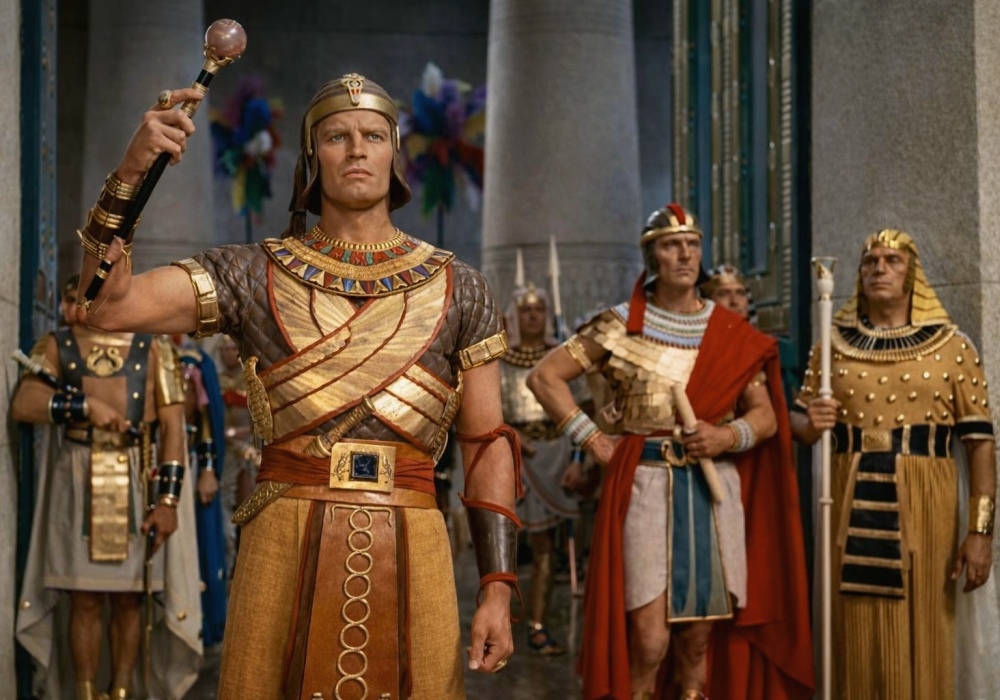
Charlton Heston as Moses in Pharaoh's Palace, Ten Commandments (1956)
Moses in the Movies
In Cecil B. DeMille’s Ten Commandments (1956), a servant named Memnet tells Nefretiri, Moses’ Egyptian love interest—it’s a Hollywood movie after all!—that Moses is actually a Hebrew:
He was born of Hebrew slaves—your king, Moses. I took him from his mother’s arms and delivered him to Bithiah, Pharaoh’s daughter. I saved him from death that was decreed upon all the male children of Israel. He is no prince of Egypt.
Nefertari takes this news very poorly, yelling “You lie! It’s not true!” Memnet then shows her the Hebrew cloth—not a biblical concept—which was in his basket, and warns her that she will inform Ramesses, the biological son of Pharaoh, that Moses is not really his brother. Nefertari responds by strangling Memnet with the cord of her gown.
When Moses enters, he sees Memnet dead and Nefertari holding the Hebrew cloth, and Nefertari tells him that she killed Memnet to keep his secret, and reassures him:
No one need ever know. The secret can die with her. You are still the prince of Egypt. You are still my Moses. Nothing has to change.[1]
The premise of the movie is that Bithiah—not a biblical name, but one derived from midrash[2]—raised Moses as her own son, keeping the fact that she was not his natural mother a secret. Even Ramesses believes himself to be Moses’ brother. Moses learning that he is really a Hebrew is a crisis that leads Moses to explore life among his own people.[3]
This premise, that Moses’ identity as a Hebrew was a closely guarded secret, is taken for granted in many popular takes on the life of Moses. For instance, in the animated Prince of Egypt (1998), Moses learns that he is a Hebrew when, after stopping a taskmaster who is whipping Yocheved—Moses’ biological mother, unbeknownst to him—his sister Miriam says:
You were saved from the river, Moses. You were placed in a basket… like a little ark, and set upon the Nile. And you were found by the princess. You’re the baby I saved. You’re my little brother.... Moses. You were born of our mother, Yocheved. You are one of us.
Shocked, Moses at first denies this: “That’s not true. You’re confused. You must be—” But Miriam responds emphatically: “No! It’s true. You were brought to the palace, but you came from here—from our people. From the Hebrews!” This leads Moses, in the next scene, to start struggling with his identity, asking the question: “Who am I?”[4]
In Exodus: Gods and Kings (2014), Moses goes to Pithom to investigate some unrest and ends up in a cave where Nun, the father of Joshua, tells Moses about his having been a baby in the river, found by Pharaoh’s daughter, Bithiah. Moses confronts Bithiah with this and she admits that it is true. Again, the underlying premise is that the Moses’ identity as an adopted Hebrew is Bithiah’s closely guarded secret, and Moses himself doesn’t even know.
These three films all assume that in the biblical narrative, Moses grows up thinking he’s an Egyptian. But is this really the case in the biblical narrative?
Going to See His Brothers
By the time Moses grows up, the biblical text implies that he already knows that he’s a Hebrew,[5] since he goes out to his “kinsfolk” or “brothers”:
שמות ב:יא וַיְהִי בַּיָּמִים הָהֵם וַיִּגְדַּל מֹשֶׁה וַיֵּצֵא אֶל אֶחָיו וַיַּרְא בְּסִבְלֹתָם...
Exod 2:11 Some time after that, when Moses had grown up, he went out to his kinsfolk and witnessed their toils...[6]
Abraham Ibn Ezra (1089–1164) suggests that Moses’ kinsfolk in Exod 2:11 efers to the Egyptians:
אבן עזרא (פירוש שני) שמות ב:יא "ויצא אל אחיו" המצרים, כי בארמון המלך היה.
Ibn Ezra (Second Commentary) Exod 2:11 “He went out to his kinsfolk” the Egyptians, for he was living in the king’s palace.
In Ibn Ezra’s reading, Moses is an elite wanting to see how the regular folk live, but then encounters how his own people, the Egyptians, mistreat the Hebrews. This, however, is a difficult way to understand the passage since, the continuation of the verse says specifically that the Hebrew is Moses’ kin, and the Egyptian is something other than kin.
Moreover, nothing in the passage explains how, if Moses thought he was Egyptian, how he came to know that he is a Hebrew. Rather, the passage explains why Moses, who by luck has had his life protected by Pharaoh’s daughter, leaves the palace and learns firsthand what his kinsfolk are really experiencing, and immediately sides with his own people against those that raised him. [7]
Thus, most commentaries assume the word אֶחָיו, “his kinsfolk,” refers to the Hebrews. For example, Midrash Tanchuma (mid-late 1st millennium C.E.) envisions Moses actually showing solidarity with his fellow Hebrew:
מדרש תנחומה שמות וַיַּרְא בְּסִבְלֹתָם – מַהוּ וַיַּרְא? שֶׁהָיָה רוֹאֶה וּבוֹכֶה בְּסִבְלוֹתָם, וְאוֹמֵר חֲבָל לִי עֲלֵיכֶם, מִי יִתֵּן מוֹתִי עֲלֵיכֶם. שֶׁאֵין לְךָ קָשֶׁה מִמְּלֶאכֶת הַטִּיט, וְהָיָה נוֹתֵן כְּתֵפָיו וּמְסַיֵּעַ לְכָל אֶחָד וְאֶחָד מֵהֶן. לְכָךְ כְּתִיב וַיַּרְא בְּסִבְלֹתָם.
Midrash Tanchuma Shemot “He witnessed their toils”—What did he witness? He saw them crying in their toils, saying “woe is me on your accounts! If only I could die in your place.” For there is nothing worse than working with mortar. And he would put out his shoulder and help each one of them, that is why it says “he witnessed their toils.”[8]
But when did he learn he was a Hebrew?
Some believe that Moses “finding out” that he was a Hebrew spurred his going out to see his kinsfolk. For example, R. Moses Nahmanides (Ramban ca. 1195–ca.1270) envisions Moses being informed somehow of his origins:
רמב"ן שמות ב:י וטעם "ויצא אל אחיו" – כי הגידו לו אשר הוא יהודי, והיה חפץ לראותם בעבור שהם אחיו. והנה הסתכל בסבלותם ועמלם, ולא יכול לסבול ולכן הרג המצרי המכה הנלחץ.
Nahmanides Exod 2:10 The reason for why “he went out to his kinsfolk” is because they told him he was an Israelite,[9] and he wished to see them because they were his kinsfolk. And here he witnessed their toils and hard work, and he could not tolerate it, therefore he killed the Egyptian who was beating the downtrodden [enslave Hebrew].
This is also the view of Moses Mendelssohn (1729–1786), whose gloss is quoted by Shadal (Samuel David Luzzato 1800–1865), who adds that Yochebed, his mother and nursemaid, likely informed Moses of his ancestry:
שד"ל שמות ב:י "ויצא אל אחיו"—כי הגידו לו את מולדתו והיה חפץ לראות את אחיו (רמבמ״ן), אולי כי אמו אשר היניקתו היתה הולכת כפעם בפעם לראות את שלום הנער כדרך המיניקות, וכשגדל מעט הגידה לו שהוא יהודי ושהיא אמו.
Shadal Exod 2:10 “Went out to his kinsmen”—For they told him his origins so he wished to see his kinsmen (Mendelssohn).[10] Perhaps his mother who had been his nursemaid, would go on occasion to see how the lad was doing, as nursemaids tend to do, and when he grew up a little, she told him he was an Israelite and that she was his mother.
Shadal, like Nahmanides, assumes that his adopted mother was keeping his ancestry a secret from him, or at least was not forthright about his origins, and that it must have been the Israelites who filled him in. And yet, these commentaries, like the movies, need to add an imaginary scene in which Moses learns about his Hebrew origin since the Torah itself never offers one. Instead, a more straightforward reading of the narrative is that Pharaoh’s daughter never pretended he was an Egyptian, and that Moses always knew his ethnic origins, as Levi Gersonides (Ralbag 1288–1344) writes:
רלב"ג שמות ב:י "ויצא אל אחיו" – יתכן שהיה מפורסם בבית פרעה כי משה היה עברי, ולזה ידע משה שהוא עברי, או הודיעה לו זה בת פרעה.
Ralbag Exod 2:10 “Went out to his kinsfolk”—it would seem that it was well known in Pharaoh’s house that Moses was a Hebrew, and thus, Moses knew he was a Hebrew, or else, Pharaoh’s daughter (must have) informed him.
Realizing that everybody always knew that Moses is an adopted Hebrew helps explain the events that follow, which lead to Moses having to leave Egypt.[11]
Nobody Thinks of Moses as the Prince
When Moses goes out to see his kinsfolk, he encounters a Hebrew being beaten by an Egyptian taskmaster:
שמות ב:יא ...וַיַּרְא אִישׁ מִצְרִי מַכֶּה אִישׁ עִבְרִי מֵאֶחָיו. ב:יב וַיִּפֶן כֹּה וָכֹה וַיַּרְא כִּי אֵין אִישׁ וַיַּךְ אֶת הַמִּצְרִי וַיִּטְמְנֵהוּ בַּחוֹל.
Exod 2:11 …He saw an Egyptian beating a Hebrew, one of his kinsmen. 2:12 He turned this way and that and, seeing no one about, he struck down the Egyptian and hid him in the sand.
Why must Moses kill him? Why not just tell the man to stop? Apparently, that is not something Moses has the power to do. If he was thought of as part of the royal family, and not just a privileged Hebrew, he would have the power to stop the Egyptian.
The next day, Moses encounters two Hebrews fighting and tries to stop it, and is greeted only with scorn:
שמות ב:יג וַיֵּצֵא בַּיּוֹם הַשֵּׁנִי וְהִנֵּה שְׁנֵי אֲנָשִׁים עִבְרִים נִצִּים וַיֹּאמֶר לָרָשָׁע לָמָּה תַכֶּה רֵעֶךָ. ב:יד וַיֹּאמֶר מִי שָׂמְךָ לְאִישׁ שַׂר וְשֹׁפֵט עָלֵינוּ הַלְהָרְגֵנִי אַתָּה אֹמֵר כַּאֲשֶׁר הָרַגְתָּ אֶת הַמִּצְרִי
Exod 2:13 When he went out the next day, he found two Hebrews fighting; so he said to the offender, “Why do you strike your fellow?” 2:14 He retorted, “Who made you chief and ruler over us? Do you mean to kill me as you killed the Egyptian?”
How is it that this Hebrew isn’t frightened of Moses, if Moses was considered to be Pharaoh’s grandson? Clearly, the Hebrew feels he has dirt on Moses, but given that royal family often get away with such things, why is this such a big issue? And yet, the offender is correct, since Moses is indeed frightened:
שמות ב:יג ...וַיִּירָא מֹשֶׁה וַיֹּאמַר אָכֵן נוֹדַע הַדָּבָר.
Exod 2:13 …Moses was frightened, and thought: Then the matter is known!
In fact, the next verse shows that Moses does not get away with it:
שמות ב:טו וַיִּשְׁמַע פַּרְעֹה אֶת הַדָּבָר הַזֶּה וַיְבַקֵּשׁ לַהֲרֹג אֶת מֹשֶׁה וַיִּבְרַח מֹשֶׁה מִפְּנֵי פַרְעֹה...
Exod 2:15 When Pharaoh learned of the matter, he sought to kill Moses; but Moses fled from Pharaoh…
If Moses had been adopted, why would the Pharaoh turn so sharply against him, wishing to kill him, just because Moses killed a taskmaster?
The Limits of Moses’ Privilege
Moses’ position in the royal palace appears to have been very limited. While on a whim, Pharaoh’s daughter decided to bring the boy up in the palace, this is akin to granting a member of an enslaved population a privileged status, something found in other historical situations of slavery.[12] Nevertheless, a member of an enslaved population always needs to look out, or else they can be sent back or disposed of on any provocation.
Moses killing an Egyptian for beating a Hebrew would have sent a powerful message to the palace that he scorns the privilege, and even after 20 years of relative ease,[13] he identifies with his own people and not with their enslavers, however friendly they were to him as an individual. In such a situation, Pharaoh’s wish to kill him is not surprising at all.
Indeed, beginning with the time when Moses was found, nothing implies that Pharaoh’s daughter intended to hide his origins.
Where Does Moses Live as a Baby?
After Pharaoh’s daughter finds baby Moses in a little ark among the rushes in the Nile, she decides she wants to keep him:
שמות ב:ו וַתִּפְתַּח וַתִּרְאֵהוּ אֶת הַיֶּלֶד וְהִנֵּה נַעַר בֹּכֶה וַתַּחְמֹל עָלָיו וַתֹּאמֶר מִיַּלְדֵי הָעִבְרִים זֶה.
Exod 2:6 When she opened it, she saw that it was a child, a boy crying. She took pity on it and said, “This must be a Hebrew child.”
A young Hebrew maiden, whom she does not realize is the boy’s sister (Miriam), asks if she should find for her a Hebrew woman to nurse the boy, and Pharaoh’s daughter agrees. The sister then brings the boy’s mother (Yochebed) to Pharaoh’s daughter:
שמות ב:ט וַתֹּאמֶר לָהּ בַּת פַּרְעֹה הֵילִיכִי אֶת הַיֶּלֶד הַזֶּה וְהֵינִקִהוּ לִי וַאֲנִי אֶתֵּן אֶת שְׂכָרֵךְ וַתִּקַּח הָאִשָּׁה הַיֶּלֶד וַתְּנִיקֵהוּ.
Exod 2:9 And Pharaoh’s daughter said to her, “Take this child and nurse it for me, and I will pay your wages.” So the woman took the child and nursed it.
While we might imagine Yochebed coming to the palace or even living there as a nursemaid, the next verse implies that baby Moses lived full-time with his Hebrew mother/nurse, only being returned to the Pharaoh’s daughter upon his weening:
שמות ב:י וַיִגְדַּל הַיֶּלֶד וַתְּבִאֵהוּ לְבַת פַּרְעֹה וַיְהִי לָהּ לְבֵן...
Exod 2:10 When the child grew up, she brought him to Pharaoh’s daughter, who made him her son….
What age is Moses weaned and thus returned to the Pharaoh’s daughter? The Torah never says, but at the party celebrating the weaning of Isaac, we are told that Ishmael was playing with him[14] so it is likely he was already at least 2 or 3 years old.[15] Similarly, in the Hellenistic period 2 Maccabees, the mother whispers to her seventh son:
2Macc 7:27 ...“My son, have pity on me. I carried you nine months in my womb and nursed you for three years and have reared you and brought you up to this point in your life and have taken care of you....”
If he returns at three years old, everyone would know that Moses was not the natural son of Pharaoh’s daughter, since she is not in possession of the child until he was around three.
“My Foundling”
The name Pharaoh’s daughter gives the baby expresses that Moses is not her natural son but a foundling, which implies that this aspect of the baby’s identity is not hidden:
שמות ב:י ...וַתִּקְרָא שְׁמוֹ מֹשֶׁה וַתֹּאמֶר כִּי מִן הַמַּיִם מְשִׁיתִהוּ.
Exod 2:10 …She named him Moses, explaining, “I drew him out of the water.”[16]
Indeed, the Torah never presents Pharaoh’s daughter as trying to keep Moses’ adoption a secret, and thus never addresses questions like how she could trick the people of the palace, given she had not been pregnant before his birth.
How is it that Pharaoh’s daughter brazenly adopts a Hebrew if her father was requiring all Hebrew baby boys to be thrown in the Nile? It would seem that, as Pharaoh’s daughter, she may do what as she pleases.[17] Nevertheless, this tension between Pharaoh’s decree (kill all male Hebrew infants) and her actions (adopting a male Hebrew infant) likely suggested to readers that she must have been hiding his origins.
A Different Kind of Hero
In popular culture, Moses sheds his power as the “son” of Pharaoh’s daughter to join his downtrodden people upon learning who he really was. This is a noble and heroic image, with much pathos. The biblical story, however, is about an infant from an enslaved people who is lucky to have caught the interest of the most powerful family in the kingdom, having been adopted by the Pharaoh’s daughter herself. Nevertheless, when he grows up, he finds that he cannot accept this tainted gift, and he throws his lot in with his own people, no matter the consequences.
Appendix
When Does Pharaoh’s Daughter Name Moses?
The pivotal role of the naming scene is clearer when we note a redaction critical point: Moses simply disappearing for three years right after the Pharaoh’s daughter found him is odd, as is her naming him only when he is weaned years later.
Redaction-critical scholars have noted that this scene is most likely a revision of the older story, which had nothing about an older sister watching over the baby. Indeed, the opening of the story strongly implies that this baby was the couple’s firstborn:
שמות ב:א וַיֵּלֶךְ אִישׁ מִבֵּית לֵוִי וַיִּקַּח אֶת בַּת לֵוִי. ב:ב וַתַּהַר הָאִשָּׁה וַתֵּלֶד בֵּן...
Exod 2:1 A certain man of the house of Levi went and took the daughter of Levi. 2:2 The woman conceived and bore a son…
As Jacob Wright (“The Birth of Moses: Between Bible and Midrash,” TheTorah 2013) notes, the verse leaves no room for an older sister (or brother), and that this this prompted the midrashic suggestion that Amram and Yochebed first had Miriam and Aaron, then separated, then reconnected (because of Miriam), conceiving Moses. If we remove the scene involving the sister and mother as nurse as a supplement, then we go immediately from Pharaoh’s daughter seeing the baby to her naming the baby:
שמות ב:ו וַתִּפְתַּח וַתִּרְאֵהוּ אֶת הַיֶּלֶד וְהִנֵּה נַעַר בֹּכֶה וַתַּחְמֹל עָלָיו וַתֹּאמֶר מִיַּלְדֵי הָעִבְרִים זֶה. // שמות ב:י וַתִּקְרָא שְׁמוֹ מֹשֶׁה וַתֹּאמֶר כִּי מִן הַמַּיִם מְשִׁיתִהוּ.
Exod 2:6 When she opened it, she saw that it was a child, a boy crying. She took pity on it and said, “This must be a Hebrew child.” // 2:10 She named him Moses, explaining, “I drew him out of the water.”
In this reconstruction, the naming follows immediately upon finding him, and it does not envision Moses being nursed by his mother. What comes clearly from this fast-moving scene is that Pharaoh’s daughter loves that she is bringing up a Hebrew, and there is no reason to think she would have hidden this fact from the child or anyone else.
TheTorah.com is a 501(c)(3) nonprofit organization.
We rely on the support of readers like you. Please support us.
Published
January 8, 2026
|
Last Updated
October 5, 2026
Previous in the Series
Next in the Series
Before you continue...
Thank you to all our readers who offered their year-end support.
Please help TheTorah.com get off to a strong start in 2025.
Footnotes


Dr. Rabbi Zev Farber is the Senior Editor of TheTorah.com at the Academic Torah Institute. He holds a Ph.D. from Emory University in Jewish Religious Cultures and Hebrew Bible, an M.A. from Hebrew University in Jewish History (biblical period), as well as ordination (yoreh yoreh) and advanced ordination (yadin yadin) from Yeshivat Chovevei Torah (YCT) Rabbinical School. He is the author of Images of Joshua in the Bible and their Reception (De Gruyter 2016) and co-author of The Bible's First Kings: Uncovering the Story of Saul, David, and Solomon (Cambridge 2025), and editor (with Jacob L. Wright) of Archaeology and History of Eighth Century Judah (SBL 2018). For more, go to zfarber.com.
Essays on Related Topics: