


 Edit article
Series
Behind the Mockery: Jewish Responses to Jesus’ Crucifixion and Resurrection


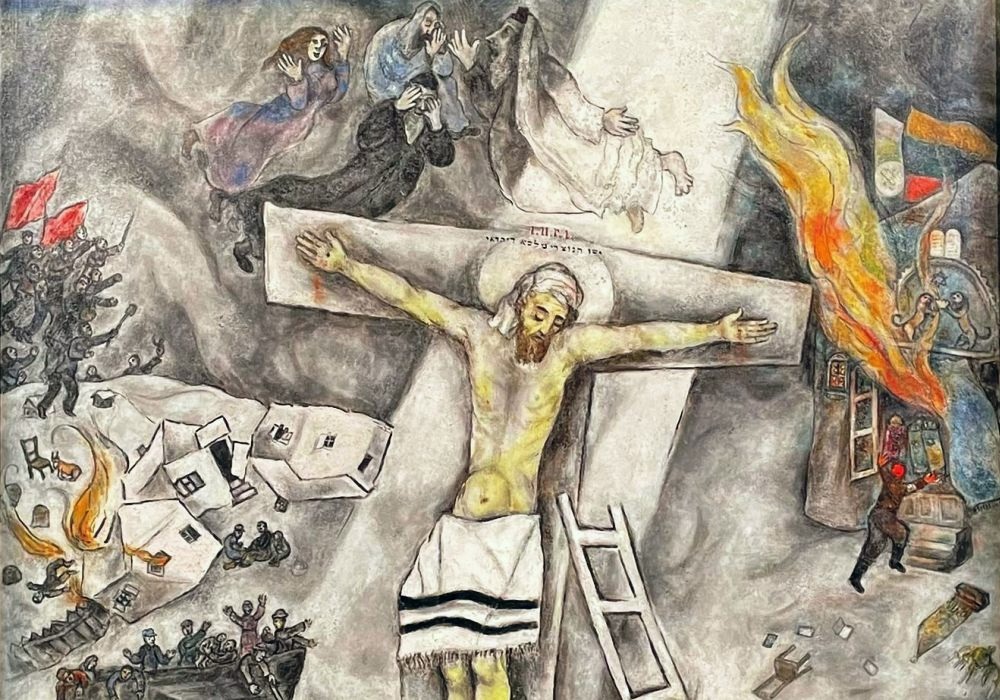
White Crucifixion (detail), Marc Chagall, 1938. Wikimedia
Jesus’ Execution in the Talmud
The Talmud has scattered references to Jesus’s life and execution and burial, which scholars have been probing for centuries. Concerning his trial and execution, a baraita (external source) in tractate Sanhedrin, deleted from most printed editions of the Babylonian Talmud, but attested to in the manuscripts,[1] states that Jesus was executed because of his engagement in sorcery and leading other Jews astray:
בבלי סנהדרין מג. בְּעֶרֶב הַפֶּסַח תְּלָאוּהוּ לְיֵשׁוּ הַנּוֹצְרִי, וְהַכָּרוֹז יוֹצֵא לְפָנָיו אַרְבָּעִים יוֹם: ״יֵשׁוּ הַנּוֹצְרִי יוֹצֵא לִיסָּקֵל עַל שֶׁכִּישֵּׁף וְהֵסִית וְהִדִּיחַ אֶת יִשְׂרָאֵל. כׇּל מִי שֶׁיּוֹדֵעַ לוֹ זְכוּת יָבוֹא וִילַמֵּד עָלָיו״. וְלֹא מָצְאוּ לוֹ זְכוּת, וּתְלָאוּהוּ בְּעֶרֶב הַפֶּסַח.
b San 43a On Passover Eve they hung [the corpse of] Jesus the Nazarene [after they had stoned him]. And a crier had gone out before him for forty days [publicly proclaiming]: Jesus the Nazarene is going to be stoned because he practiced sorcery, incited [the Jewish people to commit idolatry], and led them astray. Anyone who can say anything in his favor should come forward and plead on his behalf. But they could find nothing in his favor, and they hung him on Passover Eve.[2]
In the Talmud’s telling, Jesus is a sorcerer and a subverter of all Israel, and thus is given the death sentence of stoning, following Torah law (Deut 13:11). And yet, even the Talmud feels the need to account for the well-known image of Jesus on a cross by invoking Deuteronomy’s requirement to hang the body of the executed person:
דברים כא:כב וְכִי יִהְיֶה בְאִישׁ חֵטְא מִשְׁפַּט מָוֶת וְהוּמָת וְתָלִיתָ אֹתוֹ עַל עֵץ.
Deut 21:22 If someone is guilty of a capital offense and is put to death, and you impale the body on a stake.[3]
No echo of the Gospel stories of the crucifixion can be found in this fanciful and implausible depiction of events, which serves to justify Jesus’ execution. Indeed, Ulla, a third century amora who travelled between the lands of Israel and Babylonia, is confused as to why Jesus would have received such unusual consideration:
אָמַר עוּלָּא: וְתִסְבְּרָא? יֵשׁוּ הַנּוֹצְרִי בַּר הַפּוֹכֵי זְכוּת הוּא? מֵסִית הוּא, וְרַחֲמָנָא אָמַר (דברים יג:ט): ״לֹא תַחְמֹל וְלֹא תְכַסֶּה עָלָיו!״ אֶלָּא שָׁאנֵי יֵשׁוּ, דְּקָרוֹב לְמַלְכוּת הֲוָה.
Ulla retorted: “Do you understand this? Was Jesus the Nazarene worthy of a search for acquittal? He was an inciter, concerning whom scripture says, ‘you shall not show pity nor should you conceal him?’ (Deut 13:9). Jesus was different, for he had close [ties] with the government.”
The Talmud’s answer to Ulla, that Jesus was close to the government,[4] explains the highly unusual forty-day period of daily announcing of Jesus’ trial.[5]
It would seem that the authors of the Talmud, while aware of Jesus and his story, were either uninterested in, or unaware of, the gospel accounts of Jesus’ suffering and crucifixion. Yet other Jewish texts from this same period do present Jesus as having been crucified (or impaled) and not stoned.
Jesus’ Death: Like Haman’s
An Aramaic Purim-themed poem, composed in late 5th century Byzantine Palestine,[6] envisions the story as told by the Gospels and not like the one found in the Babylonian Talmud. In the poem, Haman complains about his fate, and Jesus responds that Haman’s experience was not unique, as he experienced the same treatment. Jesus goes on to explain his crucifixion in some detail:
סבר את בגרמך \ דאת צלב לגרמך \ ואנא שותף עימך
Do you believe that you alone, that you alone were crucified? I too shared your lot.
Jesus then complains at how he is now treated like a Roman idol, referring to his image on the crucifix:
סמיר על קיס \ ודמותי במרקוליס \ מצייר על קיס
Nailed to wood (i.e., a cross), I am (an idol) like Mercury,[7] depicted upon a piece of wood.
He then continues the self-mockery, wondering how people could be so naïve as to call him Christ after what he had been through:
סמיר על קיס \ ובשרי לטופח נקיס \ ובר נגיד הקיס
Nailed to wood, my flesh slashed at hand-breadth length, I am the son of one who carries wood [i.e., a carpenter]
סכיף באיסקוטוס \ מן אתא זיניטוס \ וקרון יתי כריסטוס
Lashed by rods, of woman born, they call me the savior (christos).
סמר במסמרין \ בגפיי מסמרין \ טב מיני אכל שע[רין][8]
Pierced with nails, my limbs clamped into place, a barley eater is better than I.
ספיה די נקיב[תה] \ עבידין בהתה \ בכל [אתר] ומדינתה \ א' פ[ל]וני
This is the end of the pierced one, disgraced in every [place] and town—Said so-and-so.[9]
Clearly, the author of the poem, knew many of the details in the Christian accounts, such as Jesus being nailed to wood, hands pierced, his father as carpenter, that he was beaten and pierced, and perhaps even the significance of his mother.
The Trees Reject Haman and Jesus
Targum Sheni, a long midrashic Aramaic rendering of the book of Esther (ca. 8th cent C.E.) knows of Jesus’ crucifixion, and also compares it to the impaling of Haman. God[10] calls together all the trees and asks which will agree to be the one on which Haman is impaled:
תרגום שני אסתר ז:ט אציתו לי אילניא וכל שתיליא דשתילו מן יומא דבראשית[11] דבר המדתא בעי למסוק לאכסנדריא דבר פנדירא! אתכנשו כולהון ועטו עיטה: מן דרומיה חמשין אמין יצטלב המן על רישיה.
Targum Sheni Esther 7:9 Listen to me, all you trees and plants that I have planted from the days of creation: The son of Hamdatha wants to go up on the high mast (=cross, gallows)[12] of Bar-Pandera (=Jesus)![13] So assemble all of you and take counsel, whichever of you is fifty cubits in height, Haman shall be impaled upon its head.
Teasing Haman for wishing to be important like Jesus by getting crucified/impaled on an enormous pole acknowledges the future popularity of Jesus on a crucifix—something Haman could not have known about since Jesus would only live hundreds of years after Haman. God and the heavenly court—and the reader!—do know.
At this point, the vine, wild fig, fig, olive, palm, citron, myrtle, oak, and pomegranate all find excuses for refusing to allow themselves to be Haman’s gallows. Only the cedar tree finally accedes, pointing out that Haman had chosen it himself, by erecting a pole that size for the execution of Mordechai:
"שמעו מני!" אמר ארזא. "צליבו יתיה להמן רשיעא ולעשרה בנוי עלי, על זקיפא די אתקין לנפשיה."
“Listen to me!”” said the cedar. “Impale the wicked Haman and his ten sons upon the pole which he prepared for himself."
The Version in Toledot Yeshu: Hung on a Cabbage Stalk
In Toledot Yeshu, a parodic version of Jesus’ life, which scholars estimate originated between the 7th and 9th centuries and continued to grow and proliferate throughout the Middle Ages in Aramaic, Arabic, Hebrew, and Yiddish versions,[14] all the trees refused to allow themselves to be used for hanging Jesus, so he ends up being impaled on a cabbage stalk, a plant that doesn’t qualify as a tree:
ומיד תפשו אותו ולא היו יכולים להצילו ש"י תלמידיו ... [15]
They immediately arrested him and his 310 disciples could not save him. …
ובאותה שעה נהרג והיה יום שישי והיה ערב פסח וערב שבת. כשהביאו לתלותו על עץ היה נשבר שהיה שם המפורש עמו
At that hour he was killed and it was the sixth day [of the week] and it was the eve of Pesach and the eve of the Sabbath. When they brought [him] to be hanged on a tree, [the] tree would break because he possessed the Ineffable Name.
Implicit in this description is that Jesus possessed divine powers. To explain this, Toledot Yeshu claims that Jesus was misusing the Tetragrammaton, something his followers did not realize:
וכשהיו רואים השוטים שנשברין העצים מתחתיו היו חושבים שמרוב צדקתו היה.
When the fools [i.e., his disciples] saw that the trees were breaking underneath his weight they thought this was happening because of his great righteousness.
The only reason Jesus is eventually crucified is because of his miscalculation:
עד שהביאו לו עקר של כרוב ביען בהיותו חי ידע מנהג ישראל שיתלוהו וידע מיתתו והריגתו וסוף יתלוהו בעץ ועשה אז בשם מפורש שלא יקבלהו עץ
[This went on] until they brought a cabbage stalk for him. For while he was alive, knowing the custom of Israel that he would be hanged, and foreseeing his death and execution and that in the end they would hang him on a tree, he then caused by means of the Ineffable Name that no tree would accept him.
ולעקר כרוב לא אמר שם מפורש לפי שאינו עץ אלא עשב וכך הוא יעלה לש'
And with regard to a cabbage stalk he did not utter the Ineffable Name, because it is not a tree, but a grass. And so Yeshu went up [there, i.e., was hanged on the cabbage stalk].
כרוב בירושלים יותר מ' ליטרין עד היום הזה.
Cabbage in Jerusalem [weighs] more than one hundred pounds until this day.[16]
While the text is clearly mocking the crucifixion, imagining the cross as just a cabbage stalk, the preoccupation with explaining how difficult it was to crucify Jesus reveals the struggle to explain Jesus’ power and appeal.[17]
What Happened to Jesus’ Body? Toledot Yeshu’s Polemic Against Resurrection
As the story continues, Toledot Yeshu writes a backstory to explain why Jesus’s followers believed that his body was resurrected after his crucifixion: Jesus knows Deuteronomy’s requirement that an executed criminal must be buried before nightfall, but his disciples are apparently ignorant of this. So as a last maneuver, Jesus predicts the disappearance of his body, telling them that if they see he is not on the cross, it means he has gone up to heaven:
וקדם שיתלוהו ידע הרשע כי יתפוש ביד יש[ראל] ויצלבוהו כפי רשעתו, ומצות התורה היא ליש[ראל] שלא יניחוהו ללין בעץ שנ[אמר] [דברים כא:כג]: "לא תלין נבלתו וגו'."
Before they were going to hang him the wicked one knew that he would be captured at the hand of Israel and that they would crucify him as befits his wickedness. [He also knew] that it is a commandment from the Torah concerning an Israelite that his corpse should not be left on the tree overnight, as it is written [Deut 21:23], “You must not let the corpse remain overnight on the tree, etc.”[18]
וצוה לתלמידיו ולאנשים שהתעה בדבריו ואמ' להם: "אם תבואו מחר לא תמצאוני על העץ כי אם בלילה אעלה לשמים וכו'", והיו דבריו בלבם.
So he commanded his disciples and the people he led astray with his words and said to them, “If you come tomorrow you will not find me on the tree because at night I will ascend to heaven, etc.”; and his words were in their hearts.[19]
Predicting that his followers would interpret his missing body as a sign of resurrection, Rabbi Yehoshua is unwilling to compromise on Torah law, and suggests that his body be taken down before nightfall anyway:
אמר ר׳ יהושע: בשביל ישו הרשע כי [חלל] את השם לא נמחוק מה שכת[וב] בתורה לא תלין וגו׳ דבריו כל העולם.
Rabbi Yehoshua sai[d], “For the sake of Yeshu the wicked, [who desecrated] the Name, we will not erase what is written in Scripture (Deut 21:23), ‘You shall not leave, etc.’ His words are eternal.”[20]
After Jesus is taken down, he is buried in a water channel in the garden of R. Judah the Gardener,[21] after which exactly what Jesus predicted would happen transpires: the people notice his body is gone and accept his explanation that he went up to heaven. The text continues:
בבקר באו האנשים שהתעם ולא מצאוהו על העץ. אמרו אמת אמר לנו ישו כי הוא בן אלה ועלה לשמים. אם התלתם אותו אנא נבלתו? ודאי באמת בשמים עלה.
In the morning, the people whom he led astray came and did not find him on the tree. They said, “Yeshu spoke the truth to us, that he is the son of God and ascended to heaven. If you hanged him, where is his corpse? Surely, in truth, he ascended to heaven.”
אז קראו לפלטוס ההגמון ושלחו וקראו ליהודה בעל הגן שקברוהו בגנו ואמרו לו: "האיש אשר תלינו אותו נבלתו מה נהיה?"
Then they called Pilate the governor and sent for and called Yehudah the gardener, who buried him in his garden, and they said to him, “What happened to the body of the man whom we hanged?”
Yehudah then explains that they took down the body and asks if Pilate would like him to disinter him and show the body to the people.[22] Pilate agrees, and Yehudah drags Jesus’ body through the marketplace.[23] Then, Yehudah brings the decomposing and now mangled body before Pilate, who orders the body to be reburied immediately.[24] This is done publicly, thus demonstrating that no resurrection took place:
הלך וקברוהו עוד בעיני הכל שהיו הולכין אחריו בגן שלו
He went and buried him once again—in the sight of all who followed him—in his garden.
In a Christian world that celebrates Jesus’ resurrection on Easter, Jews felt compelled to craft a story that both explains why Jesus’ followers thought he had been resurrected while also stating in strong and graphic terms that they are wrong. The Toledot Yeshu literature was intended only for a Jewish audience; it was not shared with outsiders.
The harsh attitude to Jesus in rabbinic literature, and in Toledot Yeshu in particular, should be understood in the light of lowly status of the Jews and the almost constant persecution they were subjected to in supersessionist, Christian Europe and Byzantium. They likely saw Jesus as the ultimate source of their misfortune and found relief in mocking him.
Scholars debate whether the details in Toledot Yeshu texts reflect the writers’ views on what they think happened to Jesus in the first century, or whether these texts are parodies that mock Jesus’ss life and death, belittle his stature among the people, and make him an object of derision. It is likely, as Kattan Gribetz suggests, that both factors come into play.[25]
Jesus’ Death, Like the Sale of Joseph: Ibn Kaspi
Jews are blamed for Jesus’ death already in the Gospels, and this motif continues and is expressed in harsher terms in the writings of the church fathers and medieval theologians.[26] Jews in the Middle Ages had to respond to such accusations in a serious way, without utilizing the insulting stories in the Talmud and Toledot Yeshu literature.
For example, in response to the accusation that the Jews were in exile because of their role in the death of Jesus, Joseph ibn Kaspi (ca. 1280–1345), in his Torah commentary Matsref la-kesef (A Crucible for Silver), offers several defenses.[27] For instance, he agrees with the Christians that the Jews wanted to harm Jesus, but argues that since it all worked out for the best in the end, the Jews should not be blamed:
מצרף לכסף בראשית מט:י וִיהִי כדבריכם כי אנחנו חשבנו עליו רעה, הנה אחר שאותו המעשה היה טוב, הנה תחשב עלינו לטובה וצדק וזכות על כל פנים. ואתן לכם שני עדים נאמנים כַמין הזה:
A Crucible for Silver Gen 49:10 And let it be as you say, that we thought evil of him, but since that deed was good [i.e., turned out for the], it should be reckoned to our benefit and justice and righteousness in any case. And I will give you two faithful witnesses for this matter:
Ibn Kaspi offers two biblical comparisons. First, the story of Joseph and his brothers, where Joseph says that though the brothers wished to do him harm, this was part of God’s plan and so they should not feel bad:
האחד – מאמר יוסף לאחיו (בראשית נ:כ): ״ואתם חשבתם עלי רעה אלהים חשבה לטובה״, כלומ[ר], אין עליכם אָשָם אבל זכות וצדקה, כי האלהים ציוה לכם לעשות כן (בראשית נ:כ) ״למען עשה כיום הזה להחיֹות עם רב״, והנה, כן היה בשוה ענין ישו, כי פגענו בו לחיותנו כיום הזה ביניכם.
The first – Joseph’s statement to his brothers, “And you thought evil of me, but God meant it for good” (Gen 50:20), as it were, you have no guilt but merit and righteousness, because God commanded you to do so “in order that He might enable the preservation of many people” (Gen 50:20). This is the same as the case of Jesus, for we struck him in order to survive among you this day.
Joseph’s sale is here ironically seen as prefiguring the crucifixion. The second example comes from a story in the book of Kings (1 Kings 20:35–42), in which a prophet tells a man to strike him; the man refuses and is punished by being eaten by a lion. He then asks a second man to strike him, and the man strikes him and wounds him, giving the prophet the ability to fulfill his mission:
ומה תרצו עוד פירוש? והנה, אתם – האיש הראשון, ואנחנו – האיש האחר, וישו, שהיה אם שליח האלוה או האלוה עצמו, הנה הוא עשה גם כן כנביא ההוא, שכתוב שם (מלכים א כ:לח): ״ויתחפש באפר על עיניו״ כדי שלא יכירהו מלך ישראל, כן עשה הוא זאת החכמה המפוארה כדי שיהיה נתלה,
And would you like another interpretation? And lo, you are the first man, and we are the second man, and Jesus, who was either a messenger of God or God himself, here he also did as that prophet, of whom it is written there (1 Kgs 20:38): “And he disguised himself with ashes over his eyes” so that the king of Israel would not recognize him, Thus did He do this glorious wise act so that He might be hanged.
Ibn Kaspi claimed that Jesus himself, knowing that he was destined to die an ignominious death, had insisted that he die at the hands of the Jews, because he did not want other peoples to torment him. This was an honor for the Jews bestowed by Jesus and so they should bear no blame.[28]
Jesus Had the Ability to Stop It: Kimḥi
R. Joseph Kimḥi (ca. 1105–ca. 1170) in his Sefer Ha-berit (Book of the Covenant) notes that, according to the Gospels, Jesus had the power to stop others from killing him, so he clearly wanted it to happen:
יוסף קמחי ספר הברית ואילו לא רצה לקבל היסורין אפילו אם היו כל העולם מקובצים נגדו לא היו יכולים להרע לו כי כן כתוב באונגליון...
Joseph Kimchi Book of the Covenant If he had not wanted to submit to the torture, even if the entire world were gathered against him, they would be unable to harm him, as is written in the Gospels…
Here Kimḥi quotes the story in John 18 about how some people tried to grab Jesus, but they fell down dead. Then he continues:
משמע מכאן כפי כוונתם כי כאשר רצה ברצון נפשו אז קבל היסורין ועל דעת זו ירד בארץ לקבל מיתה להושיע העולם מדינה של גיהנם, א"כ, מדוע העניש העם המיסרים אותו מאחר שברצון נפשו קבל המיתה?[29]
From here it is clear, according to their understanding, that since he sincerely wanted to, he submitted to the torture, and with this in mind he came down to the world to accept death, to save the world from the judgments of hell. If so, why should the nation who made him suffer be punished, given that he willingly accepted his death?[30]
Jesus Forgives the Jews… Even for This
Finally, the anonymous author of the 13th-century Sefer Nitsaḥon Yashan (Nizzahon Vetus) quotes the Gospel of Luke that Jesus himself asked God to forgive those who were putting him to death:
ספר נצחון ישן קצא ועוד יש להשיב לאותן מינין שאומרים לנו שבעון מיתת ישו אנחנו בגלות זה והלא קודם שנולד היינו בגלות; ועוד שכן כתוב להם בשעת מיתתו שביקש מאביו ואמר: אבי מחול להם מה שעושים בי כי אינם יודעים מה עושים (לוקש כג:לד). ועכשיו אני רואה אם האב והבן דבר אחד הוא ורצון אחד יש להם שכל עוון זה נמחל להם.
Nizzahon Vetus 191 Furthermore, we can respond to those heretics who say that we are in exile because we sinned in connection to Jesus’s death not only by pointing out that we had been in exile before his birth but also by citing the statement in their books that at the time of his death he appealed to his father, saying, “Father forgive them for they know not what they do” (Luke 23:34). Now, I may conclude, that if the father and son are one entity and possess a single will, this sin must have been entirely forgiven them.[31]
In short, he argues that Jesus’ message is that since Jesus and his father, God, must have forgiven whomever was involved in his death, there is no point in dwelling on who was to blame. Perhaps, the same forgiving attitude can be taken toward the generations who felt impelled to mock and lampoon Jesus to satisfy their own psychological, social, and religious needs.
TheTorah.com is a 501(c)(3) nonprofit organization.
We rely on the support of readers like you. Please support us.
Published
April 1, 2026
|
Last Updated
September 19, 2026
Previous in the Series
Next in the Series
Before you continue...
Thank you to all our readers who offered their year-end support.
Please help TheTorah.com get off to a strong start in 2025.
Footnotes


Dr. Barry Dov Walfish was the Judaica Bibliographer and Curator at the University of Toronto Libraries until his retirement in 2017. He holds a Ph.D. in Medieval Jewish Intellectual History from the University of Toronto. He is the author of Esther in Medieval Garb, Bibliographia Karaitica, and The Way of Lovers (with Sara Japhet) and is the main Judaism editor for De Gruyter’s Encyclopedia of the Bible and its Reception.

Dr. Rabbi Zev Farber is the Senior Editor of TheTorah.com at the Academic Torah Institute. He holds a Ph.D. from Emory University in Jewish Religious Cultures and Hebrew Bible, an M.A. from Hebrew University in Jewish History (biblical period), as well as ordination (yoreh yoreh) and advanced ordination (yadin yadin) from Yeshivat Chovevei Torah (YCT) Rabbinical School. He is the author of Images of Joshua in the Bible and their Reception (De Gruyter 2016) and co-author of The Bible's First Kings: Uncovering the Story of Saul, David, and Solomon (Cambridge 2025), and editor (with Jacob L. Wright) of Archaeology and History of Eighth Century Judah (SBL 2018). For more, go to zfarber.com.
Essays on Related Topics: