


 Edit article
Series
Queen Esther in Jewish Art: From Antiquity to Modern Times


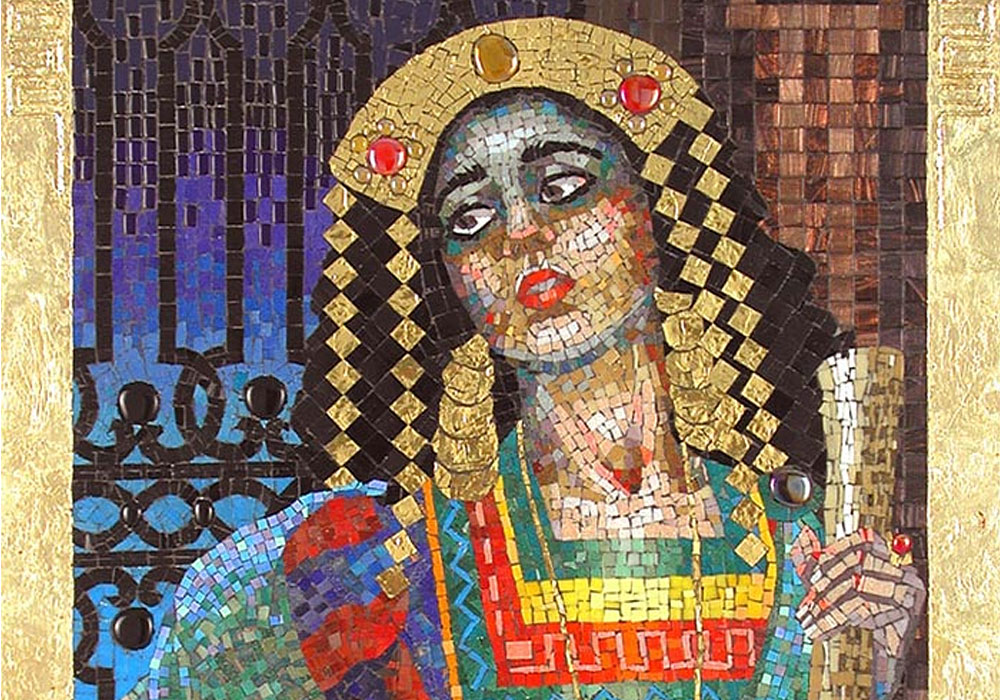
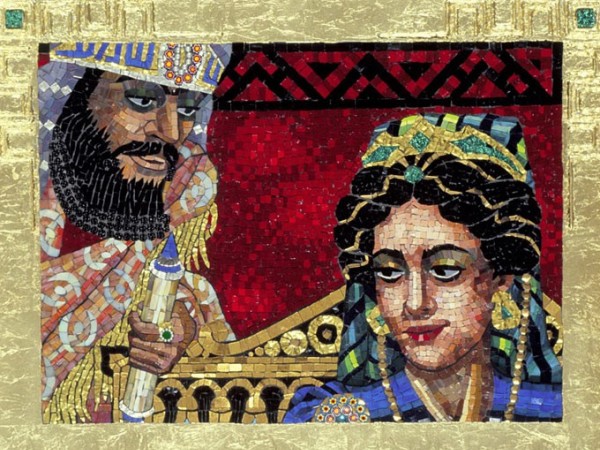
Queen Esther Holding Evidence of Haman’s Guilt (detail), by Lillian Broca, 2002.
The story of Esther has inspired artists for close to two millennia. In what follows we will explore portrayals of Esther in Jewish art spanning the centuries, emphasizing those that illustrate the development of her character in the course of the story, highlighting her feelings and emotions at critical points.
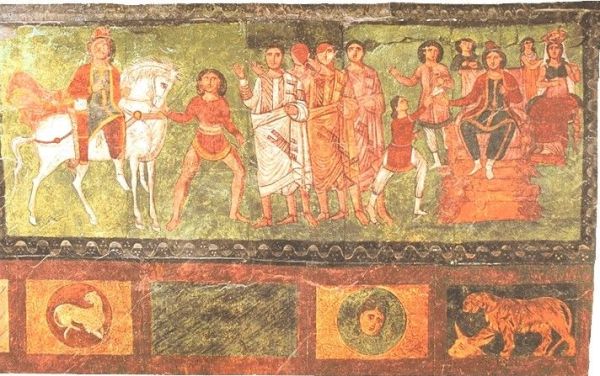
The earliest depiction of Esther[1] is from the 3rd-century C.E. frescoes on the wall of the synagogue in Dura Europos, Syria.[2] Esther is shown sitting behind Ahasuerus, wearing a crown and what looks like a halter top. Her position, behind Ahasuerus, suggests a subordinate role.
In Medieval Jewish Art
While there are many portrayals of Esther in medieval Christian art,[4] in medieval Jewish art, they are scarce. Two that stand out are from the late 13th-century Northern French Hebrew Miscellany, a lavishly illuminated Ashkenazic manuscript containing a variety of biblical and other texts.[5] In the first scene, which will continue to be depicted into modern times, Esther, knowing that appearing before the king without being summoned can result in a death sentence,[6] risks presenting herself to the king in his inner court:
אסתר ה:א וַיְהִי בַּיּוֹם הַשְּׁלִישִׁי וַתִּלְבַּשׁ אֶסְתֵּר מַלְכוּת וַתַּעֲמֹד בַּחֲצַר בֵּית הַמֶּלֶךְ הַפְּנִימִית נֹכַח בֵּית הַמֶּלֶךְ וְהַמֶּלֶךְ יוֹשֵׁב עַל כִּסֵּא מַלְכוּתוֹ בְּבֵית הַמַּלְכוּת נֹכַח פֶּתַח הַבָּיִת.
Esth 5:1 On the third day, Esther put on royal apparel and stood in the inner court of the king’s palace, facing the king’s palace, while the king was sitting on his royal throne in the throne room facing the entrance of the palace.
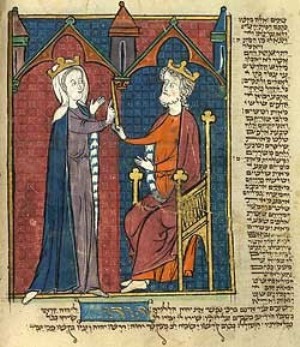
Fortunately, the king responds positively to her unexpected presence, and extends his golden scepter to her as a sign of his favor.[7] This is a crucial and climactic moment in the story; it is not surprising that it has attracted the attention of artists through the ages.
The images in this manuscript are particularly appealing for their vitality. When Esther presents herself to the king, she is smiling. We don’t know why. Is it a seductive smile, or a nervous one? In a way, she is a Jewish Mona Lisa: One can speculate endlessly on the meaning of that smile.[8]
In the second, also a popular scene for future artists, Esther beseeches the king on behalf of her people:
אסתר ח:ג וַתּוֹסֶף אֶסְתֵּר וַתְּדַבֵּר לִפְנֵי הַמֶּלֶךְ וַתִּפֹּל לִפְנֵי רַגְלָיו וַתֵּבְךְּ וַתִּתְחַנֶּן לוֹ לְהַעֲבִיר אֶת רָעַת הָמָן הָאֲגָגִי וְאֵת מַחֲשַׁבְתּוֹ אֲשֶׁר חָשַׁב עַל הַיְּהוּדִים.
Esth 8:3 Esther spoke to the king again, falling at his feet and weeping, and entreating him to avert the evil plotted by Haman the Agagite against the Jews.
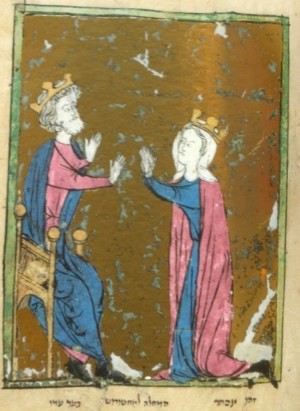
Here Esther is frowning, obviously distressed. The moment is one of extreme tension and anxiety, with the fate of her people still undecided. Again, a simple line showing a facial expression conveys feelings and emotions.
In the Early Modern Period
Illuminated megillot (Esther scrolls), many commissioned by wealthy patrons, began to appear in Italy in the 16th century and became very popular in Western Europe during the 17th and 18th-centuries.[9] The illustrations in these megillot depict many scenes in the text and often include midrashic elements; in general they are very stylized and reveal little emotion.
In Contemporary Art
It is not until the twentieth century that we see work by Jewish artists that convey emotion and nuance that enrich our understanding of the story and add new layers of meaning.
Arthur Szyk
Arthur Szyk (1894-1951), born in Lodz, Poland, was a well-known artist and illustrator, imbued with a strong sense of Jewish identity and a sense of vocation that drove him to advocate on behalf of his Jewish brethren. He was especially famous for his political caricatures, particularly those of Hitler and the Nazis during the Second World War.[10] Thoroughly steeped in Jewish tradition, he created many Judaically oriented works, most famously his Haggadah.[11]
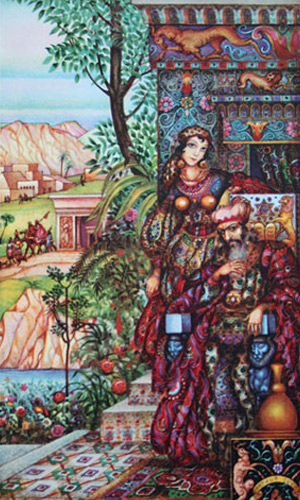
Szyk illustrated the Book of Esther twice, once in 1925, in Le Livre d’Esther (Paris),[12] and again in 1950, shortly before his death, in the Book of Esther (Israel).[13] Both sets of illustrations show the influence of the medieval manuscript tradition and the Persian miniature tradition,[14] as does much of his work. Yet the differences in the portrayal of Esther in the two editions are striking.
Le Livre d’Esther
In the earlier set, Esther is portrayed as a very beautiful woman, with soft delicate features, but showing no signs of strength of character. In the first image, before she is taken to the palace, she is depicted as part of Mordechai’s household, under his protection.[15]
In the next image she is shown in the king’s harem, with an attendant, quite comely and demure. Again, the emphasis is on her femininity, beauty, and attractiveness.
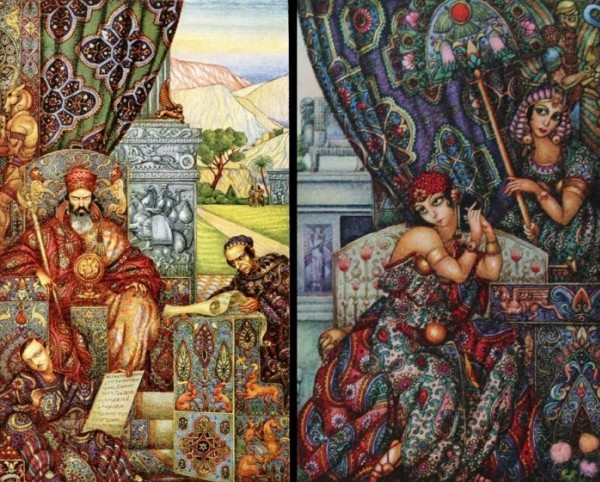
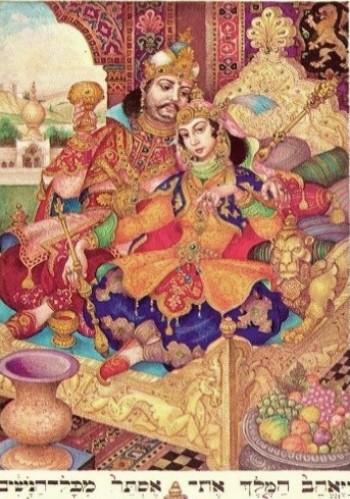
In the last illustration, she is shown next to the king, prominent but not dominant.
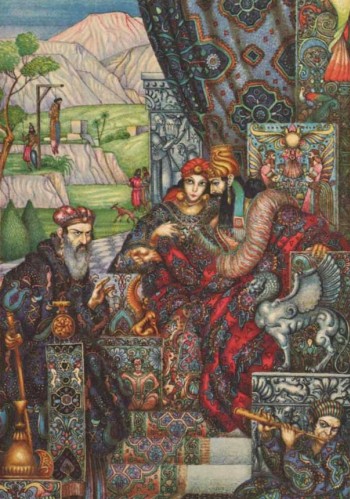
The king seems to be embracing her or leaning over to talk to her. In both this image and the first one, Mordechai is prominent: He is the dominant figure in the story, with Esther very much in the background. Esther is still under the control of Mordechai, who still has a stern and angry look.
The Book of Esther (Megillat Ester)
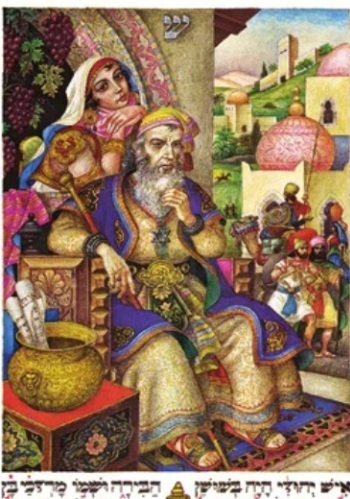
The second set, completed in 1950, but published only in 1974, portrays a completely different Esther: She shows development and maturation: Instead of a shy though beautiful young woman under Mordechai’s care, she becomes a strong self-assured queen who wields power with confidence and determination.[16]
The first image (below left) shows Esther with Mordechai while she is still living in his household, standing behind him, in a thoughtful pose. Mordechai also seems thoughtful, not stern and angry as in the earlier version. The next image (below right) is of Esther married to Ahasuerus (2:17): Esther is front and center, with her husband beside and slightly behind her, obviously captivated by his bride. She is a woman to be reckoned with.
|
|
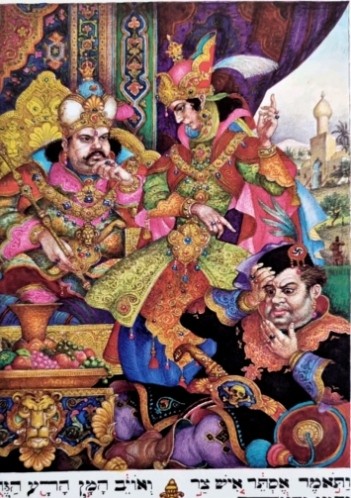
The third image (below left) represents Esther at the climax of the story, when she reveals her identity, and the plot against her people (Esth 7:3-4). She accuses Haman, here portrayed as a Nazi (7:5-6). Esther, a powerful and influential woman, who has the king’s sympathy, dominates the scene. The king has a thoughtful look while Haman seems befuddled. Esther has a stern look and points her finger at Haman as she stands over him.
|
|
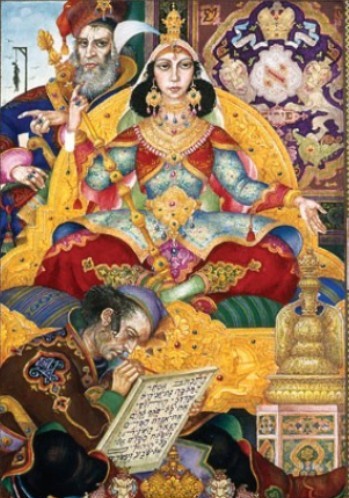
The final image (above right) is the richest of all and parallels the second image of the first series Szyk had made twenty-five years earlier.
Here, Esther dominates the canvas, resembling a Hindu goddess. She is master of her domain. Mordechai is still in the picture, but very much in the background. He is present as a trusted advisor, but this is a woman who can handle herself and is in full control of the situation.
Esther as a Role Model
I would suggest that this marked shift in the portrayal of Esther in the second book grew out of Szyk’s growing realization of the importance of strong, heroic role models for the Jewish people, especially in light of the threats facing them in Europe and the urgent need to establish a Jewish homeland in Palestine.
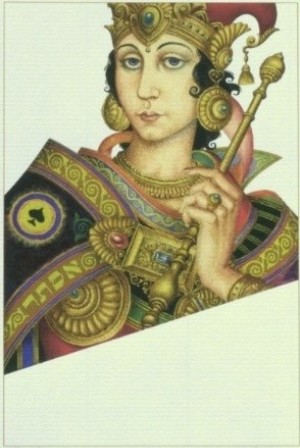
Szyk was a proud Jewish nationalist and a follower of Vladimir Jabotinsky and the Revisionist movement of Zionism.[17] With the rise of the Nazis to power he became an advocate for the Jewish cause. For this purpose, role models were required. This strong 1950 depiction of Esther is already seen in Szyk’s portrayal of her in the mid-1930s for the playing card-set, Heroes of Ancient Israel.[18]
This transformation of Esther’s image from the demure, feminine woman, subordinate to the males around her, to the strong, forceful, decisive, leader, is completed in the second set of Esther illustrations, which were influenced by Szyk’s experience of the Nazi rise to power and the horrors of the Holocaust.[19]
Aryeh Allweil
Another artist who illustrated Esther in the shadow of the Holocaust was Aryeh Allweil (1901-1967), an Israeli painter, sculptor, and illustrator. Born in Bobrka, Galicia in 1901, he made aliyah in 1920. He studied art at the Art Academy in Vienna between 1921 and 1925, then returned to Palestine and taught painting at Givat Hamoreh, Shefeyah, Jerusalem and several other locations throughout the country.[20]
Allweil was a nationalistic artist with very strong attachments to the land of Israel and the Jewish people. He was primarily a landscape painter, but between 1939 and1949 he published a series of texts with illustrations dedicated to the biblical books of Amos, Esther, and Lamentations, as well as a Passover Haggadah. In the Scroll of Esther and the Book of Amos, published between 1940 and 1941, he portrays the Jewish people in their suffering during the Holocaust. These are some of the earliest examples of Holocaust-related art.
The book of Esther in particular lends itself to such an adaptation, as it describes a major threat facing the Jewish people from a ruthless tyrant. The illustrations are very powerful and put the characters in a new light. Unlike Szyk’s work, with its portrayals of Nazis and swastikas, Allweil’s images are more universal, portraying a pogrom which could have occurred at any time in Jewish history.
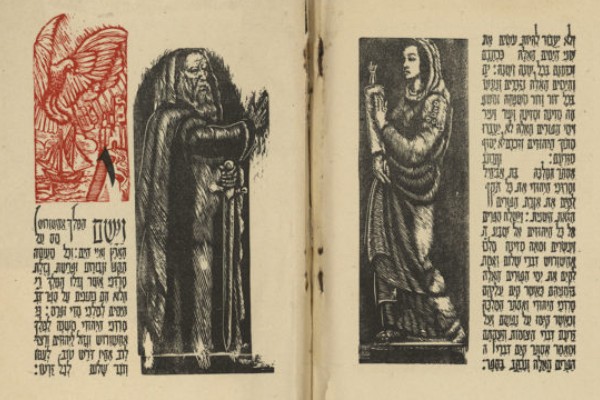
The illustrations were produced by linocut, a relatively new technique at the time, dating from the turn of the twentieth century. The artist uses an engraving knife to cut the material from the linoleum in thin precise lines. In the printing process, the ink prints only from the upper part of the linoleum producing a black background with thin white crevices. The effect is very dramatic and expressive, perfect for the gloomy subject of the artwork. An evocative image of Mordechai is simply called אִישׁ יְהוּדִי (ish yehudi).
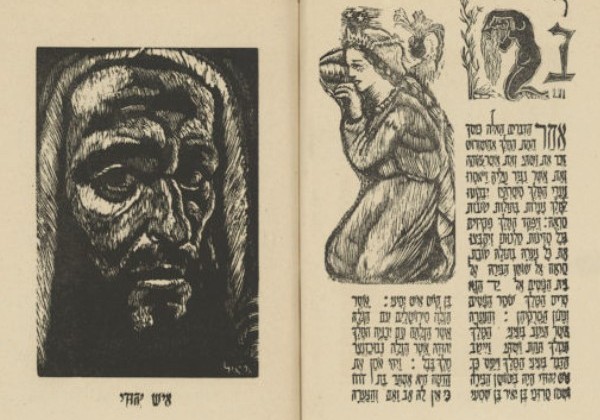
This term is taken from Esther 2:5, but here depicts Mordechai as a Jewish man, universalizing the proverbial suffering Jew of the Exile:[21]
אסתר ב:ה אִישׁ יְהוּדִי הָיָה בְּשׁוּשַׁן הַבִּירָה וּשְׁמוֹ מׇרְדֳּכַי בֶּן יָאִיר בֶּן־שִׁמְעִי בֶּן־קִישׁ אִישׁ יְמִינִי.
Esth 2:5 In the fortress Shushan lived a Jewish man by the name of Mordechai, son of Jair son of Shimei son of Kish, a Benjaminite.[22]
The first image of Esther shows her as a little girl, learning how to read under Mordechai’s tutelage.
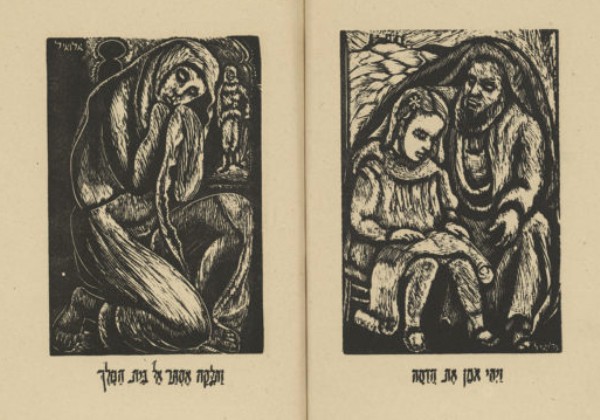
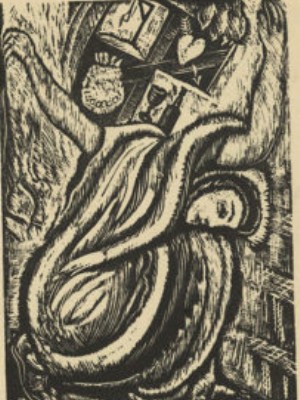
The second linocut (above, left) shows Esther being taken to the king’s palace. She is depicted as a woman in mourning, so different from what we’re used to seeing. No beauty contest here. Esther mourns her captivity.
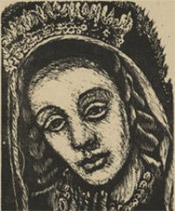
The next image shows Esther with a royal diadem after she was chosen to be queen. This is probably the most cheerful of the images in the series, but she is hardly exuberant.
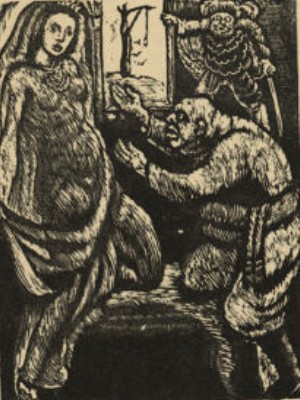
Allweil does not depict Esther appearing before Ahasuerus. The following image (below left) shows Haman pleading for his life after Esther has denounced him (7:7) She is obviously repulsed by this grotesque man who resembles a Cossack.
|
|
The next image (above, right) shows Esther bent over in supplication, pleading with the king on behalf of her people, though the king is not portrayed (8:5-6):
The final two images show Esther triumphant at the denouement of the story. In the first, she holds an open scroll, and in the second, she is with the scroll in a container, preserving the story for future generations.
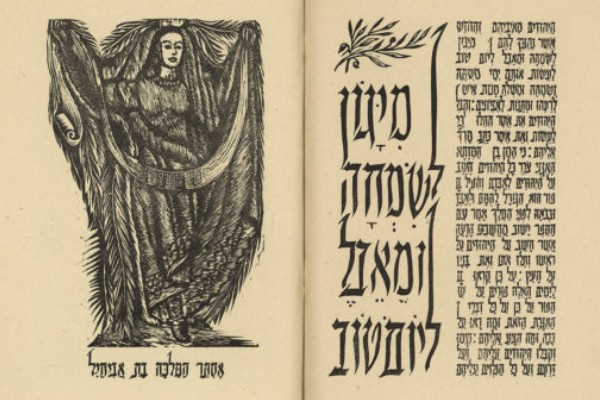
One of the final images of the volume illustrates the verse commanding the commemoration of the events of Purim:
אסתר ט:כח וְהַיָּמִים הָאֵלֶּה נִזְכָּרִים וְנַעֲשִׂים בְּכׇל־דּוֹר וָדוֹר מִשְׁפָּחָה וּמִשְׁפָּחָה מְדִינָה וּמְדִינָה וְעִיר וָעִיר וִימֵי הַפּוּרִים הָאֵלֶּה לֹא יַעַבְרוּ מִתּוֹךְ הַיְּהוּדִים וְזִכְרָם לֹא־יָסוּף מִזַּרְעָם.
Esth 9:28 These days should be remembered and kept throughout every generation: by every family, every province, and every city. And these days of Purim shall never cease among the Jews, and the memory of them shall never perish among their descendants.
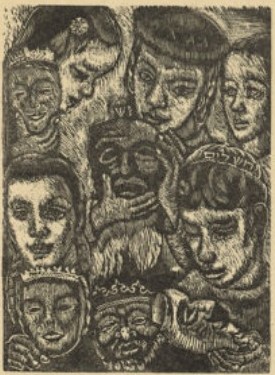
Some of the Jews are holding masks (owing to the tradition of wearing Purim costumes), but none look particularly joyful or celebratory, although perhaps it is harder to convey that in the linocut medium. But considering the timing of this work, in the throes of the Nazi orgy of destruction of the Jewish people, it is completely understandable that the Jews would not be in a celebratory mood.
Allweil’s Esther serves as a reminder to Jews that the events described must have been traumatic and that humor and levity are not always possible; not every generation can celebrate joyfully.[23]
Marc Chagall
Marc Chagall (1887-1985) was born in Belarus, moved to Paris in 1910, and spent most of the rest of his life in France (with a stint in New York from 1941-1948 to escape Nazi occupation). He was a prolific Bible illustrator. Among his many projects are the stained-glass windows at Hadassah Hospital in Jerusalem-Ein Karem (1961-1962), and in the Union Church of Pocantico Hills, N.Y. (1964-1966), as well as two series of biblical illustrations which were published in double issues of the French art magazine Verve in bound, hardcover book form, in 1956 and 1960.[24]
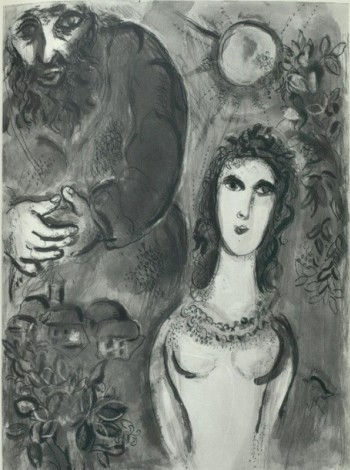
Only the second book includes a series of illustrations for the book of Esther. [25] Most are in black and white. One depicts Esther and Mordechai in a tranquil state, implying normalcy, before their lives are upended and Esther is taken to the king’s palace. In the next, Esther, now queen, is listening to Mordechai’s counsel.
|
%2C%20Esther%20in%20Mordechai%E2%80%99s%20household.jpg?alt=media&token=14f50976-425d-49d7-9079-2ac65b2ef2b5)
|
These two images illustrate the close relationship between Esther and Mordechai, in which Mordechai is an avuncular presence.
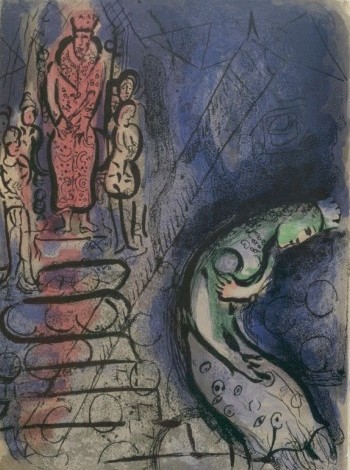
These are followed by two side-by-side images. In the one on the left, the king is standing up in front of his throne and Esther is below facing away from the king. This scene portrays Esther immediately before she approaches Ahasuerus without being summoned by him (ch. 5). She is hunched over, perhaps in prayer, with her back to the king, who presumably cannot see her. Soon she will make her appeal and seems to be mustering her courage to face the king in a life-and-death situation.
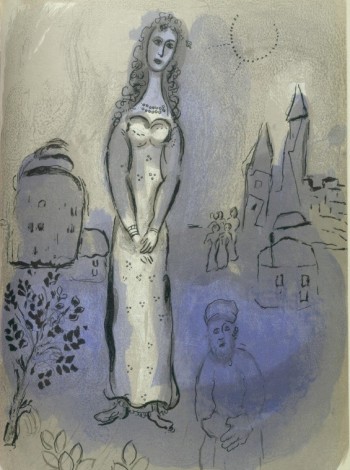
The image on the right shows Esther larger than life, towering over her surroundings. Mordechai sits in her shadow, seemingly insignificant in comparison.
|
|
In the second image (above, right), only the figure of Esther is fully realized; Mordechai and other people and buildings in the background seem to be only roughed in. The image is not associated with any particular scene or verse in the book of Esther, but likely represents Esther’s personal growth into maturity and leadership (which takes place in the course of chapters 4 and 5), to the point that from then on she will dominate the story and her towering presence is what makes all the difference.
This contrasts with earlier images in which Mordechai figures prominently in Esther’s life. Here Mordechai is fading into the background, signifying that from now on, he will be less important in her life.
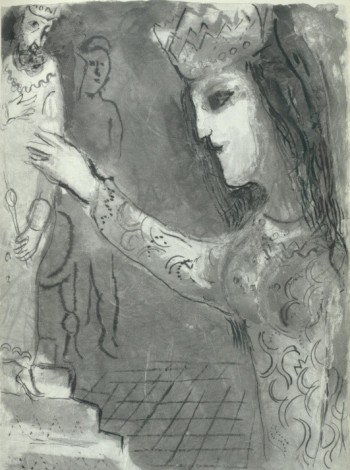
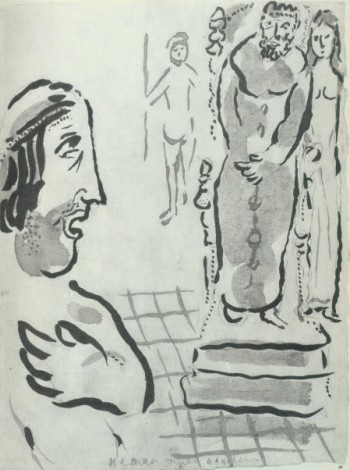
In the next scene Chagall depicts in the series (below left), Esther, after having been received favorably by Ahasuerus, invites him to a banquet in her chambers (5:3-5). She is portrayed as strong and decisive, as she acts to realize her plan to save her people. She is the dominating presence in the drawing.
|
|
The final image of Esther (above right) shows her accusing Haman (7:6), who seems to be saying: “Who? Me?” The last drawing is anomalous. For other artists, and in the biblical text, Esther dominates the accusation scene, pointing an angry finger at Haman, asking for his destruction. Here, Esther passively stands behind Ahasuerus. Both are almost in the background, while Haman in the foreground, dominates the scene, looking contrite, or feigning innocence.
The whole drawing has a raw feel to it and seems rough and unfinished. Chagall, as is often the case, surprises the viewer. Perhaps he felt that at this moment in the story, Haman’s downfall and degradation was more important to emphasize than Esther’s triumph.
Leonard Baskin
Leonard Baskin (1922-2000), one of the most prominent Jewish artists of the 20th century, created a series of illustrations for the Central Conference of American Rabbis (CCAR) edition of The Five Scrolls (1983).[26] It contains only one picture of Esther, when she asks the king to save herself and her people (7:3).
The image is striking and anomalous. It does not depict a woman of rare beauty or regal manner. Rather, Baskin’s Esther is plain looking, her hair short and her dress quite ordinary. Her hand is held over her left breast as if she is making an appeal, which fits the text, in which she asks that “my life be given to me at my petition.”
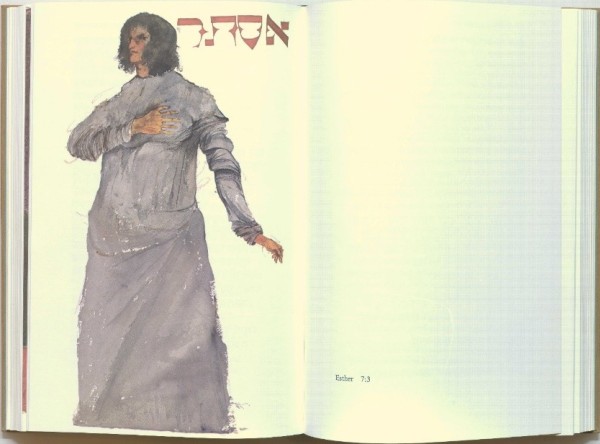
She appears calm and resolute. Her plain appearance is in line with the rabbinic statement that she was not that beautiful but nevertheless charmed everyone who saw her:
מגילה יג א רַבִּי יְהוֹשֻׁעַ בֶּן קׇרְחָה אָמַר: אֶסְתֵּר — יְרַקְרוֹקֶת הָיְתָה, וְחוּט שֶׁל חֶסֶד מָשׁוּךְ עָלֶיהָ.
Megillah 13a Rabbi Yehoshua ben Korḥa said: Esther was greenish [having a pale complexion like a myrtle], but a cord of [divine] grace was strung around her [endowing her with a beautiful appearance].[27]
Baskin’s choice of how to depict Esther may be explained by the comment of his friend Ted Hughes: “Baskin’s forms are drawn from the hard core of human pain. Each one embodies that compound of intimate secret suffering and spiritual exultation which is Baskin’s specialty. All his images, without exception, are precipitated out of this, as crystals out of a supersaturated solution.”[28]
Lilian Broca
Lilian Broca is a contemporary artist living in Vancouver. Born in 1946 in Bucharest, Romania, she studied Fine Art at Concordia University in Montreal and the Pratt Institute in New York. She works in several media—painting, drawing and, most unusually, mosaic art. She has created a series of ten mosaics on the Book of Esther (made between 2001-2009), nine of them focusing on the character of Esther, showing her transformation from a meek, shy, obedient, woman to a forceful and determined leader.
.jpg?alt=media&token=a1a83f10-db60-4bc8-9c23-5ddd0c05a047)
The entire series with the artist’s commentary offers serious reflections on the character of Esther, on the interplay between cultures played out in a non-Jewish majority society, and on the difficulties of maintaining one’s identity in such a society. It is unusual to have available an artist’s commentary on her work, but Broca has provided some on her website[29] as well as in essays in the book, The Hidden and the Revealed,[30] in which she describes her own thinking while creating these beautiful images. She also describes the techniques she used for producing them and the rich symbolism she incorporated into them.
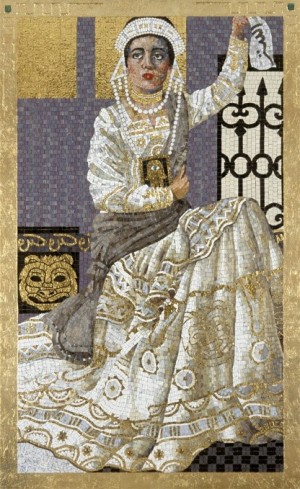
In the first image of the series, entitled Queen Esther, Broca portrays a wealthy, jewel-bedecked young woman, living in the king’s harem, who seems melancholy and not happy with her lot.
Broca explains that her hands are not shown to symbolize her lack of options.[32] Since she cannot reveal her identity, she cannot partake of her own culture and must dissimulate on a daily basis. She wears a hamsa (palm-shaped amulet) around her neck, but this does not identify her as Jewish since the hamsa is widely used to ward off evil in a variety of Christian and Muslim Middle-Eastern and North African societies. Her foot touches a wrought-iron gate which symbolizes her confinement.
The next mosaic, Esther’s Offering, seems like it should precede the first if one is following the trajectory of the story. Perhaps this order was chosen because the image in Queen Esther works well as an introduction to the series of mosaics as a whole.
Broca imagines a scene not described in the biblical text. The artist wishes to portray Esther here at the moment she found out she had won the contest and at the same time as a bride, waiting to be married, while keeping in mind that the book of Esther does not mention a wedding ceremony.[33] She wears a white dress symbolizing purity. She is shown curtseying to the king, while holding a handkerchief embroidered with her name in Farsi, “thus symbolizing in one gesture her identity and her submission to the king’s will.”[34]
The artist tries to convey Esther’s emotional state, which she describes as “frightened but determined.”[35] The lions’ heads on the mask behind Esther and on her dress, are meant to symbolize the two countries she is now intimately associated with—Persia, whose astrological reference is the constellation Leo, and the tribe of Judah, which the Bible associates with lions (Gen 49:9).
In the next mosaic, Broca has deviated from the story for dramatic effect.
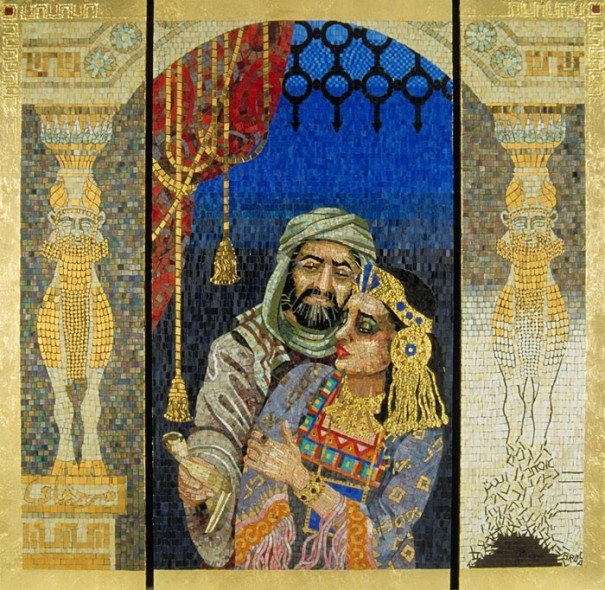
The central panel of this triptych depicts Mordechai revealing the details of Haman’s plot to Esther directly, not through messengers as described in the biblical text (Esther 4). This is the moment when she realizes that she can no longer be the submissive wife and must take on a leadership role.[36]
The panels on the left and right symbolize the Persian empire. Broca explains concerning the panel on the right: “the image of the column melts down at the bottom, first becoming two-dimensional and monochromatic, next a line drawing,” that finally pixelates into small colored fragments, forming a shapeless mound of tesserae.[37]
This is meant to symbolize the collapse of the Persian empire after the reign of Ahasuerus and Esther, and thus the fleeting nature of power and privilege. Esther’s name in Hebrew and Farsi is spelled out in the falling tesserae; she does not explain what this symbolizes.
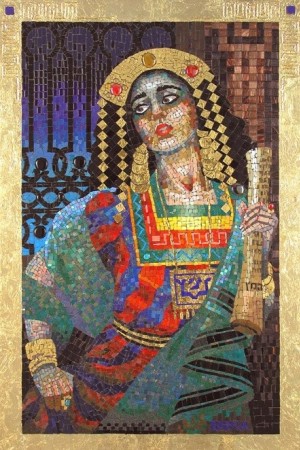
The next mosaic also reflects Broca’s desire to flesh out the story. She explains:
The queen is seen sneaking close to the walls of the dark corridor leading to her chamber, terrified of being followed by the palace spies, holding in her hand Haman’s decree that Mordechai gave her only minutes before.[38] Her facial expression shows her fear of what may follow.
Esther realizes that the stakes are high and that the fate of her people hangs in the balance; she must act decisively and with perfect timing. The artist has used exaggerated chiaroscuro (light-dark contrast) to highlight the drama of the moment.[39]
The next mosaic depicts Esther in a private moment sometime after her meeting with Mordechai, in a contemplative pose.
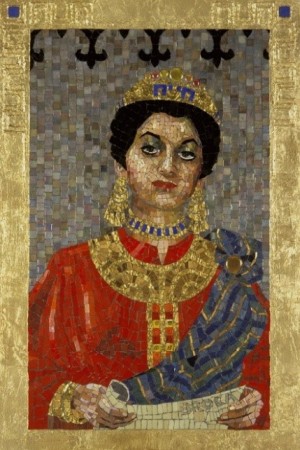
She is staring into space, pondering her next actions, holding the scroll with Haman’s decree, which has turned her life upside down. She is no longer anxious, but seems determined, having decided upon a course of action.
Again, this is a scene which the artist has invented in order to deepen our insight into Esther’s thought processes and character development.[40] It gives us the opportunity to reflect on the difficult situation that Esther found herself in and how she needed to mature quickly in order to take decisive action to save her people. Her crown has the letters ḥet and yod, signifying life, implying that she must take decisive action to save her life and the lives of her people.[41]
The next mosaic portrays one of the climactic moments of the story, when Esther risks her life to appear before the king without permission.
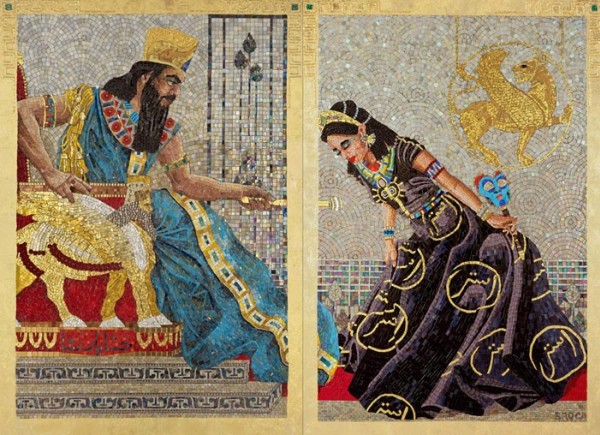
The king is depicted as a typical Persian monarch of the fifth century BCE, modeled after the carvings on the outer walls of the palace of Persepolis.[42] Esther wears a dark skirt or dress, embroidered with her name in Farsi appearing numerous times.
She is all humility and deference, as her life hangs in the balance. This makes the repeated design of her name on her dress seem odd and out of character, unless this is meant more for the viewer than for the king.[43] In her left hand she holds a mask, away from the king’s line of sight, which is meant to symbolize “the façade she must present to the world.”[44] The king is captivated by Esther’s beauty and extends the lifesaving scepter.
The next mosaic portrays the second climactic moment of the story, at the second banquet scene (chapter 7), when Esther identifies Haman as the one who is threatening her people with destruction.
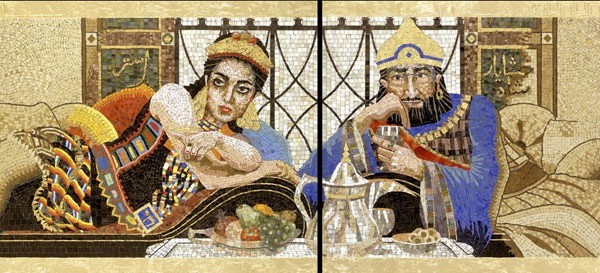
The king and Esther are reclining beside each other, in the ancient Greek or Roman style. The king has an inebriated, somewhat bemused look. Haman is out of the picture, facing them. Esther points her finger at him, sealing his fate. Esther’s look is determined, cool, and calculating. She has grown into her role and now is a commanding presence, who knows what she has to do and goes about her business with force and determination.
The next image shows Mordechai and Esther in private conversation.
This scene is also an invention of the artist: the biblical text lacks such a conversation. Yet, such a conversation is necessary because the decree that Haman issued in the king’s name could not be rescinded and therefore Esther had to make another appeal to the king. The biblical text just says that Esther goes to the king, but Broca has Mordechai and Esther consulting with each other and Mordechai presumably advising her to go to the king again.
Broca explains that Esther is smiling scoffingly,[45] but it seems to me that Esther is pondering his words, taking them in, and trying to plan the next step.
Broca introduced this image into the story because of her impression that the Scroll tells of Esther’s maturation into an independent autonomous adult, who can make decisions for herself and does not need male guidance. But perhaps the intent is to show that Esther is not yet fully liberated from male domination, which is only reflected in the final mosaic in which Esther reveals her true identity.
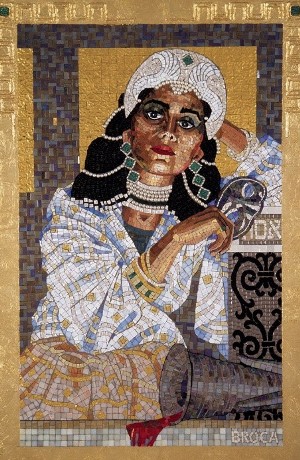
The next mosaic is again not directly taken from the story but is a reflection by the artist on the state of Esther’s identity after she has achieved her goal of saving her people.
Broca portrays a mature and confident Esther, wearing fine attire, and holding her mask, which she has presumably removed for good, now that she no longer needs to conceal her true identity. She has a dreamy look, which perhaps conveys a sense of relaxation and relief from tension. She seems to be at peace. She can now be herself and does not need to play games of concealment concerning her Jewish identity with the king or other residents in the royal palace.
The goblet of wine, a Persian rhyton, has been knocked over, its content spilling over the edge of the table onto the floor. For the artist this red wine symbolizes both the blood of the Israelites which was not spilled and the blood of the gentile enemies of Israel which will soon be spilled.[46]
Furthermore, the wrought-iron grating which symbolized the confinement and suppression of women in the story and in the ancient world in general has been reduced to a furniture decoration, which is no longer confining.
This image of Esther represents for the artist a “paragon of supreme leadership, loyalty, wisdom and vision.”[47] Esther has overcome the burden of patriarchy and succeeded in bringing peace to her people through her skills and talents. She thus serves as a model for all women.
Lilian Broca’s striking mosaics capture the ambience and flavor of the ancient Persian court. The viewer can think: Yes, this is how it could have been. Furthermore, her ability to capture emotion and expression in this art form is truly remarkable. No two of her Esthers are the same, and they cover a whole range of emotions. The entire series offers a powerful portrayal of Esther in the complexity of her situation.
Visually, the mosaics are stunning even in reproductions, and are surely more so in real life as the light plays on the thousands of tiny Venetian glass tesserae that make up each panel.[48]
Yoram Raanan
Yoram Raanan (b. 1953), an American-born mixed-media artist, received his BFA at the University of the Arts in Philadelphia in 1975. He made aliyah in 1976 and soon thereafter opened his first studio in Jerusalem. For the past few decades, his studio has been in Moshav Beit Meir, in the Judean hills.[49] He is known for his vibrant, emotionally charged paintings that combine modern expressionism with deep spiritual intensity, often featuring Jewish and biblical themes.
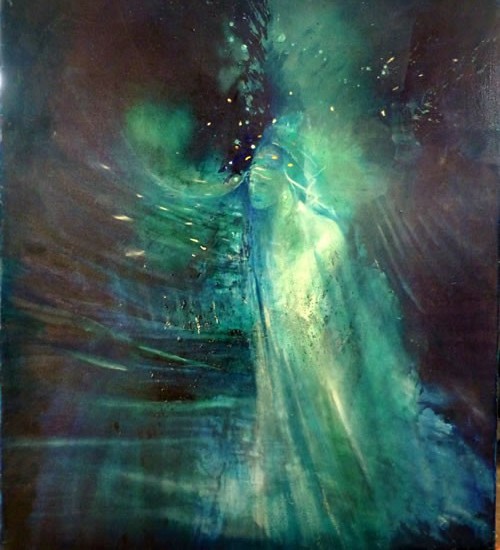
His painting of Esther is mystical.
The biblical text describes Esther building up the courage to appeal to the king on behalf of her people:
אסתר ה:א וַיְהִי בַּיּוֹם הַשְּׁלִישִׁי וַתִּלְבַּשׁ אֶסְתֵּר מַלְכוּת וַתַּעֲמֹד בַּחֲצַר בֵּית־הַמֶּלֶךְ הַפְּנִימִית נֹכַח בֵּית הַמֶּלֶךְ...
Esth 5:1 On the third day, Esther put on royal apparel and stood in the inner court of the king’s palace…
The Talmud asks,
תלמוד בבלי מגילה יד: ״וַיְהִי בַּיּוֹם הַשְּׁלִישִׁי וַתִּלְבַּשׁ אֶסְתֵּר מַלְכוּת״, בִּגְדֵי מַלְכוּת מִיבָּעֵי לֵיהּ! אֶלָּא שֶׁלְּבָשַׁתָּהּ רוּחַ הַקֹּדֶשׁ...
b. Megillah 14b "And it came to pass on the third day that Esther clothed herself in royalty (מַלְכוּת, malkhut)." Shouldn't it say “garments of royalty” (bigdei malkhut)? Rather, the Holy Spirit (malkhut) enclothed her...[50]
The Zohar elaborates:
ספר הזהר, שלח לך ל דִּכְתִּיב, (אסתר ה:א) וַיְהִי בַּיּוֹם הַשְּׁלִישִׁי וַתִּלְבַּשׁ אֶסְתֵּר מַלְכוּת...דָּא רוּחָא דְּקוּדְשָׁא, דְּהָא מַלְכוּת שְׁמַיָא, נָשִׁיב רוּחָא, מֵהַהוּא רוּחָא דַּאֲוִירָא דְּהַהוּא עָלְמָא, וְאִתְלַבְּשָׁא בֵּיהּ אֶסְתֵּר. וְכַד עָאלַת קַמֵּי מַלְכָּא אֲחַשְׁוֵרוֹשׁ, וְחָמָא הַהוּא לְבוּשָׁא דִּנְהוֹרָא, דִּיוּקְנָאָה אִדְמִי לְמַלְאַךְ אֱלֹהִים.
Zohar, Shelach Lecha 30 Since it is written (Esther 5:1), "Now it came to pass on the third day, that Esther clothed herself in royalty (מַלְכוּת, malkhut)” … that is, the Holy Spirit. For the Kingdom of Heaven blows a wind (spirit) from the spirit of the air of that world, and Esther clothed herself in it. When she entered into the presence of King Ahasuerus and he saw that robe of light, her form seemed to him like an angel of God.[51]
It is this interpretation that inspires Raanan. He explains that Queen Esther “appears like a vision glowing against the darker background. As she ventured forth to the king to serve her people we are told she was wearing malchut—alluding not only to her royal garments but also to a spiritual holiness that is said to have cloaked her.” The painting hints at this through the ethereal veils that surround her, made of blue-green light, resembling wings that spread over her as she moves forward majestically, ethereal and angelic.[52]
Raanan’s Esther resembles an angel as she moves forward to meet the king, showing how she was aided by divine providence.[53] God spread over her his protective wing to ensure her safety and the success of her mission.
Raanan’s ethereal image also emphasizes the mystery in Esther’s being, alluded to in her name אסתר, Ester, from סתר, seter, mystery or secret. His Esther is intangible and elusive, hidden and enigmatic, just as the book has been to many religious thinkers throughout the ages.
Various Visions of Esther
Contemporary artists have probed the image and character of Esther, bringing elements of the story into greater relief and occasionally adding a touch of their own invention to enrich the story and stimulate the imagination.
For Arthur Szyk, at least in the second Esther series, Esther is a strong woman, a heroine of the Jewish people. In Aryeh Allweil’s work, she is much weaker and more of a participant in a drama playing out around her, but not directing or controlling events. Marc Chagall presents a gentler Esther, who is nevertheless dominant and strong, and he shows Esther separating herself from Mordechai.
Leonard Baskin probes Esther’s soul, while Lilian Broca, though portraying her in an ancient Persian setting, sees her as a model of a Jewish woman in a gentile society trying to negotiate her way through a minefield of complicated relationships. Finally, Yoram Raanan stresses the spiritual aspects of Esther’s being and seeks allusions to the divine in her story.
Each artist in his or her own way, conveys a personal vision of Esther through their art.[54]
TheTorah.com is a 501(c)(3) nonprofit organization.
We rely on the support of readers like you. Please support us.
Published
March 2, 2026
|
Last Updated
October 2, 2026
Previous in the Series
Next in the Series
Before you continue...
Thank you to all our readers who offered their year-end support.
Please help TheTorah.com get off to a strong start in 2025.
Footnotes


Dr. Barry Dov Walfish was the Judaica Bibliographer and Curator at the University of Toronto Libraries until his retirement in 2017. He holds a Ph.D. in Medieval Jewish Intellectual History from the University of Toronto. He is the author of Esther in Medieval Garb, Bibliographia Karaitica, and The Way of Lovers (with Sara Japhet) and is the main Judaism editor for De Gruyter’s Encyclopedia of the Bible and its Reception.
Essays on Related Topics: