

 Edit article
Series
The Temple That Survived Its Destruction


Holyland Model of Jerusalem and the Second Temple, with inset: the Greek inscription excavated from the Temple Mount warning non-Jews not to proceed beyond the Temple barrier, on pain of death. Wikimedia
Flavius Josephus (37–ca. 100), priest, turncoat, apologist, and historian,[1] took upon himself to demonstrate to his largely non-Jewish Greek-reading audience that the now destroyed Jerusalem Temple was a place of great sanctity, and that it remains so for Jews.[2]
The Temple in The Jewish War: An Impressive Building Dedicated to Purity
In his earliest work, The Jewish War (c. 75 C.E.), written soon after the Temple’s destruction, Josephus focuses on the majesty of the building. Already in the introduction, Josephus depicts the Temple Mount and the Temple as part of the broader story of Jerusalem during the time of invasion of Titus.[3]
When describing Herod’s building projects, Josephus wants his readers to understand how extensively Herod invested in rebuilding the Temple, making it larger and more beautiful, doubling the area of its precincts:
Josephus 1.401 Thus, in the fifteenth year of his reign (23–22 B.C.E.), he restored the Temple and, by erecting new foundation walls, enlarged the surrounding area to double its former extent. The expenditure devoted to this work was incalculable. Its magnificence never surpassed. As evidence, one would have pointed to the great colonnades around the Temple courts and to the fortress which dominated it on the north. The colonnades Herod reconstructed from the foundations.
This brief description lacks any reference to law, custom, or religious commandment. Josephus writes as a historian and tour guide, even when making observations about Jewish practice. For example, while writing about the columns on the Temple Mount, he defends the beauty of the Temple, despite its lack of Greco-Roman artwork:
Josephus, War, 5.191 The natural magnificence of these columns, their excellent polish and fine adjustment, presented a striking spectacle, without any adventitious embellishment of painting or sculpture.
Non-Jewish temples contained statues, images, paintings, and other works of art.[4] The Jerusalem Temple was devoid of any of these. Here, Josephus hints to the knowledgeable reader at the biblical prohibition of making images of paint or carving, but his actual words only relate to the lack on the level of aesthetic.
Limit for Foreigners
One legal norm that Josephus emphasizes is the purity requirement for people visiting the Temple precinct. He first notes that non-Jews were allowed in this area only up to the stone balustrade (Heb: soreg) in “First Sacred Precinct” (Gk: to prōton hieron), or Outer Court:[5]
Josephus, War, 5.193–194 in this (=the balustrade), at regular intervals, stood slabs giving warning, some in Greek, others in Latin characters, of the law of purification, to wit, that no foreigner was permitted to enter the holy place, for so the second enclosure of the Temple was called.
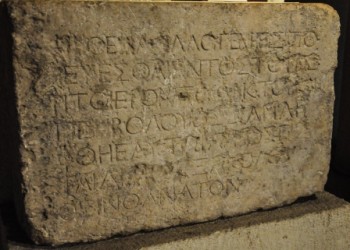
Two copies of the Greek inscription prohibiting non-Jews from crossing the barrier were discovered to the north of the Temple Mount:
A foreigner shall not enter beyond the barrier surrounding the sacred precinct (= the Second Sacred Precinct), and anyone caught shall be liable to death.[6]
It is likely that a foreign tourist or visitor to the Temple Mount would have complied with these instructions.[7]
Court of Women (עזרת נשים)
Up fourteen stairs from the balustrade, a gate led to the “Second Sacred Precinct,” or Inner Court, also known as the Court of Women (gunaikonitin), meaning it allowed women in addition to men:
Josephus, War, 5.199 on the other side, there was one gate on the south and one on the north, giving access to the women’s court. Women were not permitted to enter by the others, nor yet to pass by way of their own gate beyond the partition wall. This court was, however, thrown open for worship to all Jewish women alike, whether natives of the country or visitors from abroad.
While most of this is likely connected to Jewish laws of purity, Josephus says nothing about Jewish law here, and continues in his guide mode, describing the gates and courtyards (5.200–206).
The Temple
In describing the Temple, Josephus offers measurements of height and width, a description of the façade, of the Sanctuary[8] and what was inside, and the curtain. He further provides explanations for the items in the Sanctuary such as the Menorah and loaves of shewbread (5.217). Josephus does not mention any laws or rules related to these. Only when the description reaches the Holy of Holies does Josephus emphasize something that was important to Jews theologically, that the Holy of Holies was entirely empty, i.e., with no representation of a deity:
Josephus, War 5.219 the innermost recess measured 20 cubits and was screened in like manner from the outer portion by a veil. In this stood nothing, whatever: unapproachable, inviolable, invisible to all. It was called the Holy of Holy.
Josephus then describes the majesty of the exterior building (222–224), then continues to describe the altar, this time mentioning, as an aside, a rule found in Exod 20:22, and in the case of this rule sounds more like Antiquities 3-4 which is based on Temple law in the Bible, as we shall see below. The parenthetical comment is brief:
Josephus, War, 5.225 …No iron was used in its construction, nor did iron ever touch it.
At this point Josephus returns basically to tour guide mode but begins to share halakhic details beginning with a description of who was allowed where familiar from Leviticus 12–15:
Josephus, War, 5.227 Persons afflicted with gonorrhea or leprosy were excluded from the city altogether. The Temple was closed to women during their menstruation, and even when free from impurity, they were not permitted to pass the boundary which we have mentioned above. Men not thoroughly clean were debarred from admission to the inner court, from which even priests were excluded when undergoing purification.
In addition, he notes that those priests who could not serve or officiate on account of a blemish (Leviticus 21:21–23) could be in the area enclosed by the balustrade together with priests who were not tainted by blemish. They could receive priestly portions but not wear priestly garments, which were worn only by those who served (5.228).
He then adds the prohibition from Leviticus (10:8–11) that a priest may not serve when drunk, and adds a reason touching on the care with which ritual duties must be performed:
Josephus, War, 5.229 The priests who were without blemish went up to the altar and the sanctuary, clothed in fine linen, scrupulously abstaining from strong drink through reverence for the ritual, lest they should be guilty of any transgression in their ministrations.
The High Priest, he notes could also go up to officiate but usually did so only on the Sabbath or New Moon or a Festival (230). Josephus then describes the fancy garments of the High Priest based on the Bible (231–236), including the head piece which “encompassed his head… above which there was another crown of gold, whereon were embossed the sacred letters, to wit, four vowels,”[9] a reference to the tetragrammaton. Josephus ends this depiction with the pinnacle of the Temple’s holiest moment, the Yom Kippur ritual (see Lev. 16):
Josephus, War, 5.236 These robes were not worn by the High Priest in general when he assumed plainer attire, but only when he penetrated to the innermost sanctuary. This he entered alone once in the year, on the day on which it was universal custom to keep fast to God.
While Josephus is clearly trying to impress the readers with the Temple’s beauty and some of its rules, he sticks mostly to the tone of a descriptive guide, as one might expect of a work aimed at a Non-Jewish audience.
Herod Knocked Down the Second Temple to Build a Bigger One
Twenty years later, in his longest work, Antiquities of the Jews (c. 94 C.E.), Josephus tells the Jewish story of the world and their history from Genesis up until the Roman period, which he covered in The Jewish War. In the later parts of the book, where he covers the rule of Herod, Josephus’ descriptive tone regarding the Temple (Antiquities 15.380–425) is similar to what we find in The Jewish War.
He begins with a speech in which Herod explains why he has decided to tear down the current Temple:
Josephus Antiquities 15:385 …[T]he enterprise which I now propose to undertake… is the most pious and beautiful one of our time. For this was the Temple which our fathers built to the Most Great God after their return from Babylon, but it lacks 60 cubits in height, the amount by which the first Temple built by Solomon exceeded it.
Herod pauses to ensure that nobody thinks he is blaming the ancients for building cheaply. Instead, it was the fault of Judea’s Persian overlords:
15:386 Yet no one should condemn our fathers for neglecting their pious duty, for it was not their fault that this Temple is smaller. Rather, it was Cyrus and Darius, the son of Hystaspes, who prescribed these dimensions for building. Since our fathers were subject to them and their descendants, and after them to the Macedonians, they had no opportunity to restore this first archetype of piety to its former size.
But now, given Herod’s good relationship with Rome, he will build a much nicer one, worthy of King Solomon:
15:388 But since, by the will of God, I am now ruler and there continues to be a long period of peace and an abundance of wealth and great revenues, and what is of most importance, the Romans, who are, so to speak, the masters of the world, are my loyal friends, I will try to remedy the oversight caused by the necessity and subjection of that earlier time and, by this act of piety, make full return to God for the gift of this kingdom.
In this retelling, Rome is to thank for the splendid final years of the Temple, a significant point since Josephus wants the Roman readers to respect the now destroyed Jewish edifice, even though it was the center for an enormous rebellion against the empire.[10]
The people are panicked that they might go without a Temple for years, so Herod assures them that we will have all the materials and personnel ready before he starts construction:
Josephus Antiquities 15:390 [H]e prepared a thousand wagons to carry the stones, selected ten thousand of the most skilled workmen, purchased priestly robes for a thousand priests, and trained some as masons, others as carpenters, and began the construction only after all these preparations had diligently been made by him.
Josephus throws in the odd detail that he trained priests as builders,[11] without explaining to the non-Jewish reader what would have been obvious to the Jewish reader: the necessity of avoiding Gentiles, or even non-Priestly Jews, working on the holy premises.[12]
At this point, Josephus offers his description of Herod’s construction of the new Temple by Herod.
The section is written in the same cadence of tour-guide mode that we find in The Jewish War. Nothing in the description of the construction or in the description of the First Sacred Precinct reflects law (except perhaps, his discussion of the balustrade, past which Non-Jews were forbidden to proceed under pain of death).[13] Josephus’ depiction of the Temple in the early part of Antiquities, however, is quite different.
Torah, Temple, and Halakhah
In the early sections of Antiquities, Josephus wishes to explain Torah law to his non-Jewish readers, and this includes details relevant to the (now destroyed) Jerusalem Temple:
- Temple vessels (Ant 3. 139–150);
- Sacrifices (Ant 3. 224–286);
- Temple ritual purity and impurity (Ant 3.258–273);
- Priests (Ant 3.277–279).
Basing himself on biblical law, Josephus mentions purification and the need to maintain a high level of purity in the Temple courtyards and in the Temple itself.[14] While Josephus might not have been able to impress his audience with the physical structure of a temple that no longer existed, he can call their attention to the wisdom of Moses the lawgiver:
Josephus, Antiquities 4.196 I wish first to describe the constitution, which is consonant with the renown of Moyses for virtue, and to convey to those reading, what sort of constitution it was at the beginning, and then to return to the narrative of the rest. Everything has been written as he left it. We have added nothing for embellishment, nor anything that Moyses has not left behind…
He starts off his rendition of the Torah’s laws with the requirement to have one Temple, as demanded in Deuteronomy 12, conveying to his readers the religious and theological purity of Temple law and ritual:
4.200 Let there be, in the fairest part of the land of the Canaanites, one holy city that is renowned for its excellence, whichever God selects for Himself through prophecy; and let there be one Temple in it and one altar of stones that are not hewn but chosen and joined together, which, smeared with whitewash, will be appealing and clean to view. 4.201 Let the access to this be not by steps but by a sloping ramp.[15] In another city let there be neither an altar nor a temple, for God is one and the stock of the Hebrews one.
Josephus then explains the reason for the pilgrimage festivals as a form of social cohesion:
Josephus, Antiquities 5.203 Let them [the people] come together three times a year from the ends of the land that the Hebrews conquer, into the city in which they establish the Temple, in order that they may give thanks to God for the benefits that they have received and that they may appeal for benefits for the future; and coming together and taking a common meal, may they be dear to each other. 5.204 For it is well that they not be ignorant of one another, being compatriots and sharing in the same practices. This will occur for them through such intermingling, instilling a memory of them through sight and association, for if they remain unmixed with one another they will be thought completely strangers to each other.
This presentation of the function of the Jerusalem Temple in the context of Torah law is aimed at strengthening the connection between the sacred text and the destroyed building, by presenting centralized worship as the foundational law of the one Temple—the first law of the Mosaic Constitution in Josephus’ retelling—was the basis for the Temple’s spiritual survival past beyond its physical existence.
Against Apion
Several years later, Josephus composed Against Apion (ca. 97 C.E.), as a rebuttal to the work of Apion, son of Pleisthenes, an Alexandrian grammarian, who flourished during the time of the early Roman emperors Tiberius and Caligula. Among Apion’s books—all of which are now lost—was one he composed about Jews and Judaism, which Josephus felt to be insulting to his people and their traditions.[16] As part of this work, Josephus takes the opportunity respond to several other scholars, including Manetho, Chaeremon, and Lysimachus (Against Apion 1.73–74), whom Josephus thought were misunderstanding Judaism.
Jews Don’t Worship Donkeys or Sacrifice Greeks
Josephus first rebuts several popular calumnies. For instance, Josephus calls Apion out on repeating the story that Jews worship the head of a donkey:
Josephus, Against Apion 2.80 For Apion dared to assert that in this shrine the Judeans had set up the head of an ass, and worshipped that animal, considering it worthy of the greatest reverence. He claims that this was revealed when Antiochus Epiphanes plundered the temple and discovered this head, made of gold and worth a considerable sum of money.[17]
While Josephus’ main point is that this is a false rumor, he cannot help adding a little sarcasm, given Apion is Egyptian:
Josephus, Against Apion 2.81 On this, I would say first that, since he is an Egyptian, even if we did possess any such thing, he should certainly not have made it a matter of censure, since an ass is no worse than the hawks, goats, and other animals which constitute Gods among them.
2.82 Next, how did he not understand that in proposing his incredible lie he stands convicted by the facts? For we always observe the same laws, to which we hold fast eternally, and although various misfortunes have shaken our city (like others’ also) and although (Antiochus) the Pious, Pompey the Great, Licinius Crassus and, most recently, Titus Caesar have defeated us in war and occupied our temple, they have not discovered there anything of that sort, but only the purest form of piety, concerning which there is nothing we cannot communicate to others.
Josephus then turns to another of Apion’s “historical” claims, namely, that Jews sacrifice a gentile and eat him. Apion’s story is offered as the “real” backstory to King Antiochus’ persecution of Judea, according to which, when the king entered the Temple, he found a man sitting on a couch feasting. The man begged the king to save him, and the king asked him what the situation was, and the man explained:
Josephus, Against Apion 2.93 He said, reports Apion, that he was a Greek and that, while travelling through the province on account of his livelihood, he was suddenly kidnapped by strangers, taken to the temple and shut in there, where he was seen by nobody but fattened up by the provision of all sorts of feasts.
2.94 At first, these unexpected treats deceived him and made him happy, but then he became suspicious, and later horror-struck; and when he finally asked the slaves who had access to him, he heard about the unmentionable law of the Judeans, on account of which he was being fed, a practice that they repeated every year at a certain set time.
2.95 They would capture a Greek foreigner and fatten him up over a year, then take him out to a certain wood and kill the man and sacrifice his body in accordance with their rites, and eat from his innards and, whilst sacrificing this Greek, would swear that they would nurture hostility towards Greeks; then they would throw the dead man’s remains into a pit.
Josephus expresses total contempt for this story:
Josephus, Against Apion 2.97 A story of this sort is not merely full of every kind of tragedy; it also bristles with a cruel impudence… 2.102 But I leave these matters now: stupid people should be refuted by facts, not arguments.
This leads to Josephus’ description of the truth of the Temple:
Josephus, Against Apion 2.102 All those who saw the design of our temple know what it was like and how its sanctity was kept intact and impenetrable. 2.103 For it had four surrounding courts, and each of these had its own protection in accordance with the law. Thus, anyone was allowed to enter the outer court, even foreigners; only menstruating women were prohibited entry.
2.104 To the second court all Judeans were admitted, together with their wives if they were free of all impurity; to the third, male Judeans if they were clean and purified; to the fourth, priests wearing priestly vestments; but to the inner sanctuary, only the high priests dressed in the vestments special to themselves.
2.105 Indeed, so careful is the provision for all aspects of the cultic activity that a time is set for the priests to enter at certain hours: hence, in the morning, when the temple was opened, the priests had to enter who were to offer the traditional sacrifices, and again at midday, until the temple was closed.[18]
While this level of separation might not have been common or accepted in Hellenistic-Roman temples,[19] Josephus writes as if it was clear that the Jewish practice was known and understandable to his non-Jewish readers. Josephus continues:
Against Apion 2.106 Finally, it is not even permitted to carry any vessel into the temple. The only items placed therein were an altar, a table, an incense altar, and a lampstand, all of which are also listed in the law.
He continues by noting that only priests were allowed in, and they could bring nothing with them into it.[20] Josephus’ long exposition here was meant to show that the Temple was sacred and pure, and that the laws of the Temple Mount and the Temple would have forbidden holding a Greek man in the Temple.
One Temple for One God
The second reference to the Temple, whose tone is tame as opposed to aggressive, comes in the context of a discussion of priesthood and sacrifice (2.193–198). Josephus begins by emphasizing the Temple’s unique place in Jewish life:
2.193 Against Apion One temple of the one God – for like is always attracted to like – common to all people as belonging to the common God of all.
Josephus then describes the laws of the courtyards and entry to the Temple mentioned earlier, but transitions quickly to describing the priesthood and sacrifices (2.193–198). Josephus sees a society governed by priests. This may reflect the biblical role of the priest as the arbiter of law (e.g., Deut 17:8–12).[21] Josephus continues by showing the wisdom of the laws surrounding worship at the Temple:
Sobriety (Lev 10:8–11)
Against Apion 2.195 We offer sacrifices not for our gratification or drunkenness, for that is undesirable to God and would be a pretext for violence and lavish expenditure, but such as are sober, orderly and well-behaved, so that, especially when sacrificing, we may act in sober moderation.[22]
Prayer for Common Welfare (1 Kgs 8:38-39)
2.196 And at the sacrifice we must first offer prayers for the common welfare, and then for ourselves; for we were born for communal fellowship and the person who sets greater store by this than by his own personal concerns would be especially pleasing to God. 2.197 And let appeal be made to God through prayer and request, not that He might give good things...[23]
Purification (Lev 12–15)
2.198 In view of the sacrifices, the law has decreed purifications after a funeral, after childbirth, after sexual union with a woman, and from many other causes….
The writing here follows the same pattern found in Antiquities 3–4. Here as well, Josephus is attempting to persuade his readers of the positive qualities of Jewish law in general, including those of the now destroyed Temple.
The Enduring Significance of the Jerusalem
Josephus explains the laws of the Temple in relation to the religious and Temple-related conceptual world of his readers.[24] Differences between pagan temples and the Jerusalem Temple would have made several aspects of the Jerusalem Temple incomprehensible to the non-Jew. For example, most temples in the Hellenistic-Roman world were open to all,[25] and non-Jewish temples contained statues, images, paintings, and other works of art.[26]
In the Graeco-Roman world, destruction of temples ended their ritual significance. The Jewish attitude towards their destroyed Temple was an exception, in that its sanctity was based on the Bible, and the enduring place of ritual law in Jewish life. Torah, or the “ancestral laws” of the Jews served, as it were, as the constitution of the Jews in the land of Israel. Torah and Temple were the main mediators between the Jews and God.[27] While the Temple might have been physically destroyed, as long as Torah, and its laws regarding worship in the sacred precinct, continues to exist, the Temple as a religious and ideological system continues to exist and remains sacred for the Jews just as the biblical text itself.
Josephus attempts to introduce his Non-Jewish readers to this principle, not from any practical interest, as Josephus never offers the slightest hint that he envisioned a possible rebuilding of the Temple. Rather, describing Temple’s beauty and norms provided him with the perfect way to combat negative depictions of Jews and Judaism.[28] Highlighting not only its history and architecture, but details from its ritual practice enabled Josephus to make his case for the once glorious and now destroyed Temple.
TheTorah.com is a 501(c)(3) nonprofit organization.
We rely on the support of readers like you. Please support us.
Published
July 22, 2026
|
Last Updated
October 6, 2026
Previous in the Series
Next in the Series
Before you continue...
Thank you to all our readers who offered their year-end support.
Please help TheTorah.com get off to a strong start in 2025.
Footnotes


Prof. Joshua Schwartz is Professor (Emeritus) of Historical Geography of Ancient Israel, Department of Land of Israel Studies and Archaeology, Bar-Ilan University, Ramat-Gan, Israel, and Chair, Board of Directors, Israel Antiquities Authority. He received his Ph.D. (1981) from The Hebrew University of Jerusalem. His most recent books are: Jews and Christians in Roman-Byzantine Palestine: History, Daily Life and Material Culture, Volumes 1–2 (Peter Lang 2018); Jerusalem: From its Beginning to the Ottoman Conquest (Ingenborg Rennert Center for Jerusalem Studies 2017), co-edited with Avraham Faust and Eyal Baruch; Jews and Christians in the First and Second Centuries: The Interbellum 70–132 CE (Brill 2018), co-edited with Peter J. Tomson; and The History of Jerusalem: The Second Temple Period 332 BCE – 70 CE, Volume One, History, Society and Cult, and Volume Two, The Material Culture (Yad Izhak Ben-Zvi 2020), co-edited with Ronny Reich and Isaiah Gafni.
Essays on Related Topics: