


 Edit article
Series
Why Ten Plagues?


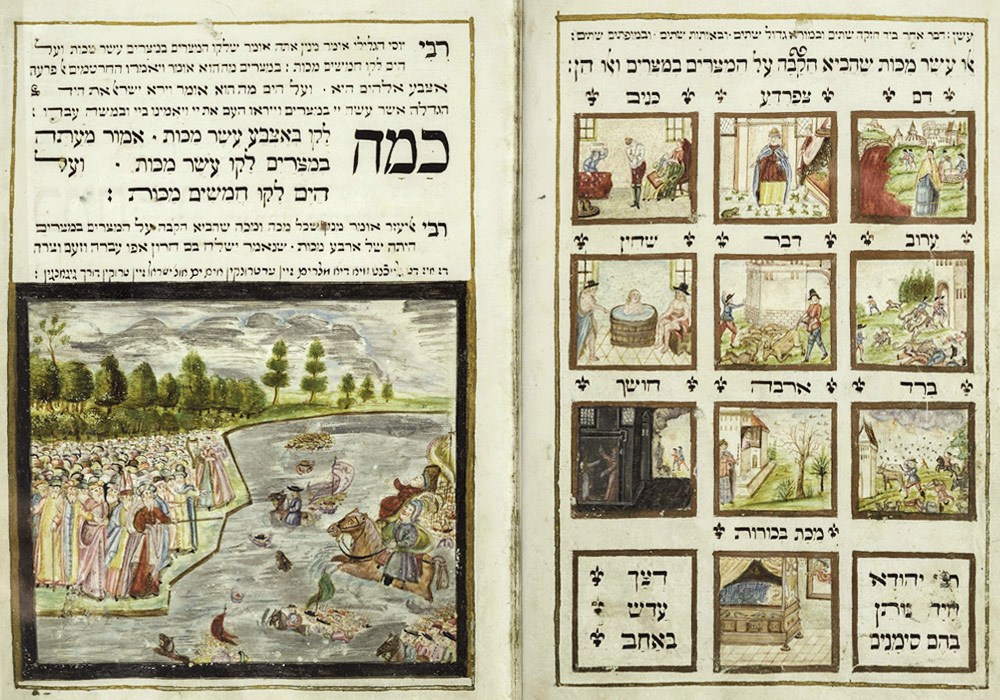
The Ten Plagues, in The Leipnik Haggadah, 1734. Yahad.net
The Book of Exodus implies that God could have liberated the Israelites at any point. After the plague of boils (שְׁחִין), Moses delivers YHWH’s message to Pharaoh:
שמות ט:טו כִּי עַתָּה שָׁלַחְתִּי אֶת־יָדִי וָאַךְ אוֹתְךָ וְאֶת־עַמְּךָ בַּדָּבֶר וַתִּכָּחֵד מִן־הָאָרֶץ. ט:טז וְאוּלָם בַּעֲבוּר זֹאת הֶעֱמַדְתִּיךָ בַּעֲבוּר הַרְאֹתְךָ אֶת־כֹּחִי וּלְמַעַן סַפֵּר שְׁמִי בְּכׇל־הָאָרֶץ.
Exod 9:15 I could have stretched forth My hand and stricken you and your people with pestilence, and you would have been effaced from the earth. 9:16 Nevertheless I have spared you for this purpose: in order to show you My power, and in order that My fame may resound throughout the world.[1]
If God could have wiped the Egyptians out with a single act, why did God send ten plagues?
Traditional Answers
For some two thousand years, readers of the Book of Exodus have inferred that God had a hidden reason for sending ten plagues, ascribing tacit meaning to the number.
One of the most influential of such readers is the Church Father Augustine of Hippo (354-430 C.E.) whose writings went on to shape Western Christianity. In a sermon attributed to Augustine, “On the Plagues of Egypt and Ten Commandments of the Law,” he explains the connection between each of the plagues and the ten commandments.[2] An example is his effort to connect the plague of locusts to the eighth commandment:
On the Plagues 8:11 The eighth commandment: You shall not bear false witness (Ex 20:16). The eighth plague: locusts, animals whose teeth do the damage. What does being a false witness mean, if not doing damage by biting and ruining by lying?[3]
Inspired by this sermon, many medieval European Christians believed that through the ten plagues, God was anticipating the Ten Commandments, sending each plague as a warning not to disobey the corresponding commandment in Exodus 20.[4]
Jewish tradition also developed explanations for why there were ten plagues. In Kabbalistic thought, some, such as R. Bahya ben Asher ibn Halawa (ca. 1255–ca. 1340, Spain), saw the ten plagues as representing the ten Sephirot, the ten divine emanations or manifestations through which God, engaging in the ongoing creation of the world, is revealed[5]:
רבנו בחיי, שמות ג:יט ויתכן לפי הקבלה כי מפני שהיו מכות מצרים עשר כחשבון י' ספירות מפני זה הזכיר בכל נפלאותי שהם רמז לכלל ספירות כי האחרונה הנקראת כל נמשכת ונאצלת מן האל"ף שהיא פלא וכן היא נפלאת ורחוקה מלהשיג.
R. Bahya, Shemot 3:19 Using a kabbalistic approach, since the plagues of Egypt numbered ten, like the number of Sephirot (emanations), for this reason, the Torah describes [the plagues] as “all of my wonders” (niflaotai) alluding to the total number of the Sephirot (emanations). For the last one of these Sephirot, also known as כל (kol) “all,” continues and emanates from the letter aleph, which is a wonder (pele), indeed it is a wondrous (niflet) and hard to grasp.[6]
Other Kabbalistic interpretations, picking up on language in Exodus’ account that associates the plagues with God’s fingers, identify each plague/divine finger with one of the ten sephirot.[7]
Challenges from Modern Scholarship
Although originating from different kinds of biblical interpreters and from different historical periods, such interpretations all arose from the belief that God had some reason for sending precisely ten plagues—a hidden motive but one that could be inferred by someone who knew how to read between the lines of the Bible. But it is difficult to prove that the author of the book of Exodus ascribed significance to the number of plagues.
The Torah nowhere mentions the number of the plagues or ascribes any significance to their position in the sequence: it is not even certain that, from the biblical author’s perspective, they should be distinguished as a set from the other miraculous signs and wonders recorded in Exodus, like the burning bush, Aaron’s staff turning into a serpent, and the parting of the sea.
Evidence from elsewhere in the Bible also argues against the idea that the number of plagues had a special significance for the biblical author. The Bible recounts the plagues in two other places, Psalms 78 and 105, but in those versions of the story, there are only seven or eight plagues. Did the authors of these psalms know some alternative, shorter version of the exodus story with fewer number of plagues?
Indeed, scholars have posited that there once existed versions of the exodus story with fewer numbers of plagues—seven,[8] three,[9] or even one.[10] The number grew to ten only after the various biblical sources were grafted together by an editor into the form we have in the book of Exodus.[11] According to this reconstruction of the story’s development, the fact that there are ten plagues was a byproduct of how the biblical account was composed and not essential to the meaning of the exodus story in its earliest forms.
While this view is widespread among academic biblical scholars, however, some maintain that the number and sequence of the plagues is no accident but was intentionally planned by the editors of the Torah—not God but some anonymous scribes—to suggest a meaning or convey a lesson beyond what the biblical account asserts explicitly.
For example, the biblical scholar Ziony Zevit (“Invoking Creation in the Story of the Ten Plagues”) argues that the ten plagues correspond to ten acts of creation in Genesis.[12] In this and other modern scholarly attempts to discern patterns or logic in the number of the plagues,[13] the editors of the Torah chose the number of plagues deliberately in order to communicate that God’s motivations in sending the plagues were more profound than the motives that God explicitly verbalizes to Moses and the Egyptians.
There is no way to answer the question definitively of whether the ten-ness of the plagues in the exodus story is an incidental detail, an unintended byproduct of how the Torah was composed, or encodes some kind of hidden message as scholars like Zevit argue. But we can gain some insight by investigating what led early interpreters of the Bible to read meaning into the number of plagues.
Hellenistic Transformations of the Ten Plagues
The first known text to explicitly mention that there were ten plagues, after providing a brief description of each of them in what is essentially a list,[14] is Jubilees, a retelling of Genesis and Exodus (up to the revelation at Sinai) composed in the second century B.C.E. It may not be a coincidence that this is the earliest source that explicitly mentions the number ten:
Jub 48:7 Everything happened by your word. Ten great and severe punishments came to the land of Egypt so that you could take revenge on it for Israel.[15]
What led the author of the book of Jubilees to refer to the plagues of Egypt as a set of ten? Jubilees was written at a time when people’s understanding of the Bible was being reshaped by the influence of Greek culture, and that change included new ways of relating to details in the Bible that previously had no special significance of their own.
An example is the early Jewish practice of assembling lists of significant facts from the Bible. Both the Dead Sea Scrolls and rabbinic literature record various lists that catalogue bits of information gleaned from the Torah—the names of prophets, miracles, and other data collected from the biblical canon. At some point during the Hellenistic period, Jewish scholars began to carefully cull the Bible for such information which they then arranged in the form of memorizable lists, much as people today assemble information from different sources as “listicles” that are easy to read and remember.
Shaye Cohen (Harvard University) has explained the rise of such scriptural lists as a Jewish adaptation of the role of lists in Hellenistic Greek textual scholarship and pedagogy. For example, among the papyri fragments found near Oxyrhynchus, Egypt, are those from a Greek manuscript that records lists of the Greek leaders of the expedition to Troy, the suitors of Penelope, and the Argonauts who accompanied Jason on his quest for the Golden Fleece.[16]
Cohen argues that the influence of this practice is what led Jewish scholars in the period to formulate lists of information culled from the Bible, which helps to explain the lists that appear in or are presupposed by Jubilees such as a list of the various angels created on the first day of the world[17] and the trials of Abraham.[18] The Hellenized Jewish practice of organizing and condensing biblical data into easily counted lists can also account for Jubilees’ treatment of the plagues as a catalogue-like set of ten items.
But Jubilees does not ascribe any special significance to the fact that there are ten plagues. For some insight into the origins of seeing significance in the number ten in this context, we need to turn to Philo of Alexandria, a Jewish philosopher and biblical commentator from the first century C.E.
Philo on the Perfection of the Number Ten
Philo is the first known biblical interpreter to offer an explanation for why God sent ten plagues. While what he says is brief, it is very telling when placed in the context of the intellectual world that Philo inhabited in first century Alexandria. One of his treatments of the ten plagues, a reading that offers an explanation for the number ten, appears in On the Life of Moses, a kind of biography of Moses that ascribes to him the virtues of a Greek philosopher.
On the Life of Moses 1.94 “The punishments inflicted on the land were ten—a perfect number for the chastisement of those who brought sin to perfection.”[19]
To understand what Philo means by ten being a perfect number, we need to understand his view of numerals in general. Although he was not a particularly original mathematical thinker, Philo took such an interest in numbers that he came to be known in later times as a Pythagorean, a member of a philosophical school that ascribed cosmic significance to numerals.[20]
Reimagining Moses as a Mathematician
This focus on numbers is reflected in Philo’s description of Moses, depicted as a master mathematician who drew on that ability as a source of divine knowledge. To explain why the prophet allowed only ten kinds of animals to be sacrificed,[21] for example, Philo offered the following comment:
The Special Laws, 4.105 For as (Moses) always adhered to the principles of mathematical science, which he knew by close association to be a paramount factor in all that exists, he never enacted any law, great or small, without calling to his aid, and as it were accommodating to his enactment, its appropriate number.[22]
That number, according to Philo, was ten:
The Special Laws, 4.105 But of all the numbers from the unit upwards ten is the most perfect, and, as Moses says, most holy and sacred, and with this he seals his list of the clean kinds of animals when he wishes to appoint them for the use of the members of his commonwealth.
Mathematics was not just another source of knowledge for Philo; it revealed the foundation of reality, and he believed it was relevant for understanding every law promulgated by Moses.
Finding Meaning in Biblical Numerals
Philo thought so deeply about the significance of numerals that he devoted a whole treatise to numbers, in which he likely sought to explain the various numbers found in the Five Books of Moses, including the number ten.[23] While that work was lost, glimpses of his interest in numbers are scattered in his surviving writings.
In his treatise On the Account of the World’s Creation, in a section where he is discussing why God created the world in seven days, he has an extensive discussion on the special properties of the number seven, but also reflects on the numerals 1–10 in general, sorting them into different categories according to characteristics such as whether they were even or odd, prime or composite.[24]
While all numbers from 1 to 10 were meaningful for Philo’s understanding of the Torah, as noted above, the number ten had special significance as the most perfect of the numbers. As Philo explains in On the Decalogue, ten contains all the different kinds of numbers — the odd (1, 3, 5, 7, 9), the even (2, 4, 6, 8), and numbers comprising both the even and the odd (e.g., 6, formed from 2 × 3).[25] It also encompasses all the dimensions of Euclidean geometry and all ten categories of existence identified by Aristotle:
The Decalogue 8.30-31 Those who study the doctrines of philosophy say that the categories in nature, as they are called, are ten only, substance, quality, quantity, relation, activity, passivity, state, position and the indispensables for all existence, time and place. There is nothing which does not participate in these categories.[26]
In other words, what made ten “perfect” according to Philo was its totality, its status as a complete set for the universe, the fact that it encompasses everything within it in every possible combination.
How the Ten-ness of the Ten Plagues Became Meaningful
Philo did not invent this conception of numerals: He learned it from Greek philosophy, and especially Neo-Pythagorean philosophy—the thought of Pythagoras as expanded upon by Plato and his disciples. In particular, Philo here seems influenced by arithmology, a form of reasoning about numbers that focused on their symbolic meaning.[27]
What Philo was doing in his commentary on the ten plagues, therefore, was simply applying Pythagorean/Platonic arithmology to the understanding of the biblical text. As he goes on to explain, the plagues involved different combinations of the four basic elements that comprised the physical world according to Aristotle--earth, water, air and fire:
The Life of Moses 1.97 God apportioned the punishments: He granted to Moses’ brother the three punishments from the denser elements of earth and water, from which corporeal qualities were created; He bestowed upon Moses alone an equal number consisting of air and fire, the life-giving elements; one correction, the seventh, He entrusted to both together, and the three remaining to round out the ten He reserved for Himself.[28]
The first few plagues (e.g., the turning of the water into blood, the frogs, the gnats) involve the heaviest elements, earth and water. The next set combined the lighter elements—air and fire (the hail, locusts, and darkness). The boils involved a combination of heavy and light--earth and air--and the last three (the flies, the cattle disease, the death of the first born) originated from that part of the cosmos beyond the material realm altogether.
For Philo, the ten-ness of the plagues reflected their totality as a complete set of the cosmos. They incorporated every aspect of the world—both the material realm with all four of its elements in various combinations and the non-material realm from whence the soul originates. What led Philo to this view was not the Bible itself but his exposure to the philosophical analysis of numerals as a reflection of the universe’s structure.
The mind’s impulse to detect patterns in experience is very powerful, and it sometimes leads people to overinterpret reality, to find patterns that are not really there. We cannot resolve whether that is the case for how interpreters have decoded the number of the ten plagues, but we can say something about the origin of this way of reading the exodus story: it was not the Bible by itself but early Jewish exposure to arithmology that first infused the ten-ness of the plagues with esoteric cosmic meaning.[29]
TheTorah.com is a 501(c)(3) nonprofit organization.
We rely on the support of readers like you. Please support us.
Published
March 31, 2026
|
Last Updated
September 14, 2026
Previous in the Series
Next in the Series
Before you continue...
Thank you to all our readers who offered their year-end support.
Please help TheTorah.com get off to a strong start in 2025.
Footnotes


Prof. Steven Weitzman serves as Abraham M. Ellis Professor of Hebrew and Semitic Languages and Literatures and the Ella Darivoff Director of the Herbert D. Katz Center of Advanced Judaic Studies at the University of Pennsylvania. He received his Ph.D. from Harvard University after completing his B.A. at UC Berkeley, and spent several years teaching Religious Studies at Indiana University and Stanford, where he also served as director of their Jewish Studies programs. Weitzman specializes in the Hebrew Bible and early Jewish culture and in his scholarship, he seeks insight by putting the study of ancient texts into conversation with recent research in fields like literary theory, anthropology, and genetics. His publications include The Jews: A History (co-authored with John Efrom and Matthias Lehman), a biography of King Solomon titled, Solomon: The Lure of Wisdom (Yale’s “Jewish Lives” series) and his The Origin of the Jews: the Quest for Roots in a Rootless Age (Princeton University Press, 2017).
Essays on Related Topics: