


 Edit article
Series
’Twas the Blight before Christmas—Antisemitic Interpretations of the Nativity


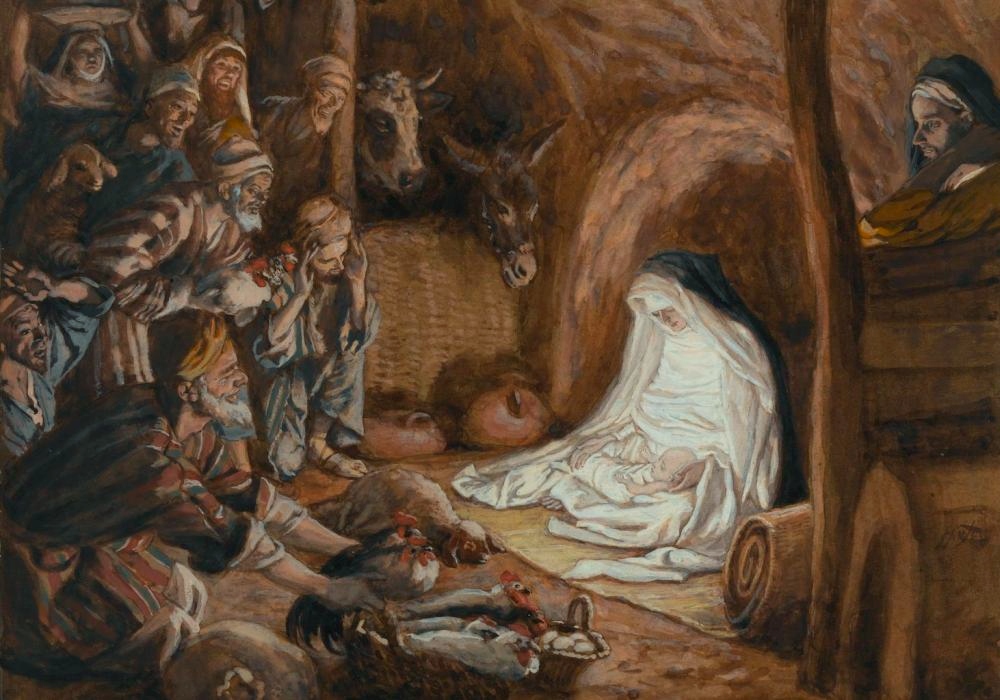
The Adoration of the Shepherds, 1886–1894 James Tissot, Brooklyn Museum
Are the Gospels Antisemitic?
Determining whether the Gospels are antisemitic remains an intractable problem. We lack a consensus definition of antisemitism[1]; we debate whether the term, suggesting an ethnic or racial component, is applicable to the pre-modern era; we argue over appropriate designations—antisemitism, Judeophobia, Jew-hatred (Judenhass), anti-Judaism.
We also lack consensus over who has the authority to determine if the text promotes antisemitism. Indeed, we debate whether we can speak of Judaism, let alone anti-Judaism, in the late Second Temple period, or if this term is appropriate only after the rise of rabbinic authority. I’ll use the term antisemitism for the sake of convenience.
Many of my Christian students insist that because the text is the Word of God, it cannot be antisemitic, because antisemitism is a sin. These readers exculpate the text and locate antisemitism not in the words on the page, but in the interpretations of the reader.
Academics, some with what may be apologetic agendas, insist that negative comments about Jews in the Gospels—e.g., Jesus tells the Jews who oppose him, “You are from your father the devil” (John 8:44); all the Jews (lit. “all the people”) clamored for Jesus to be killed (Matt 27:25)[2]—do not really mean “all Jews” but just a subset, usually the “leadership” of the population. The texts here cited, and others, lack such distinctions between leaders and the rest of the population, and most of those Jews followed other teachers rather than Jesus’s disciples.
A final attempt (there are several others, but I am limited by word count) to demonstrate the Gospels are not antisemitic is to claim that they are written both by and for Jews, and Jews would not be antisemitic. Aside from fraught discussions of the “self-hating” Jew, the problems here include lack of secure ability to determine the ethnicity of the authors of the Gospels or the composition of their intended audiences.[3]
Rather than trying to resolve the general arguments about whether the Gospels are antisemitic, I will instead show how Christians have introduced antisemitic teachings into the Christmas Stories and then turn to the broader subject of Christmas and supersessionism, the idea that Christians have replaced Jews as the covenant community.[4] I shall not cite the sermons and books where I found this material—I do not want to label people antisemitic, and I suspect that most would be appalled to think that they are promoting such a view.
Four, and Maybe Five, Antisemitic Christmas Claims
The Christmas Stories appear in Matthew (chs. 1–2) and Luke (chs. 1–2).[5] These chapters yield both the Jewish origins of the Christmas story[6] and give rise to numerous subsequent antisemitic interpretations.[7] Here are my top four, and a fifth to reconsider.
1. Jews would have stoned Mary for adultery.
Mary is engaged when she becomes pregnant, but the marriage has not been consummated:
Matt 1:18 Now the birth of Jesus the Messiah took place in this way. When his mother Mary had been engaged to Joseph, but before they lived together, she was found to be with child from the Holy Spirit.[8]
According to Jewish legal norms, once engaged, which is a legal process, the woman is sexually available only to her husband-to-be (see Deut 22:23–24). Thus, Mary—Joseph’s legally contracted wife-to-be—could be charged with adultery for being pregnant with a child other than Joseph’s.[9] To break the engagement requires a legal divorce, and indeed, that is Joseph’s initial plan:
Matt 1:19 Her husband Joseph, being a righteous (the equivalent Hebrew would be צַדִּיק) man and unwilling to expose her to public disgrace, planned to divorce her quietly.[10]
Several commentators (who, again, will be cited anonymously) insist Jews would have stoned Mary for committing adultery. While biblical law does speak of stoning adulterers (Lev 20:10; Deut 22:22), the Bible includes no narratives of anyone stoned for adultery. The adulterous relationship between David and Bathsheba (2 Sam 12) never mentions its possibility.[11]
Moreover, the rabbis also make stoning almost impossible.[12] More relevant to Mary’s case is the ritual test of bitter waters, designed for a husband who suspects adultery but cannot prove it (Num 5),[13] not stoning.
Commentators support the claim that Mary would have been stoned by citing an account in the Gospel of John (8:2–11), in which the scribes and Pharisees bring a woman accused of adultery to Jesus:
John 8:4 They said to him, “Teacher, this woman was caught in the very act of committing adultery. 8:5 Now in the law Moses commanded us to stone such women. Now what do you say?”[14]
Jesus, however, famously responds:
John 8:7 ...“Let anyone among you who is without sin be the first to throw a stone at her.”[15]
For these commentators, the story shows both that Jews are stoning women for adultery and that Jesus, knowing the circumstances surrounding his own conception and thus his mother’s reputation, is particularly appalled by this practice. The use of John to support the claim that Mary should have been stoned misunderstands the Pharisees’ intentions.
The accused woman of John 8 is not about to be stoned. The scene is set in the Temple (not a place of capital punishment) and it does not depict a trial. The woman’s partner in the adultery is not present to be similarly judged (e.g. Deut 22:22), nor is anyone carrying stones.[16] The point of the confrontation is to test Jesus:
John 8:6 They said this to test him, so that they might have some charge to bring against him.[17]
Were he to advise stoning her, the Pharisees could have charged him with heartlessness; were he to advise against stoning, they could question his authority for ignoring Torah. Their question, like similar questions such as “Is it lawful to pay taxes to Caesar” (Matt 22:17//Mark 12:14), is designed to trap, not to gain information.[18]
Other commentators suggest that Mary leaves Bethlehem to escape stoning. They read Luke (where Mary visits Elizabeth) in light of Matthew (where Joseph is concerned about the pregnancy). Luke simply says that after learning that she will bear a child and that her previously infertile cousin Elizabeth is six-months pregnant (Luke 1:35–35), Mary goes to visit Elizabeth:
Luke 1:39 In those days Mary set out and went with haste to a Judean town in the hill country, 1:40 where she entered the house of Zechariah and greeted Elizabeth.[19]
Had Mary been worried about her own pregnancy showing, her returning to Nazareth (Lk 1:56) when she is still pregnant would make no sense. Luke’s episode is not about Mary’s apparent adultery. Rather, its focus is the birth of Elizabeth’s son, John the Baptist, and his connection to Jesus: When Mary first arrives, the unborn John “leaps” in Elizabeth’s womb (v. 41).
2. Mary and Joseph are turned away from the inn because they had no money.
For those who need more of Tiny Tim and the Ghost of Christmas Past in their nativity story, there is the play, “A Christmas Carol: Scrooge in Bethlehem”:
Adapted from Charles Dickens’ 19th-century English story, A Christmas Carol, this delightful children’s musical tells the story of Scrooge, the greedy, obsessed Bethlehem innkeeper who refuses shelter to Mary and Joseph on that first Christmas night.[20]
This charming story reinforces the “Jews are greedy” stereotype. Googling “Greedy innkeeper” shows the staying power of the trope.
Luke mentions neither an innkeeper nor money. Joseph and Mary travel from Nazareth in the Galilee to Bethlehem in Judea after Caesar Augustus decrees all residents are to be registered, presumably for purposes of taxation (Luke 2:1–5). In Bethlehem, Mary goes into labor and needs a place to give birth:
Luke 2:6 While they were there, the time came for her to deliver her child. 2:7 And she gave birth to her firstborn son and wrapped him in bands of cloth and laid him in a manger, because there was no place (τόπος) in the guest room (κατάλυμα).[21]
Though the Greek term κατάλυμα (kataluma) is often understood as referring to an inn, the term is better translated as “guest room.” This would have been a public space where strangers could congregate; the same term is used for the site of the Last Supper (Luke 22:11).
The Greek word τόπος (topos) refers to a place or a space. Luke uses the term seventeen more times,[22] all suggesting a particular location. Thus, the description that there was “no place in the guest room” means that there was no space there suitable for having a baby. Mary would not want to give birth in a public space (neither would I), and such a noisy location would be unhelpful for a newborn. Thus, Mary gives birth in a more private area.
3. Mary giving birth in the inn would make everyone under its roof ritually impure.
An increasingly common trope in Christian, and most often Protestant, settings adduces Jewish purity laws—always regarded as negative—to explain why Mary is barred from giving birth at the inn. She must give birth in a stable lest she make everyone else residing in the inn ritually impure. Interpreters then argue that Jesus later dismissed these laws.[23]
Because purity issues are frequently connected to women (e.g., both menstruation and childbirth create states of impurity), seeing Jesus as doing away with the purity laws serves to bolster the view that Jesus is a feminist against a misogynist Jewish culture. Luke, however, says nothing here about ritual purity, so the interpreter needs to import the negative stereotype into the text.
Missing in this negative stereotype is the fact that most people are impure most of the time; the purity status is relevant only for entry into the Jerusalem Temple. The laws thus do not restrict women from the public sphere, any more than they would restrict men who had recently prepared a corpse for burial or shared a room with a menstruating woman.
Mary, after giving birth to Jesus, does not lament her status of ritual impurity. Likewise, Luke’s account of Mary’s cousin Elizabeth participating in a ceremony in her home for the circumcision and naming of her son John (later to be known as the “immerser” or the “baptizer”) makes no mention of purity concerns:
Luke 1:59 On the eighth day they came to circumcise the child, and they were going to name him Zechariah after his father. 1:60 But his mother said, “No; he is to be called John.”[24]
In addition, it makes little sense to posit that an “innkeeper” (if there were one) would be tracking purity violations for the inn’s guests. Purity laws also applied to men—for example, a man who ejaculates is impure. I doubt anyone at the inn would have been checking the sheets every morning. (Whether there were sheets is yet another question.)
Finally, Jesus does not do away with purity laws. To the contrary, he restores impure people to purity by healing them of the condition that rendered them impure—e.g., a woman suffering uterine or vaginal bleeding; people suffering from skin diseases; corpses.[25]
4. Jesus’s birth is announced to social outcasts or nobodies.
After Jesus’s birth, an angel announces the news to a group of nearby shepherds:
Luke 2:10 But the angel said to them, “Do not be afraid, for see, I am bringing you good news of great joy for all the people: 2:11 to you is born this day in the city of David a Savior, who is the Messiah, the Lord. 2:12 This will be a sign for you: you will find a child wrapped in bands of cloth and lying in a manger.”[26]
Christian sermons on this narrative often suggest that Jesus’s birth is first announced to the shepherds because they represent the “outcast” and “impure” in society.[27] This claim of Christian inclusivity functions most effectively if it is set against the negative stereotype that Jews approve only of the rich and associate poverty with sin. Thus, the announcement of the birth of Jesus signals a change to this system.
Commentators sometimes cite rabbinic sources, especially the Mishnah, to support their claims about the shepherds’ outcast status:
משנה קידושין ד:יד אַבָּא גֻרְיָן אִישׁ צַדְיָן אוֹמֵר מִשּׁוּם אַבָּא גֻרְיָא, לֹא יְלַמֵּד אָדָם אֶת בְּנוֹ, חַמָּר, גַּמָּל, סַפָּר, סַפָּן, רוֹעֶה, וְחֶנְוָנִי, שֶׁאֻמָּנוּתָן אֻמָּנוּת לִסְטִים.
m. Qidd. 4:14 Abba Gurion of Sidon says in the name of Abba Guria: Let a person not train his son as a donkey driver, a camel driver, a barber, a sailor, a shepherd, or a shopkeeper, for their trades are the trade of bandits.[28]
Extracting one saying from a collection of 4,224 mishnayot, the antisemitic approach concludes that Jews thought shepherds were thieves, but God announces the birth of Jesus to these outcasts.
This falsehood requires ignoring most of the Torah, the Prophets, and Wisdom literature, as well as many other rabbinic texts; it would discount Rachel, Moses, David, and Rabbi Akiva. To associate shepherds with the outcast and impure would also make a mockery of the psalmist’s claim, יְהוָה רֹעִי, “YHWH is my shepherd” (Ps 23:1). It would make Jesus’s proclamation, “I am the good shepherd” (in John 10:10, 14), odd.
In addition, Luke depicts the shepherds as messengers to the people, who are amazed at their words:
Luke 2:17 When they saw this, they made known what had been told them about this child, 2:18 and all who heard it were amazed at what the shepherds told them.[29]
Were the shepherds “outcast” or “nobodies,” there would be no reason for anyone else to take seriously what they have to say.[30]
5. Jesus is a Palestinian
Jesus the Palestinian, or a “Palestinian-Jew,” has become a testcase for showing how difficult it is both to determine if antisemitism is present and to decide who has the authority to make the determination. In 2024, the Vatican crèche, fashioned from olive wood by two Palestinian artisans, Johny Andonia and Faten Nastas Mitwasi at Bethlehem’s Dar al-Kalima University, featured the baby Jesus lying on a kaffiyeh. Photos of the Pope Francis looking at this display pleased those invested in the cessation of Israel’s bombing of Gaza and distressed those who concluded from the images that the Pope approved of Hamas. After the negative response, the keffiyeh was removed.[31]
Several commentators, not all of them Jews, have noted the anachronism of the label “Jesus the Palestinian.” The term “Palestine” came into common use after the Bar Kochba rebellion (132–135 C.E.). While it does appear in the writings of Josephus (e.g., Ant. 1.136, 145; 20.259; War 5.384, Apion 1.171) and Philo (e..g, Abr.133; Mos. 1.163) to describe a geographic area, it does not function as an ethnic identity (as do, e.g., “Syrian” and “Egyptian”). It is never mentioned in the Bible; the Gospel stories speak only of Judea, Samaria, and the Galilee. The Gospels make clear that Jesus was a Jew, born in “Bethlehem of Judea” (Βηθλέεμ τῆς Ἰουδαίας; Matt 2:1, 5).
Whether speaking of Jesus the Palestinian is antisemitic or not depends, in part, on whether the claim erases his Jewish identity. Jesus has been imaged as Italian and Swedish, Kenyan and Venezuelan, Korean and Ukrainian; he is, for his followers, a universal figure. None of these identifications needs erase his Jewish identity: Jews can also be identified, and self-identify, as Italian and Swedish, etc. Problems emerge when Herod and his soldiers are seen as the Jews, but not Jesus or Mary or Joseph, or the grieving parents in Bethlehem.
Supersessionist Christmas
The antisemitic readings just detailed (and there are others) are not intrinsic to the nativity stories. However, a soft supersessionist agenda is. The Gospels present Jesus as the fulfillment of eschatological hopes grounded in earlier scripture, and thus they claim to hold the definitive interpretation of those earlier texts. The Gospels present Jews who fail to follow Jesus as unfaithful to their own tradition and not understanding the meaning of their own texts.[32]
In the nativity stories of Matthew and Luke, Jesus is the culmination of all of Israel’s hopes. Just as Luke’s angel declares to the shepherds the birth of “a Savior, who is the Messiah, the Lord” (2:11), so an angel in Matthew tells Joseph about Mary’s son:
Matt 1:21 “She will bear a son, and you are to name him Jesus, for he will save his people from their sins.”[33]
The name “Jesus” comes from the Hebrew root י.שׁ.ע, meaning “save”; the same root underlies the names Joshua and Hosea as well as the term “hosanna.” Later, magi who come from the East to visit the newborn Jesus describe him as “king of the Jews”:[34]
Matt 2:2 They asked, “Where is the child who has been born king of the Jews? For we observed his star in the east and have come to pay him homage.”[35]
Jesus is not only the representative of God on earth; he is, as John 1:1 and Trinitarian theology would later proclaim, God incarnate, in the flesh. For some Christian readers, he provides what they think, on the basis of the Gospel texts, is lacking in Judaism: forgiveness of sins; a present God. The Gospel of John offers a version of this approach by claiming that:
John 1:17 The law indeed was given through Moses; grace and truth came through Jesus Christ.[36]
Telling children at Christmas time that they can choose between law on the one hand, and grace and truth in the other, introduces a negative view of the “Old Testament.” Stereotypes of the Old Testament “God of wrath” and the New Testament “God of love” are an easy next step.[37]
Other groups of Jews in antiquity, and today, made similar claims to be the true heirs of Moses, and they did so by delegitimating or seeking to replace other groups. For example:
The residents of Qumran see their community, the yachad, as the culmination of Israel’s history.
The Mishnah limits the true retainers and interpreters of Torah to the rabbis and so displaces the priests.
Philo dismisses the radical allegorizers.
Josephus condemns the rebels.
The distinction between these other forms of Jewish identity formation and the Gospels is that they are not also invested in communities comprised of both Jews and gentiles. Jews who speak negatively of other Jews, even to the point of delegitimizing them, are still working within a Jewish paradigm.
Matthew and Luke are both outward facing, to the gentile church, and so are not operating on the same model.[38] As time goes on and the Jewish origins of Jesus and his first followers are downplayed and then lost, the Gospels’ claims of being the correct readers of what comes to be called the “Old Testament” and the attendant claims that Jews do not understand their own texts (see 2 Cor 3:14) take on even more pernicious connotations.
Matthew never ends the mission “to the lost sheep of the house of Israel” (10:6; 15:24), but the future of the movement is among “all the gentiles” (πάντα τὰ ἔθνη, 28:19) who are to be evangelized about Jesus’s teaching, resurrection and lordship, while the story told among “the Jews” (Ἰουδαίοι) is that the disciples stole Jesus’s corpse (28:15).[39] Luke’s Jesus is more optimistic in expecting the Jews in Jerusalem to accept his Lordship one day:[40]
Luke 13:35 “...And I tell you, you will not see me until the time comes when you say, ‘Blessed is the one who comes in the name of the Lord.’”[41]
Disagreement without Delegitimization
Such supersessionism is inevitable, but it need not be harmful to Jews.[42] Christians can still claim that the covenant with Israel remains:
Rom 11:29 For the gifts and the calling of God are irrevocable.[43]
Homilists can remind their congregations that Jesus, Mary, and Joseph were faithful Jews, and that the Christmas messages of love and light and liberation are all grounded in the Scriptures of Israel and Second Temple Judaism. Priests and pastors can warn the faithful against the triumphalism that marginalizes others or, worse, makes them outcasts.
I can live with eschatological supersessionism. I can also appreciate the joys of Christmas while agreeing to disagree with some of its implications. But while we await the messianic age, it would be nice to have a merry little Christmas, without the helpings of antisemitism.
TheTorah.com is a 501(c)(3) nonprofit organization.
We rely on the support of readers like you. Please support us.
Published
December 23, 2025
|
Last Updated
August 26, 2026
Previous in the Series
Next in the Series
Before you continue...
Thank you to all our readers who offered their year-end support.
Please help TheTorah.com get off to a strong start in 2025.
Footnotes


Prof. Amy-Jill Levine is Rabbi Stanley M. Kessler Distinguished Professor of New Testament and Jewish Studies, Hartford International University for Religion and Peace; University Professor of New Testament and Jewish Studies/Mary Jane Werthan Professor of Jewish Studies (Emerita), Vanderbilt. Her over 30 books include The Misunderstood Jew: The Church and the Scandal of the Jewish Jesus, Short Stories by Jesus: The Enigmatic Parables of a Controversial Rabbi; Jesus for Everyone, Not Just Christians, six children’s books (with Sandy Sasso); The Gospel of Luke (with Ben Witherington III, the first biblical commentary by a Jew and an Evangelical); The Jewish Annotated New Testament (co-edited with Marc Brettler), The Bible With and Without Jesus: How Jews and Christians Read the Same Stories Differently (with Marc Brettler), The Pharisees (co-edited with Joseph Sievers), and nine Beginner’s Guide Bible studies.
Essays on Related Topics: