


Op-ed
I’m Retiring from My Professorship, but Not from TheTorah.com
To me, TheTorah.com’s success feels like a נס גדול—a significant miracle.
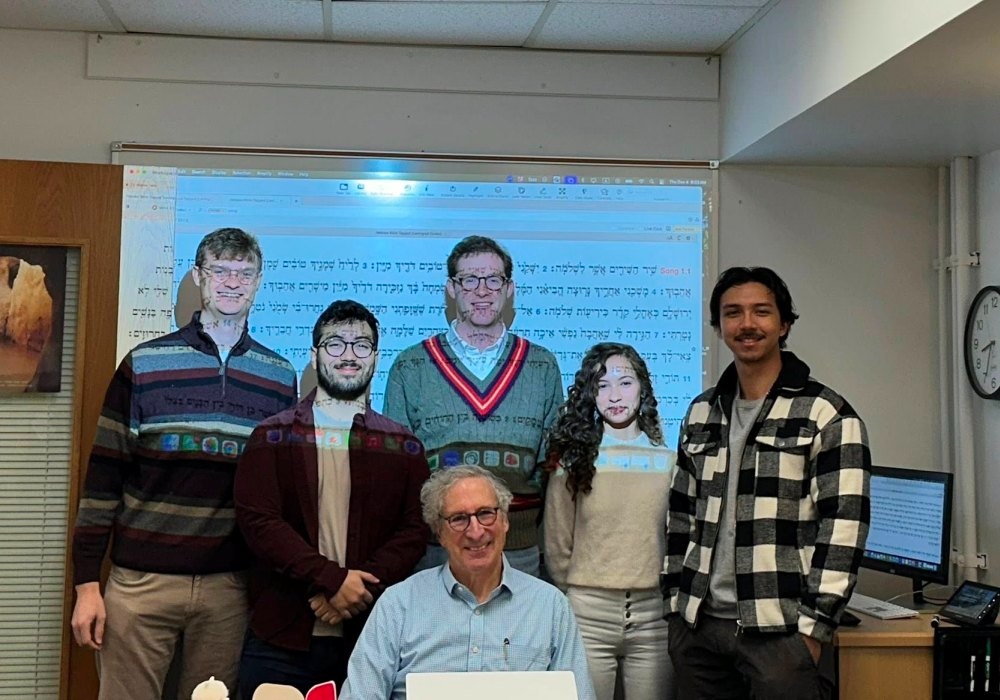
Prof. Marc Brettler teaching his final graduate seminar (on the Song of Songs) at Duke University.
I have spent over forty years in the university classroom—and just three weeks ago, I taught my last class at Duke University. Although I am officially retiring at the end of June, I am not retiring from the academic world. I will continue writing and speaking, and I will also edit all pieces submitted to TheTorah.com, working with the editorial staff to ensure that each and every essay we publish reads well and is academically sound (not that I need to agree with everything it says).
In addition to the importance of this work, I enjoy it immensely because I learn so many new things every week—and not only about the Bible. Even thinking about pieces we put out very recently, how else would I ever have encountered Chinese Jewish naming practices connected to the prohibition against eating the gid hanesheh, the “sciatic nerve”?
Tsachi Slater’s article “The Chanukah Oil Miracle Never Happened—A 19th Century Heresy” also introduced me to many new worlds. —streets I often pass now that I have made aliya and moved to Jerusalem. The accusations of heresy (I always love to hear about these!) against Slonimski and Alexandrov bring up questions that lie at the very core of TheTorah.com’s mission:
What does it mean to be religious today, and how is it impacted by studying past events? How do science and religion intersect? Does it make sense to observe commandments that are based on historical errors? Can a story be “only” allegorical, and yet meaningful? (My answer is yes and yes.)
I was also delighted to see that non-Jews engaged in this debate about the historicity of a Jewish miracle. When we founded TheTorah.com, we were focused on Jewish readers and never imagined that our essays would gain such traction in the non-Jewish world, or that we would include essays on New Testament and Qur’anic passages that related to the Tanakh. It brings me special pleasure that Amy-Jill Levine, an NT professor with whom I have collaborated in the past, has written for us. Many academic friends, and even former roommates from forty years ago—Peretz Rodman and Marty Lockshin—as well as former students such as Noam Cohen, have contributed pieces to the site.
I hope that the articles we have brought you over the years have increased your knowledge of specific texts, the history of their composition, how they relate to and differ from other texts, how they are interpreted in different communities, and how they have been understood over time. To my mind, all of these issues, some traditional, some more modern, are part of שׁבעים פנים לתורה, the seventy facets of what the Torah might mean—about which we also have a recent article.
We never imagined that we would create a site that would be so widely read, including in university classrooms, synagogues and study groups.
So far, over 325 people—rabbis, academics, readers of all types and stripes—have contributed to our year-end campaign, and we are slightly past the 80% mark toward our goal. In the wake of Chanukah, I consider our success to be a נס גדול—a significant miracle—and I hope that you will, through your generosity, help this miracle continue, and even expand.

TheTorah.com is a 501(c)(3) nonprofit organization.
We rely on the support of readers like you. Please support us.
Footnotes


Prof. Marc Zvi Brettler is Bernice & Morton Lerner Distinguished Professor of Judaic Studies at Duke University, and Dora Golding Professor of Biblical Studies (Emeritus) at Brandeis University. He is author of many books and articles, including How to Read the Jewish Bible (also published in Hebrew), co-editor of The Jewish Study Bible and The Jewish Annotated New Testament (with Amy-Jill Levine), and co-author of The Bible and the Believer (with Peter Enns and Daniel J. Harrington), and The Bible With and Without Jesus: How Jews and Christians Read the Same Stories Differently (with Amy-Jill Levine). Brettler is a cofounder of TheTorah.com.


