


 Edit article
Series
A Longer Look at Moses’ Very Short Prayer


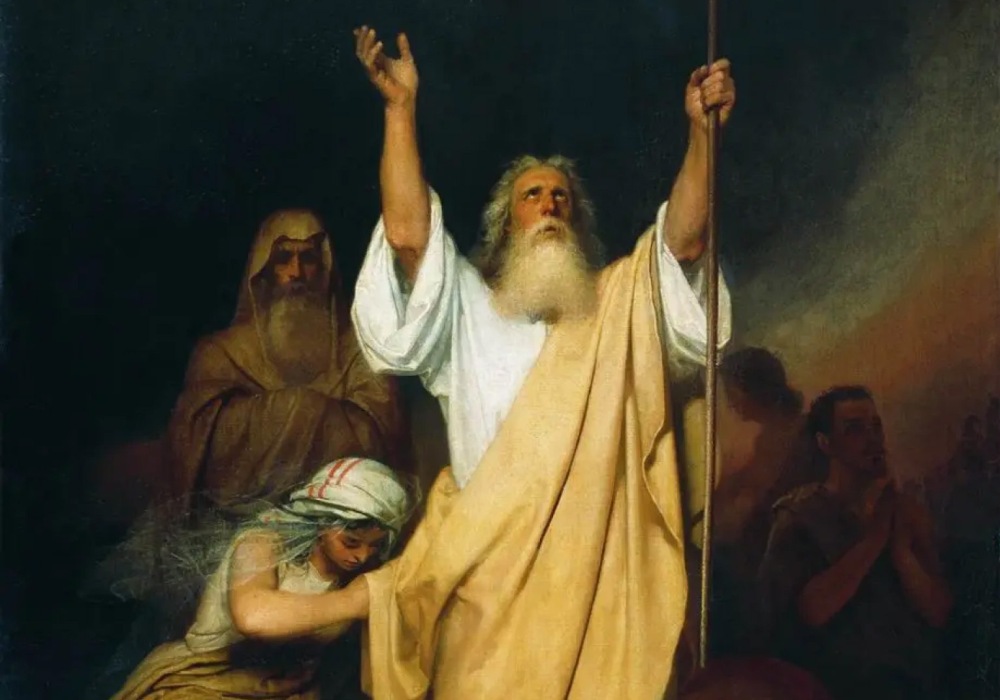
Prayer of Moses after the Israelites go through the Red Sea (detail), Ivan Kramskoy, 1861. Wikiart
The paradigm for both prolonged and brief prayer is Moses, as Rabbi Eliezer (2nd cent. C.E.) informs his students, according to the early rabbinic midrash Sifrei Numbers:
ספרי במדבר בהעלותך קה שאלו תלמידיו את ר' אליעזר: "עד כמה יאריך אדם בתפילתו?" א[מר] להן: "לא יאריך יותר ממשה, שנ[אמר] (דברים ט:כה) 'וא<ת>פלל לפני יי את ארבעים יום.'"[1]
Sifrei Numbers §105 His students asked Rabbi Eliezer: “How much may one lengthen one’s prayer?” He said to them: “He should not go longer than Moses, as it says (Deut 9:25), ‘And I prayed before the LORD for forty days.’”[2]
This refers to the prayer Moses offered in the aftermath of the sin of the golden calf.
"ועד כמה יקצר אדם בתפילתו?" א[מר] להן: "לא יקצר פחות ממשה שנ[אמר] (במדבר יב:יג): 'אֵל נָא רְפָא נָא לָהּ.'"
[The students then asked:] “And how brief may one be in one’s prayers?” He answered them: “He should not abbreviate more than Moses, as it says (Num 12:13), ‘O God, pray, heal her.’”
This refers to the appeal Moses offered after Miriam was stricken with a skin affliction, an appeal comprising only five words, totaling only eleven letters.
At this point, echoing Ecclesiastes’ famous list of apt times (Eccl 3:1–8), Rabbi Eliezer makes a general observation:
"יש שעה לקצר ויש שעה להאריך."
“There is a time to be brief [in prayer], and a time to prolong.”[3]
The Logic of Moses’ Brevity
Why was Miriam’s affliction a time for brevity? Sifrei Numbers asks this question:
ספרי במדבר בהעלותך קה מפני מה לא האריך משה בתפליתו?
Sifrei Numbers §105 Why did Moses not pray at length?
It offers explanations around the following three issues:
Nepotism—Moses didn’t want to give the impression that he was overly favoring his sister:
שלא יהו ישר[אל] או[מרים] "מפני שהיא אחותו, עומד ומרבה בתפילה. "
So that the Israelites shouldn’t say: “Because she is his sister, he is standing in prayer excessively.”
Callousness—Moses didn’t want to give the impression that he was callous to her pain:
ד[בר] א[חר]: שלא יהו ישראל אומרין: "אחותו נתונה בצרה והוא עומד ומרבה בתפלה. "[4]
Another interpretation: So that the Israelites shouldn’t say: “His sister is in distress, and he is offering lengthy prayers.”
Effectiveness—Moses intended to pray longer, but God cut him off by answering his prayer immediately:
ד[בר] א[חר]: לא זה הוא שמשה מתפלל והק[דוש] שומע תפילתו? כמה שנ[אמר] (איוב כב:כח): "ותגזר אמר ויק[ם] לך וג'", (ישעיה נח:ט) "אז תקרא ויי יענה."
Another interpretation: Is it not that Moses prays and the Holy One hears his prayer? As it says (Job 22:28): “You will decree and it will be fulfilled, etc.” (Isa 58:9) “Then, when you call, the LORD will answer.”
Forgiveness—The medieval commentator Levi Gersonides (1288–1344) suggests that Moses’ prayer was not so much a genuine plea as an indication to God that he, Moses, had forgiven Miriam for speaking against him, so there was no need for more than a few words:
רלב"ג במדבר יב:יג והנה התפלל משה לה׳ יתעלה בעבור אחותו במלות קצרות מאד, לפי שלא נצטרך ליותר מזה בזאת התפילה; כי ה׳ יתעלה עשה זה לכבוד משה, וכבר מחל להם משה על מה שחטאו לו, כמו שביקש ממנו אהרן; והנה הראה להם שמחל להם זה בהתפללו לה׳ יתעלה שירפא מרים אחותו.
Gersonides Num 12:13 Moses prayed to God on behalf of his sister in very few words, since nothing more than this was needed in this prayer. For God did this only because of the offense to Moses’ honor, and Moses had already forgiven them (Miriam and Aaron) for how they sinned against him, as Aaron requested of him, so he showed them that he forgave them by his prayer to God that God heal his sister Miriam.
Offense—Jacob Milgrom (1923–2010) picks up on the dynamic that Gersonides notes, but takes it in the opposite direction: Moses was stingy with his words because he felt offended by what Miriam had said.[5]
The Text of the Prayer
But this entire line of reflection on the brevity of Moses’ prayer can be questioned. The starting point for a different approach is a grammatical anomaly. According to the Masoretic Text and all ancient witnesses, the first word of the prayer is אֵל (“God”). For over a century, however, many scholars have argued, in my view decisively, for revocalizing as אַל (“[let] not”), because the word נא generally occurs only after verbs and after the particles הנה “behold,” אם “if,” and אַל “let not.” Moses’ prayer would represent the only case in which the word נא occurs at the beginning of a sentence, or after a vocative. [6]
Ordinarily, the phrase אַל נא “let not” negates a subsequent verb, but occasionally, as in the proposed revocalization of Numbers 12:13, the phrase occurs as a standalone sentence, as an initial interjection that opens a discourse. Here are two examples from Genesis.
1. After one of the angels urges Lot to flee to the hills lest he be caught up in the destruction of the cities of the plain, Lot objects:
בראשית יט:יח וַיֹּאמֶר לוֹט אֲלֵהֶם אַל נָא אֲדֹנָי.
Gen 19:18 Lot said to them: “Oh no, my lords!”
He asks instead that a little town closer by be spared, so that he might flee there, and the angel consents.
2. After Esau politely refuses Jacob’s gift, Jacob pleads with Esau, rather, to accept the gift:
בראשית לג:י וַיֹּאמֶר יַעֲקֹב אַל נָא אִם נָא מָצָאתִי חֵן בְּעֵינֶיךָ וְלָקַחְתָּ מִנְחָתִי מִיָּדִי...
Gen 33:10 But Jacob said, “No, I pray you; if you would do me this favor, accept from me this gift…”
Esau eventually gives in and accepts the gift.
In both of these cases, the words אַל נא signify resistance to a course of action in relation to the speaker that the speaker’s interlocutor has settled on and articulated: the angel’s determination that Lot should flee to the hills, Esau’s refusal of the gift. They also introduce an alternative proposal: flight to a nearby town, acceptance of the gift. In the case of Moses’ prayer for Miriam (Num 12:13), however, Moses is not replying to God, as God has not spoken to him at all.[7] This apparent anomaly, to which I will propose a solution below, may have been one factor in the repointing of the word from an original אַל to אֵל.
Moses’ Prayer for Miriam and His Prayer for the People in Korah
The repointing to אֵל could also have drawn inspiration from a prayer uttered by Moses and Aaron elsewhere in Numbers, in response to God’s threat to wipe out the people of Israel on account of Korah’s rebellion:
במדבר טז:כב וַיִּפְּלוּ עַל פְּנֵיהֶם וַיֹּאמְרוּ אֵל אֱלֹהֵי הָרוּחֹת לְכׇל בָּשָׂר הָאִישׁ אֶחָד יֶחֱטָא וְעַל כׇּל הָעֵדָה תִּקְצֹף.
Num 16:22 They fell on their faces and said: “God (אֵל), Source of the breath of all flesh! When one man sins, will You be wrathful with the whole community?”
This prayer makes reference to flesh (בשר), while just before Moses’ prayer on Miriam’s behalf, we find (in Num 12:12) the word בשרו “his flesh.” A Fragment Targum offers evidence that these two prayers were understood to be connected, as it introduces flesh into an expanded version of Moses’ prayer for Miriam:
תרגום ירושלמי קטעים במדבר יב:יג אלהא דמסי כל בשרא אסי יתה.
Fragment Targum V Num 12:13 “O God who heals all flesh, heal her.”[8]
Targum Pseudo-Jonathan’s rendering is even more striking:
תרגום יונתן במדבר יב:יג בבעו ברחמין אלקא רחמנא בבעו אלקא דשליט בנישמת כל בישרא אסי בבעו לה.
Pseudo-Jonathan Num 12:13 I pray by the mercy of the merciful God, God who rules over the souls of all flesh, heal her, I pray.
The epithet, “God who rules over the souls of all flesh,” is drawn directly from the Palestinian targum tradition to Numbers 16:22.[9] In short, the perceived connection between these two prayers likely influenced the pointing of the opening word in Num 12:13 as אֵל.
Naʾ and ʾAnah
The tradents who repointed the word as אֵל may not have been troubled by the resulting anomalousness of the initial נא in Numbers 12:13 because they perceived little difference between נא and the phonologically and rhetorically similar interjection אָנָּה. Indeed, in a quick reading, Moses’ prayer looks quite similar to that which Joseph’s brothers ascribe to their father and use themselves:
בראשית נ:יז כֹּה תֹאמְרוּ לְיוֹסֵף אָנָּא שָׂא נָא פֶּשַׁע אַחֶיךָ וְחַטָּאתָם כִּי רָעָה גְמָלוּךָ וְעַתָּה שָׂא נָא לְפֶשַׁע עַבְדֵי אֱלֹהֵי אָבִיךָ...
Gen 50:17 “So shall you say to Joseph, ‘Forgive, I urge you, the offense and guilt of your brothers who treated you so harshly.’ Therefore, please forgive the offense of the servants of the God of your father.”…[10]
But what would an original vocalization אַל נא “let not” mean in the context of Moses’ prayer? How is it consistent with the usage of the phrase in the cases of Lot and Jacob above?
Moses Responds to God’s Action on His Behalf
After Miriam and Aaron spoke negatively about Moses, God comes to Moses’ defense and punishes Miriam with a skin affliction. Therefore, Moses treats Miriam’s affliction as a course of action that God has settled on in relation to himself, and is appealing to God to desist, and to heal Miriam. God has, as it were, “spoken” to Moses and said, let Miriam suffer for her sin against you, and Moses responds and says, “pray, let it not be so,”i.e., seeing that this is on my account, I ask that You do otherwise.
Building on Aaron’s Request
Recognizing an original אַל נא in Moses’ prayer also enables us to appreciate how Moses’ prayer works in context, as it is the third use of this phrase in the story. After Miriam is struck with the skin affliction, Aaron pleads with Moses on his own and Miriam’s behalf, and both verses feature the phrase:
במדבר יב:יא וַיֹּאמֶר אַהֲרֹן אֶל מֹשֶׁה בִּי אֲדֹנִי
Num 12:11 Aaron said to Moses: “O my lord,
אַל נָא תָשֵׁת עָלֵינוּ חַטָּאת אֲשֶׁר נוֹאַלְנוּ וַאֲשֶׁר חָטָאנוּ.
let not the sin which we committed in our folly be accounted to us.
יב:יב אַל נָא תְהִי כַּמֵּת אֲשֶׁר בְּצֵאתוֹ מֵרֶחֶם אִמּוֹ וַיֵּאָכֵל חֲצִי בְשָׂרוֹ.
Num 12:12 Let her not be as one dead, who emerges from his mother’s womb with half his flesh eaten away.”
In essence, Aaron asks Moses to forgive them, and, implicitly, to intervene on Miriam’s behalf.[11] Moses’ prayer comes in response to this plea.
יב:יג וַיִּצְעַק מֹשֶׁה אֶל יְ־הֹוָה לֵאמֹר *אַל נָא רְפָא נָא לָהּ.
12:13 So Moses cried out to YHWH, saying, “Pray, let it not be so! Pray, heal her!”
By picking up the language employed by Aaron, and opening his prayer with the words אַל נא, Moses makes Aaron’s plaintive description of Miriam’s condition his own, and implicitly signals his forgiveness.[12]
Not Such a Brief Prayer After All
How brief was Moses’ prayer, really? It is important to appreciate that, while Deuteronomy 9 indicates how long Moses prayed after the sin of the golden calf—forty days and forty nights—the Torah does not explicitly say that Moses’ prayer in Numbers 12:13 was brief. Neither explicitly nor, it seems, implicitly, does the Torah thematize the apparent brevity of Moses’ prayer. I am inclined to think that we are not supposed to imagine it as especially brief. It consists of two distinct sentences, and the first of them, אַל נא (“Pray, let it not be so”) is laden with Aaron’s prior appeal.
TheTorah.com is a 501(c)(3) nonprofit organization.
We rely on the support of readers like you. Please support us.
Published
June 4, 2026
|
Last Updated
October 4, 2026
Previous in the Series
Next in the Series
Before you continue...
Thank you to all our readers who offered their year-end support.
Please help TheTorah.com get off to a strong start in 2025.
Footnotes


Dr. Tzvi Novick is the Abrams Jewish Thought and Culture Professor of Theology at the University of Notre Dame. He has an M.A. from Yeshiva University and a Ph.D. from Yale. His research focuses on law and ethics in rabbinic Judaism. He has also written on topics in the Hebrew Bible and Second Temple Judaism, and on Jewish liturgical poetry (piyyut) from late antiquity.
Essays on Related Topics: