


 Edit article
Series
When the Exodus Is Your Story—but Egypt Is Your Homeland


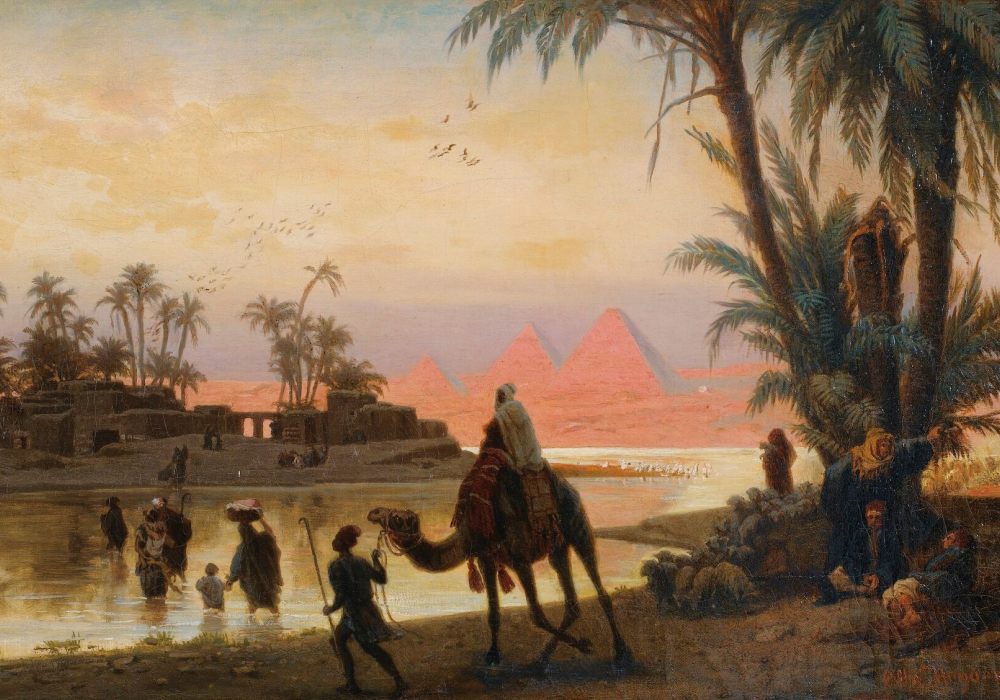
Caravan near the Pyramids, Otto Heyden (1820–1897). Wikimedia
I was born and raised in Upper (southern) Egypt in a predominantly Christian village.[1] Every morning at school we sang the national anthem, and we were taught in the history curriculum that pharaonic Egypt is a proud and central part of our tradition, history, and identity.
During my elementary and junior high school years, I also went to the Presbyterian Church’s daily after school Christian education program. Our Christian education teachers taught us the content of the Bible (in its expansive, Christian form) well.
Central to the biblical narrative that we learned was the exodus of the Israelites from Egypt. We were taught that Egypt, the anti-elect, oppressed the people of God, and as a result God plagued Egypt with ten plagues, culminating in the death of the firstborn of the Egyptians.[2]
Absent from this biblical curriculum was any sympathy for the people who suffered from the plagues, or those who drowned in the sea. Remarkably, we read the text from the perspective of the Israelites. The Egypt of the story stood in for something else. In the church or when reading biblical texts (especially the ones that portray Egypt as a house of slavery or a monster),[3] we did not feel an association with Egypt.
Egypt is a Villain in Exodus
Indeed, the most popular image of Egypt in the Bible is that of a “house of slavery,” in which the Israelites are subjected to oppressive forced labor. The book of Exodus speaks of a Pharaoh who does not “know” Joseph, sees the blessing of the proliferation of the Israelites as a threat, and as a result imperils them under ruthless taskmasters who make their lives bitter with all kinds of work and labor (Exod 1:8-14).
When Pharaoh refuses to let the Israelites go to worship their God, YHWH brings one plague after the other, punishing not just Pharaoh, but all Egyptians. These plagues culminate with the killing of the firstborn of every Egyptian household, while the Israelite households are spared (Exod 12:21-30). Even after the Israelites depart from Egypt, YHWH hardens Pharaoh’s heart to pursue the Israelites so that YHWH will decimate Pharaoh and his army by the sea (Exod 14:17-18).
For Christian Egyptians who read the Bible as scripture, this presents a challenge: How can we reconcile this negative depiction of Egypt in the Bible with are own national identity? With whom do Egyptians identify when they read the story of the Exodus? What is the relationship between the different and sometimes competing political and religious facets of identity?[4]
That was my personal experience. As a Christian Egyptian I struggled with formulating my identity in light of the negative representation of Egypt in the Old Testament. For a period of time I, like most of Christian Egyptians, interpreted the exodus spiritually or allegorically. Identifying with Israel of the Hebrew Bible and not with Egypt, I read the exodus as a spiritual struggle against evil that happens to be represented by the figure of Egypt.
This approach goes back as early as the first century C.E., beginning with the work of the Jewish philosopher Philo (Alexandria, ca. 20 B.C.E.-50 C.E.)[5] and later the Church Father Origen (Alexandria, ca. 185-253 C.E.). I will focus on Origen, a prolific scholar and theologian who was one of the most influential figures in early Christian thought.[6]
Origen: Exodus is an Allegory
In his third homily on Exodus, Origen spiritualizes leaving Egypt as a metaphor for the soul “leaving the world.”[7] It is a journey in which believers leave behind and “depart from Egypt, that is from the darkness of ignorance” and receive the light of knowledge through God’s law.[8]
In the same homily, Origen compares the defeat of Pharaoh to the defeat of Satan under the feet of Christ:
Therefore, let us go in full confidence that not only "may he flee from us," but also "Satan may be ground under our feet," as also Pharao was drowned in the sea and destroyed in the deep abyss. If, however, we withdraw from the Egypt of vices we will pass over the floods of the world as on a solid road through Jesus Christ our Lord, "to whom belong glory and sovereignty for ever and ever. Amen."[9]
One immediately realizes that this allegorical interpretation “spiritualizes” what Egypt stands for. Egypt, oppression, and even Israel itself, are not the literal entities that once were in the text. Instead, they represent something else, something about spiritual struggles.
The Supersessionist Problem
This line of interpretation is still prominent among many Christian Egyptians. After all, it is impossible to avoid spiritualizing the text if one wants to preach from it in a new context, such as modern Egypt. The challenge, however, is that this line of interpretation emerges out of a supersessionist approach in which Christianity replaces Judaism.[10] Thus, this poses a real danger to interreligious dialogue between Jews, Muslims, and Christians.
In addition, the allegorical approach disconnects the biblical text (at least for me) from its historical and socio-political context. Moreover, it dismisses how the biblical representation of Egypt shapes our self-image and self-understanding. Indeed, after watching the Prince of Egypt with my 7 year old she asked me: "Daddy does God love Egyptians?"
At one point, with an increasing political awareness of my identity as an Egyptian, I thought the only way to deal with the portrayal of Egypt in the exodus narrative was to discard the text and not engage with it as scripture because it is offensive. This created further tension between the religious and political facets of my identity.
The Good Side of Egypt
To soften the negative portrayal of Egypt in the Bible we can point out that Egypt is also portrayed positively in various stories, especially as a place of refuge. Abraham went down to Egypt during a severe famine (Gen 12). Even though Joseph’s journey to Egypt started with him being thrown unjustly into prison, eventually he became the second in command after he saved Egypt and Canaan from a deadly famine (Gen 37-50). Jacob and the rest of his family receive profound hospitality from Pharaoh, who offers them the best land in Egypt (Gen 45-47).
Jeroboam found safety in Egypt (1 Kgs 11). Even Jesus found refuge in Egypt when the holy family fled the horrors of Herod (Matt 2). The story of Jesus fleeing a massacre in the holy land and going down to Egypt is a reversal of the Exodus motif. Egypt is not a place of danger but a place of safety.
Isaiah: Egypt Will Be Blessed
One of the most beloved Bible verses for Christian Egyptians is Isaiah’s declaration:
ישעיהו יט:כד בַּיּוֹם הַהוּא יִהְיֶה יִשְׂרָאֵל שְׁלִישִׁיָּה לְמִצְרַיִם וּלְאַשּׁוּר בְּרָכָה בְּקֶרֶב הָאָרֶץ. יט:כה אֲשֶׁר בֵּרְכוֹ יְ־הֹוָה צְבָאוֹת לֵאמֹר בָּרוּךְ עַמִּי מִצְרַיִם וּמַעֲשֵׂה יָדַי אַשּׁוּר וְנַחֲלָתִי יִשְׂרָאֵל.
Isa 19:24 On that day Israel will be the third party with Egypt and Assyria, a blessing in the midst of the earth, 19:25 whom YHWH of hosts has blessed, saying, “Blessed be Egypt My people and Assyria the work of My hands and Israel My heritage.”
This salvation oracle employs language that is usually reserved for Israel and applies it to Egypt’s relationship with God.
The text does this, however, in a way that preserves the uniqueness of YHWH’s relationship with Israel. Thus, it encourages an inclusive theology that does not follow the replacement or supersessionist model. The long history of enmity between Israel and Egypt is replaced with a notion of mutual blessings in fulfillment of the Abrahamic promises (Gen 12:1-3).[11]
The Oppressed Egypt
We can also question the essentialization of Egypt as a place of oppression by pointing out how the Bible preserves some narratives and prophetic oracles that speak of Egyptians as the oppressed. For example, Hagar the Egyptian is treated harshly by both Sarah and Abraham.
Hagar’s Affliction
The Bible uses the same vocabulary to describe the experiences of oppression, escape, and wandering in the wilderness of the Israelites in the Exodus narrative and of Hagar:[12]
ענה — The verb oppress (anah in the pi‘el ) is used to describe both Sarah’s affliction of Hagar (Gen 16:6) and the oppression inflicted upon the Israelites by the Egyptians (Deut 26:6).[13]
ברח — Hagar flees (barach) her oppressive conditions (Gen 16:6), as do the Israelites (Exod 14:5).[14]
גרש —Sarah casts out (garash in the pi‘el ) Hagar (Gen 21:10), just as Pharaoh casts out the Israelites (Exod 12:39).[15]
שלח — Abraham sends away (shalach) Hagar (Gen 21:14) and Moses uses the same word, shalach, in his request to Pharaoh to let his people go, shaping how the exodus from Egypt is perceived (Exod 5:1–2).[16]
תעה — Like the Israelites, Hagar wanders (ta‘ah) in the wilderness (Gen 21:14) and God provides the life-saving gift of water (v.19).[17]
These similarities show that the Bible views Hagar the Egyptian as being oppressed by none other than the ancestors of Israel, Abraham and Sarah.[18]
Isaiah: The Redemption of Egypt
In the chapter cited above, Isaiah speaks of the salvation and healing of the Egyptians from the blows of its oppressors:
ישעיהו יט:כ וְהָיָה לְאוֹת וּלְעֵד לַיהֹוָה צְבָאוֹת בְּאֶרֶץ מִצְרָיִם כִּי יִצְעֲקוּ אֶל יְהֹוָה מִפְּנֵי לֹחֲצִים וְיִשְׁלַח לָהֶם מוֹשִׁיעַ וָרָב וְהִצִּילָם׃
Isa 19:20 They shall serve as a symbol and reminder of GOD of Hosts in the land of Egypt, so that when [the Egyptians] cry out to GOD against oppressors, a savior and champion will be sent to deliver them.
This is similar to Exodus where YHWH hears the cry of the Israelites on account of their oppressors (3:1-10).[19]
While in Exodus, YHWH strikes Egypt with plagues without a promise of healing or redemption, in Isaiah, YHWH listens to the prayers of the stricken Egyptians and heals them:
ישעיהו יט:כב וְנָגַף יְ־הֹוָה אֶת מִצְרַיִם נָגֹף וְרָפוֹא וְשָׁבוּ עַד יְ־הֹוָה וְנֶעְתַּר לָהֶם וּרְפָאָם.
Isa 19:22 YHWH will strike Egypt, striking and healing; they will return to YHWH, and he will listen to their supplications and heal them.
The Exodus From a “Narrow”[20] Sense of Identity
These approaches reflect my own journey toward embracing both sides of my identity, the religious and the political. This journey has been more recently informed by postcolonial theory, which helped me see that both discarding the text and allegorizing it hinges on the assumption that identity is pure and rigid, and thus both approaches try to assimilate the political into the religious or vice versa.
The critical theorist Homi K. Bhabha questions "the simple polarization of the world into self and other," thereby emphasizing the hybridity of identity.[21] Identity is mixed, neither stable nor coherent. The liminal, the interstitial (the border, the threshold, the in-between), brings forth new forms of identities that complicate any rigid construction of self and other.
The recognition of the complexity of one's or a community's identity is an exodus through which one is liberated from rigid conceptions of identity. On this journey of liberation one learns how to deal with the shame of being the oppressor and one learns how to yearn for a just and peaceful liberation when the oppressor becomes the oppressed (see Isa 19:20, 22 above).
By concomitantly reading through the lens of both the Egyptians and the Israelites, one negotiates difference and sameness not with an other that is outside of oneself but rather with an other that is within. Entering the text through different lenses confronts us with how we relate to power, calling us to seek liberation and healing not at the expense of the other, but rather together with those who are different from us religiously and politically.
Experiencing the exodus as a Christian Egyptian means living with an identity that holds a tension, a paradox; one is simultaneously an “Egyptian” and an “Israelite.” We are not unlike Moses, who leaves Egypt but never makes it into the promised land.
TheTorah.com is a 501(c)(3) nonprofit organization.
We rely on the support of readers like you. Please support us.
Published
March 23, 2026
|
Last Updated
September 10, 2026
Previous in the Series
Next in the Series
Before you continue...
Thank you to all our readers who offered their year-end support.
Please help TheTorah.com get off to a strong start in 2025.
Footnotes


Prof. Safwat Marzouk is Associate Professor of Old Testament at Union Presbyterian Seminary in Richmond, Virginia. He holds a Ph.D. in Biblical Studies from Princeton Theological Seminary. Marzouk is the author of Egypt as a Monster in the Book of Ezekiel (Mohr Siebeck, 2015) and a number of articles including “Migration in the Joseph Narrative: Integration, Separation, and Transnationalism,” and “Interrogating Identity: A Christian Egyptian Reading of the Hagar-Ishmael Traditions.”
Essays on Related Topics: